
Why Data Ethics Matter in Sponsorship Programs
Ethical data use—privacy, informed consent, transparency and bias reduction—is essential in sponsorship programs to protect donors and sustain trust.

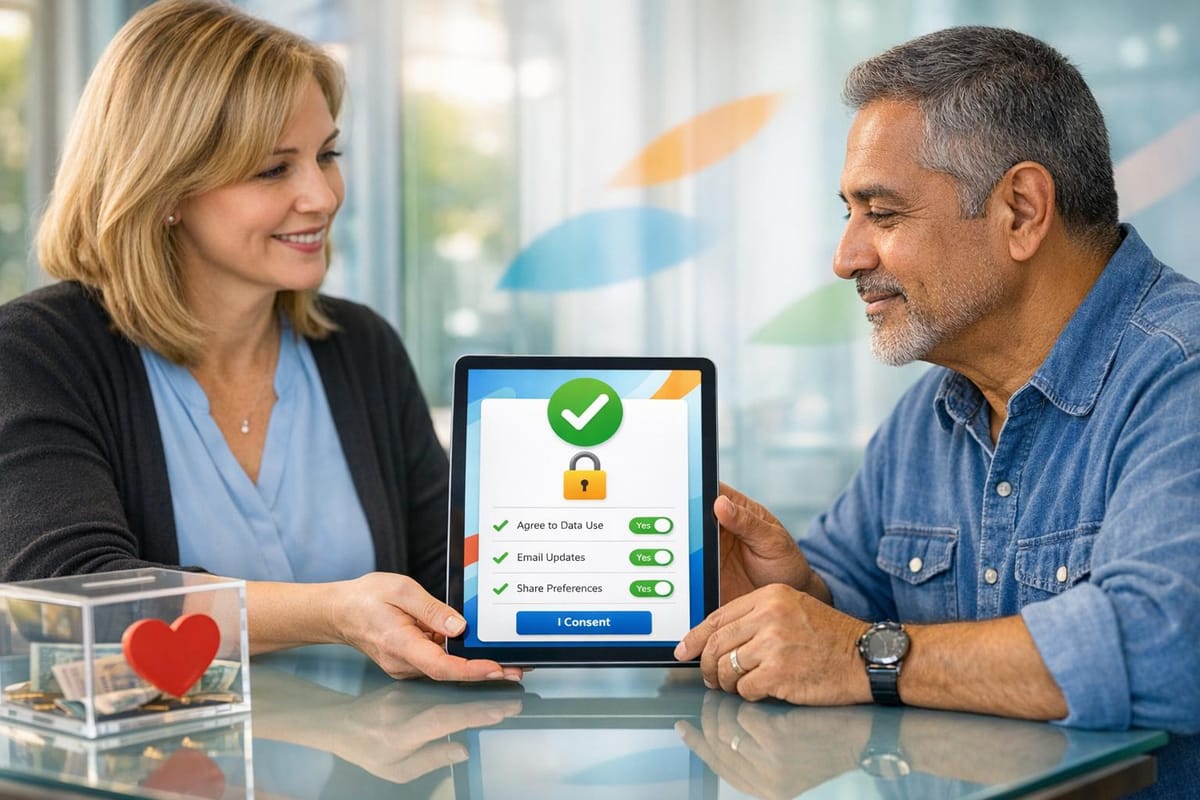
Effective sponsorship programs require data ethics as a non-negotiable foundation - it’s the backbone of trust between nonprofits, donors, and beneficiaries. Mismanaging sensitive information can lead to donor distrust, reputational damage, and even legal consequences. Here's what you need to know:
- Privacy: Protect donor and recipient data with secure systems, encryption, and access controls.
- Consent: Clearly explain how data is used, offer opt-out options, and regularly renew permissions.
- Transparency: Show donors how their data is handled through public policies like a Data Charter.
- Compliance: Follow laws like GDPR (EU/UK) and CCPA (California) to avoid fines and maintain credibility.
- Bias Reduction: Use anonymized data and diverse review processes to ensure fair decisions.
Nonprofits using ethical data practices see better donor retention and higher contributions. Tools like HelpYouSponsor simplify compliance and empower donors with control over their data, fostering stronger connections without compromising security.
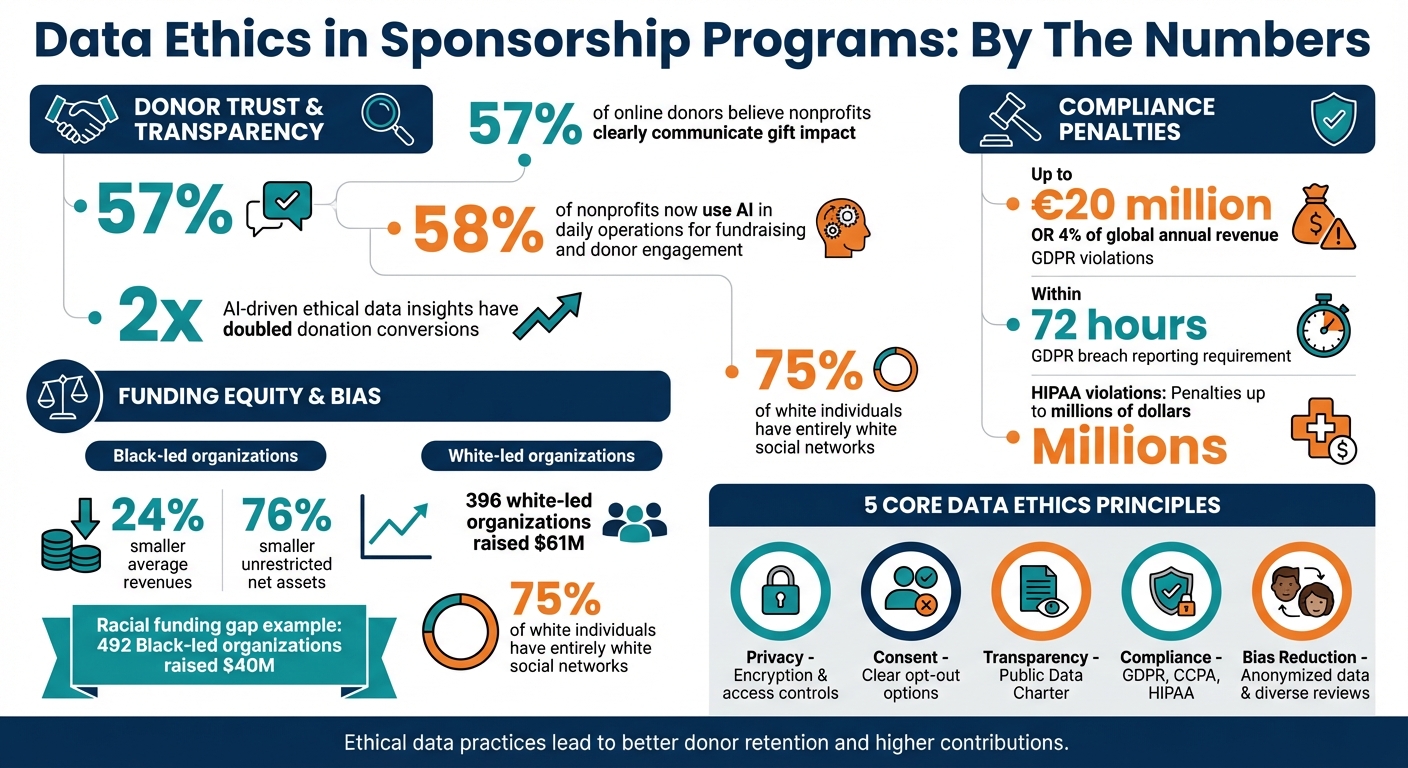
Data Ethics Impact on Nonprofit Fundraising: Key Statistics and Compliance Requirements
Data, Trust, and Fundraising: The Ethics Every Nonprofit Must Face
Integrating ethical data practices is just one of many fundraising strategies that modern organizations use to build long-term donor relationships.
Key Principles of Data Ethics in Sponsorship Programs
Data ethics in sponsorship programs revolves around three core principles designed to safeguard the data of donors and beneficiaries. These principles are essential to building and maintaining trust, which directly impacts donor engagement and the success of sponsorship efforts. As Shilpi Agarwal, Founder and CEO of DataEthics4All Foundation, states: "Ethics is needed for an end to end Data Governance strategy from data collection to data selling." By focusing on privacy, consent, and transparency, organizations can create ethical data practices that align with their mission.
Protecting Donor Privacy
Ensuring donor privacy starts with secure systems and strict access controls. Using a centralized donor management system with features like encryption, multi-factor authentication, and secure passwords helps protect sensitive information. Access should be limited to authorized personnel only, and regular backups and system updates are crucial for safeguarding data against technical failures. Human error is often a weak link in data security, so consistent staff training and clear protocols are key to minimizing risks.
Getting Informed Consent
Informed consent means giving donors and beneficiaries all the information they need to make educated decisions about their data. This requires clear, straightforward explanations of how data will be collected, used, and protected. Providing opt-out options for non-essential data collection and obtaining explicit consent before sharing any personal information publicly - especially for children in sponsorship programs - is non-negotiable. Consent isn’t a one-time process; it should be reviewed and renewed regularly, particularly for long-term sponsorships. Nyasha Mhungu from ASU Lodestar Center highlights the stakes: "Beneficiaries entrust nonprofits with their personal information, often in times of need or crisis. A breach of this trust can severely damage an organization's reputation and hinder its ability to fulfill its mission."
Maintaining Transparency
Transparency fosters trust by showing donors exactly how their data is handled. A public Data Charter can outline the organization's commitments to ethical data practices, including collection, usage, privacy, and security. Brandolon Barnett of Giving Compass explains: "A data charter... serves as a guide for how we handle data ethically and responsibly, ensuring that our actions are transparent and aligned with our mission to support diverse communities and drive positive social impact." Organizations should also disclose any third-party providers involved in data processing. With only 57% of online donors believing that nonprofits clearly communicate the impact of their gifts, bridging this transparency gap is crucial to earning and retaining donor trust.
Regulatory Compliance and Data Ethics
Following regulatory standards is essential for maintaining the ethical foundation that builds and preserves donor trust. Nonprofit organizations managing sponsorship programs must navigate a web of data protection laws. For example, the General Data Protection Regulation (GDPR) applies to any nonprofit gathering data from EU or UK residents, no matter where the organization is based. This regulation mandates explicit consent for data collection, transparency about how data is used, and ensures individuals can access, correct, or delete their information.
In the U.S., nonprofits must consider laws like the California Consumer Privacy Act (CCPA) and its extension, the California Privacy Rights Act (CPRA). These laws give California residents control over their personal data. The CPRA also introduces the category of "Sensitive Personal Information" (SPI), covering details like social security numbers and precise geolocation data. Nonprofits handling personal data from 100,000 or more California residents fall under its scope. Additionally, nonprofits must contend with other state-specific privacy laws across the country.
Sector-specific regulations add another layer of complexity. For example:
- HIPAA governs sensitive health data in healthcare-related sponsorships.
- FERPA applies to nonprofits managing student records in education.
- Communication laws like the CAN-SPAM Act require clear opt-out mechanisms and truthful email subject lines.
- The Telephone Consumer Protection Act (TCPA) oversees fundraising calls and text-to-give campaigns.
As an expert from 501c3.org explains:
"How seriously your organization takes data compliance reflects its commitment to transparency and respect for donors."
These laws and regulations highlight the ethical duty nonprofits have in managing data responsibly.
Legal and Financial Risks of Non-Compliance
Failing to comply with these regulations can lead to hefty fines and erode donor trust. Under GDPR, violations can result in fines as high as €20 million or 4% of an organization’s global annual revenue, whichever is greater. GDPR also requires organizations to report data breaches within 72 hours of discovery. Similarly, HIPAA violations can lead to penalties amounting to millions of dollars.
The financial impact doesn’t stop at fines. Non-compliance can cause lasting reputational damage, making it harder to secure donations. When donors lose confidence in how their data is handled, they may withdraw their support, directly affecting revenue. State charity officials also have the authority to investigate financial and data mismanagement, adding further scrutiny. On top of that, breaches of the CAN-SPAM Act can lead to emails being flagged as spam, severely limiting a nonprofit’s ability to connect with its audience.
Reducing Bias and Maintaining Data Accuracy
For nonprofits, eliminating bias in sponsorship data is crucial to making fair funding decisions. Bias can creep in through various channels: confirmation bias (favoring data that aligns with pre-existing beliefs), selection bias (relying on unrepresentative samples), or historical bias (using outdated data that reflects past inequalities). These distortions can skew funding decisions and undermine efforts to serve communities fairly.
The effects of such biases are stark. For instance, Black-led organizations' revenues are, on average, 24% smaller than those of white-led organizations. Their unrestricted net assets are 76% smaller, often reflecting a lack of donor trust. Additionally, research shows that 75% of white individuals have entirely white social networks, limiting leaders of color from accessing "friend-of-a-friend" funding opportunities. Fred Ali, CEO of the Weingart Foundation, highlights this issue:
"One of the reasons we don't see enough equity in funding is the biases that people bring to the work. Whether we know it or not, there are bias ingrained into our assumptions, systems, and practices."
A 2019 analysis by Echoing Green revealed a $20 million racial funding gap in its U.S. applicant pool. Black-led organizations (492 applicants) raised $40 million, while white-led organizations (396 applicants) raised $61 million. To address this, Echoing Green adopted blind application reviews - removing demographic details during evaluation - and provided implicit bias training for its fellowship panels. They also ensured alumni fellows led the judging process to monitor racial equity at key decision points. This example demonstrates the importance of accurate and unbiased data practices.
Identifying and Reducing Bias in Data
Start by evaluating your data collection methods. Are your sourcing channels unintentionally excluding smaller grassroots organizations or underrepresented leaders? Before collecting data, document your expected findings to avoid unconsciously seeking only supportive evidence. When analyzing donor patterns, consider using the median instead of the mean to identify whether a few high-income donors are overshadowing trends among smaller contributors.
Involve diverse stakeholders in reviewing your data to spot potential biases. Mike Roberts, CEO of the First Nations Development Institute, shared an experience where his Native American-led organization faced an 18-month delay for a grant renewal despite a 25-year relationship with the foundation. Meanwhile, a white-led peer organization secured funding in just three months. Such discrepancies highlight the need for implicit bias training for staff involved in sponsorship decisions. These steps lay the groundwork for implementing technical safeguards with child sponsorship software.
Using Anonymization and Encryption
To reduce bias and protect sensitive information, anonymize data and use encryption. Removing personally identifiable information (PII) allows organizations to focus on behavioral data - such as donation frequency, engagement timing, and communication preferences - rather than demographics. Ashley Montgomery, Content Marketing Manager at Fundraise Up, explains:
"Our AI operates using non-personally identifiable information (non-PII) data. This means that the most sensitive personal details of donors are not processed. Instead of relying on sensitive personal information, we focus on behavioral and engagement data."
Encryption ensures data integrity by preventing unauthorized access or tampering, keeping records accurate for decision-making. Techniques like data masking - replacing sensitive values with randomized ones during testing or analysis - add another layer of security. Limiting data access to authorized personnel and performing regular audits can further improve transparency and ensure compliance with donor consent. For vulnerable groups, such as children in poverty who are often targeted by hackers, strong cybersecurity measures are especially critical.
How Ethical Data Practices Build Donor Trust
Creating Long-Term Donor Relationships
Clear and transparent data practices are key to earning and keeping donor trust. When nonprofits openly explain how they collect and use data - like analyzing donation habits or preferred communication styles to create tailored experiences - donors feel more comfortable sharing their information. This openness builds a foundation for long-term relationships.
Giving donors control over their data is another powerful way to foster trust. By offering clear consent options, organizations empower supporters to decide how their information is used. Nonprofits can also focus on non-personally identifiable data, such as engagement patterns or interaction timing, to gain insights without crossing privacy boundaries. As Ashley Montgomery, Content Marketing Manager at Fundraise Up, puts it:
"By focusing on these less sensitive data points, we're still able to provide valuable insights without compromising donor privacy."
Additionally, using AI to handle routine data tasks allows staff to focus on more personal interactions, like storytelling and direct outreach. These ethical practices not only strengthen donor relationships but also pave the way for better fundraising outcomes and future trends.
Improving Fundraising Results
Ethical data management doesn't just build trust - it also delivers measurable results. For example, AI-driven insights have been shown to double donation conversions. This isn't about manipulating donors; it's about understanding their preferences and creating personalized experiences that make them feel appreciated.
With 58% of nonprofits now using AI in their daily operations for fundraising and donor engagement, those prioritizing ethical data practices report noticeable gains. These include higher donor retention rates and increased revenue. When donors trust how their data is handled, they’re more likely to stay engaged. Personalization - like knowing the best times to reach out or tailoring donation options - further strengthens their connection to the cause, boosting both loyalty and contributions.
Applying Data Ethics in Sponsorship Platforms
For sponsorship platforms to truly uphold data ethics, they must go beyond just acknowledging these principles. The key lies in implementing clear policies and providing ongoing training to staff.
Creating Ethics Policies and Staff Training
The backbone of ethical data management is a set of well-defined written policies. These should outline how data is collected, stored, and shared, with specific details like password requirements and access limitations. Clear guidelines help ensure that everyone understands their role in protecting sensitive information.
But policies alone aren't enough. Regular training sessions are essential to make sure team members can identify and address privacy risks. For instance, volunteers who interact with donors need to grasp the importance of not sharing sponsor contact details without explicit consent. This kind of training equips staff to handle data breaches effectively and act quickly if one occurs.
Incorporating ethical practices into everyday workflows is another crucial step. When accountability becomes part of the daily routine, it strengthens trust and ensures that the organization is consistently upholding its values.
Using HelpYouSponsor for Ethical Data Management
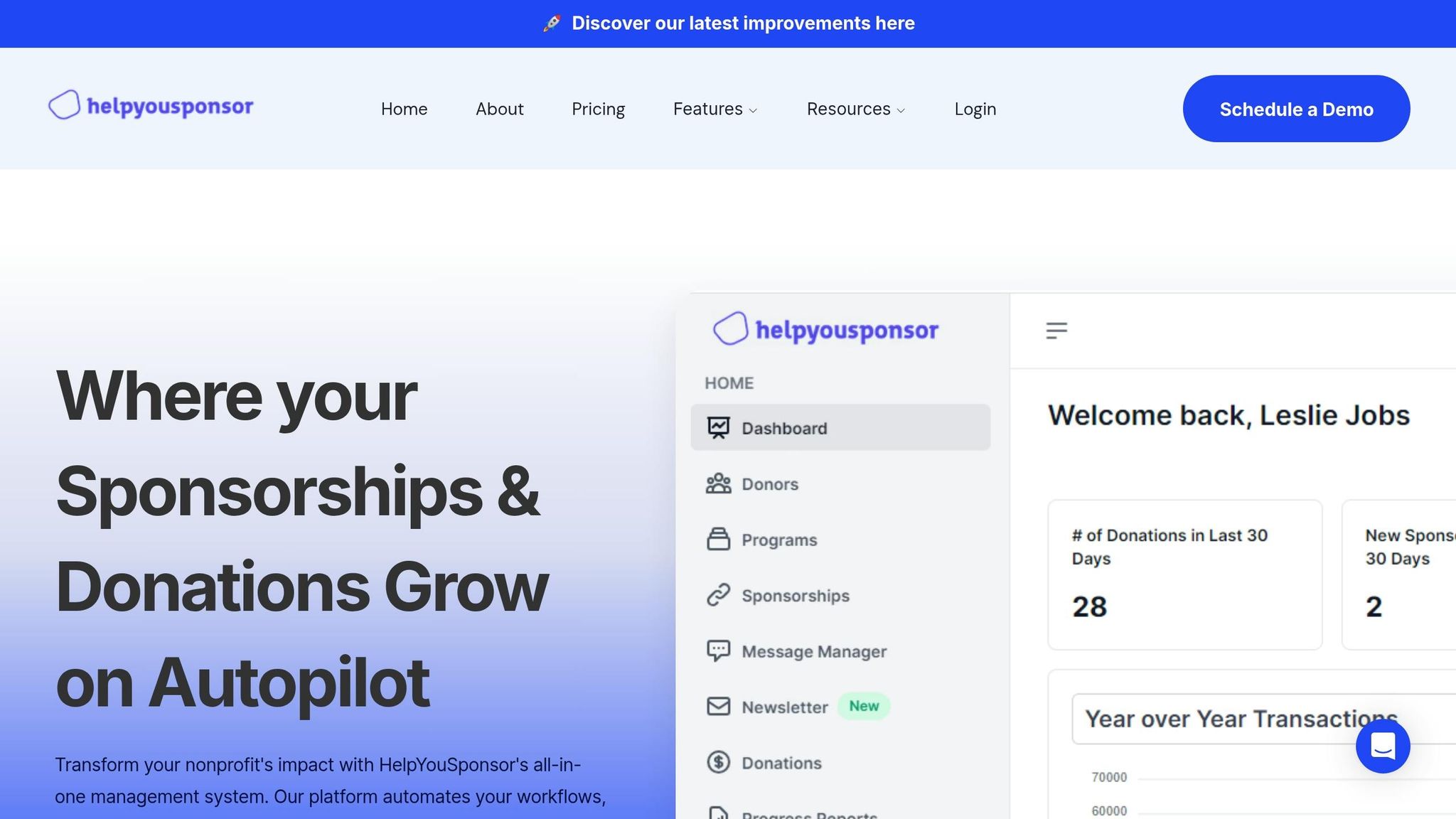
HelpYouSponsor takes ethical data management to the next level by embedding it directly into its platform. It uses advanced encryption and access controls to limit who can view sensitive data, while its centralized database tracks every change made to donor information.
One standout feature is the 24/7 self-service portal for donors. This tool allows donors to update payment details, download tax documents, and adjust their communication preferences. Not only does this improve data accuracy, but it also promotes transparency by giving donors more control over their own information.
The platform also simplifies compliance with regulations like GDPR and CCPA. Built-in tools make it easy to manage consent and handle "right to be forgotten" requests, ensuring that data can be deleted quickly and completely when required. By integrating these compliance features, HelpYouSponsor not only strengthens donor confidence but also makes managing ethical data practices more efficient.
Conclusion
Ethical data practices are the backbone of strong donor relationships and meaningful outcomes. By prioritizing transparency in data use, safeguarding donor privacy through behavioral insights rather than sensitive personal details, and adhering to regulations like GDPR and SOC 2 Type II, organizations can create a foundation of trust. This trust allows teams to shift their focus toward fostering the human connections that fuel their mission.
Consider this: nonprofits that adopt AI and ethical data practices have seen donation conversions double, with 58% already integrating these approaches into their operations. The key lies in striking a balance between personalization and privacy - using data to better understand donors while ensuring they retain full control over their information. These results highlight the importance of tools that blend ethical standards with operational efficiency.
Platforms like HelpYouSponsor exemplify how ethics and functionality can coexist. With features like advanced encryption, access controls, and self-service portals, these platforms make compliance a seamless part of daily operations. Tools for managing consent and handling "right to be forgotten" requests empower organizations to meet evolving privacy expectations without compromising productivity.
When ethical data management becomes second nature, teams can spend less time worrying about technicalities and more time on what truly matters: storytelling, stewardship, and building lasting donor relationships. These connections are what transform one-time contributions into lifelong support.
The way forward is simple: embrace transparency, rely on behavioral insights, and utilize platforms like HelpYouSponsor to earn trust and advance your mission.
FAQs
What data should a sponsorship program avoid collecting?
Sponsorship programs must steer clear of gathering sensitive personal information that could jeopardize donor privacy or trust. This includes details like health records, financial information, or any other data that might lead to ethical or legal concerns. Protecting donor privacy not only builds trust but also ensures adherence to ethical practices.
How often should donors re-consent to data use?
When there are major changes in how donor data is processed or after a certain period, donors should provide fresh consent for its use. This approach aligns with best practices in data ethics and regulations like GDPR. Regularly updating consent not only ensures compliance but also helps maintain trust with donors.
What should we do first after a data breach?
After a data breach, the first step is to contain the situation and evaluate the extent of the damage. It's crucial to inform affected stakeholders as soon as possible and implement measures to stop similar incidents from happening again. Building and maintaining donor trust, along with following strict data ethics, plays a key role in preserving credibility and securing lasting support.