
How Wealth Insights Can Guide Your Fundraising Strategy
Wealth screening helps nonprofits identify under-engaged, high-capacity donors, set precise asks, and tailor outreach to win major gifts.

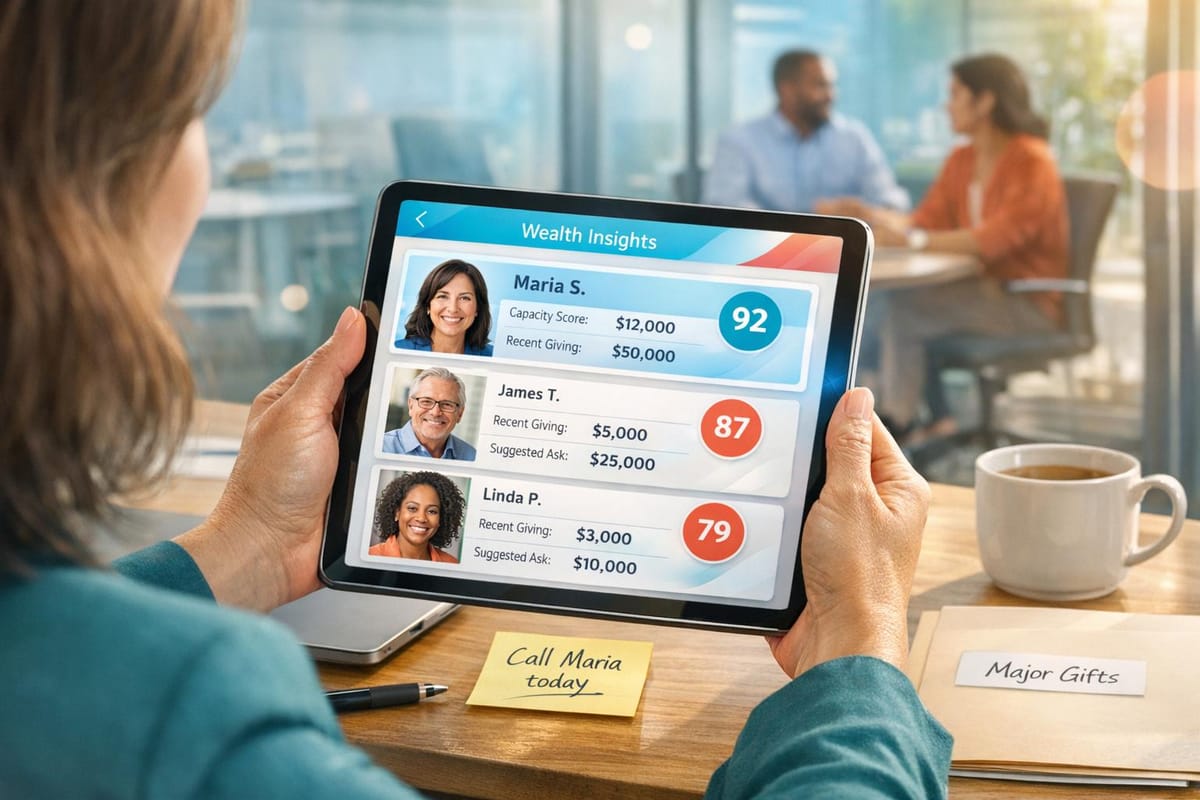
Wealth insights can transform your fundraising efforts by helping you identify donors with the capacity and interest to make significant contributions. Nonprofits often generate 90% of their revenue from just 10% of donors, meaning targeting the right individuals is crucial. Wealth screening simplifies this process by analyzing data like real estate ownership, stock holdings, and giving history to pinpoint high-potential donors.
Key Takeaways:
- Wealth Screening: Analyzes financial capacity, giving history, and donor interest.
- Benefits: Helps focus on high-impact donors, set appropriate ask amounts, and tailor messaging.
- Data to Use: Financial indicators (real estate, stocks) and personal details (age, location, interests).
- Action Steps:
- Follow ethical donor data management practices to clean your donor database before screening.
- Segment donors into tiers based on capacity and engagement.
- Use personalized communication for each donor group.
- Continuously update donor profiles to reflect financial changes.
By focusing on wealth data, nonprofits can build stronger donor relationships, secure major gifts, and improve the effectiveness of campaigns. These insights are also vital for refining your donor acquisition strategies to ensure long-term growth.
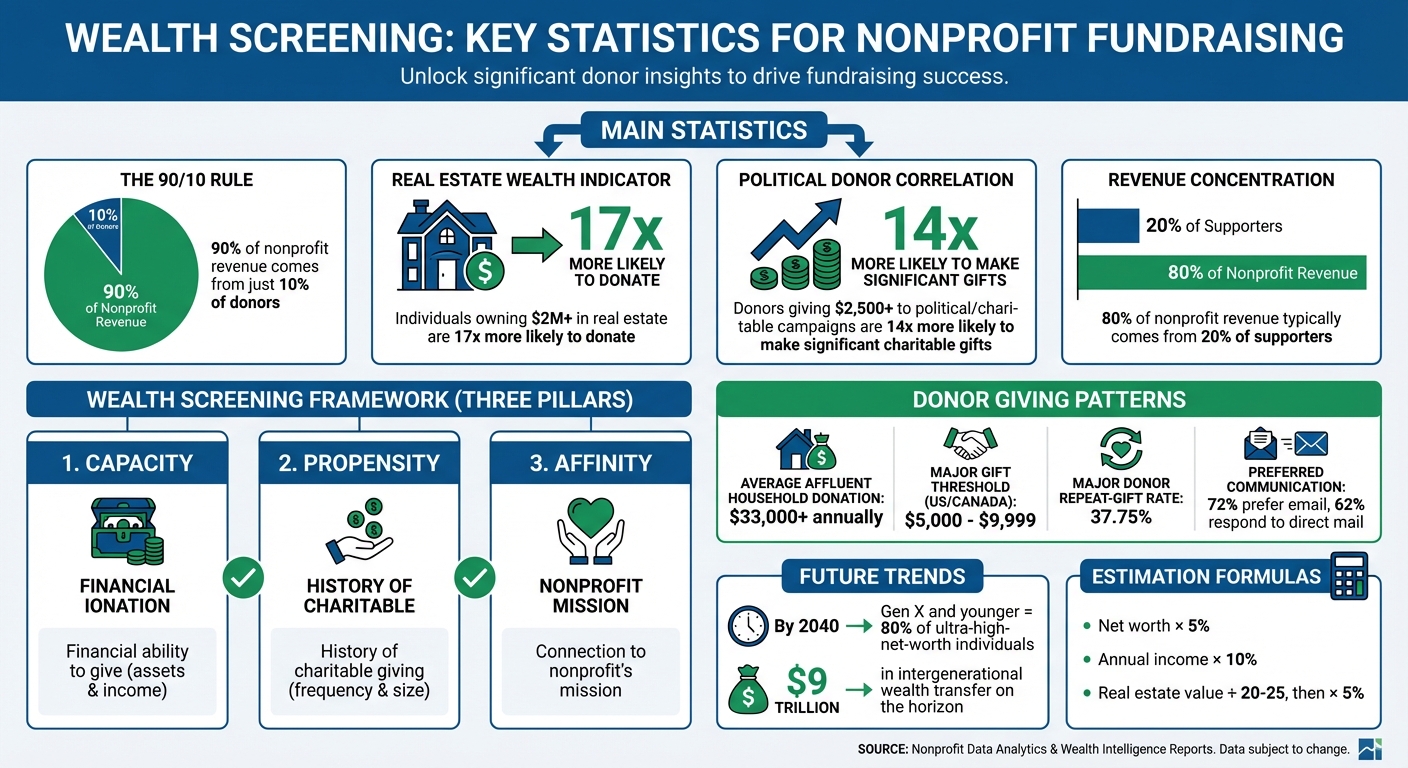
Wealth Screening Statistics and Donor Capacity Indicators for Nonprofits
What is Wealth Screening and Why It Matters
What is Wealth Screening?
Wealth screening is a method nonprofits use to uncover potential major donors by analyzing public and third-party data that reveals their financial ability to give. This research process identifies "wealth markers" such as real estate ownership, stock portfolios, business connections, and board memberships, which can indicate a donor's capacity to make meaningful contributions.
This approach evaluates three key factors:
- Capacity: A donor’s financial ability to give, based on their assets and income.
- Propensity: Their history of charitable giving, including frequency and size of past donations.
- Affinity: The donor’s interest in or connection to your nonprofit's mission.
Modern wealth screening tools often integrate with CRMs, helping nonprofits uncover donors within their existing database who may have the potential to contribute significantly more than they currently do. This data-driven strategy reshapes how organizations understand their donors and focus their fundraising efforts.
Benefits of Wealth Screening for Nonprofits
Wealth screening turns fundraising into a more targeted and strategic process. It helps nonprofits concentrate on the donors who can make the biggest difference - after all, around 80% of a nonprofit's revenue typically comes from just 20% of its supporters. By identifying donors with both the financial means and the willingness to give, nonprofits can prioritize outreach and tailor donation requests to match each donor’s capacity.
The insights gained through wealth screening often reveal trends that might otherwise go unnoticed. For instance, individuals who own $2 million or more in real estate are 17 times more likely to donate compared to the general population. Similarly, donors who contribute over $2,500 to political or charitable campaigns are 14 times more likely to make significant charitable gifts. These patterns allow nonprofits to personalize their communication strategies, segment donors effectively, and create personalized donor journeys to focus resources where they’ll have the greatest impact. For programs like child sponsorships, wealth screening can identify donors who could sponsor multiple children, fund educational initiatives, or establish long-term legacy gifts to support the organization’s mission.
To get the most accurate results, it’s essential to clean up your donor database before screening. This means removing duplicate records and eliminating outdated or lapsed contacts. Start by screening your current supporters - you might discover untapped potential among those who already support your cause. However, it’s important to validate automated screening results with qualitative research to avoid misinterpretations. Additionally, re-screen your database periodically, as financial situations can change due to factors like market shifts, property sales, or career advancements. These practices lay the groundwork for understanding the types of wealth data you can leverage.
Types of Wealth Data for Donor Assessment
Financial Capacity Indicators
Understanding a donor's financial situation is crucial for assessing their potential to contribute. Real estate ownership often serves as a strong indicator of wealth. For instance, individuals owning properties valued at over $2 million are 17 times more likely to donate. This includes not just primary residences but also vacation homes, commercial properties, and undeveloped land. Property tax records can reveal the value of these assets and provide insights into geographic patterns, which can inform regional fundraising strategies.
Stock holdings and securities are another key measure of financial capacity. Publicly available data from SEC filings (accessible via SEC.gov) can highlight details like publicly traded shares, insider transactions, and other equity-related events, all of which indicate liquidity and wealth-building opportunities. Similarly, business affiliations - whether as executives, board members, or business owners - signal high income levels and significant professional influence. Foundation affiliations can also point to donors who are already oriented toward philanthropy.
A donor's history of charitable giving and political contributions further demonstrates their willingness to support causes. Political donation data, available through FEC.gov, acts as a publicly accessible proxy for both civic engagement and financial capacity. Nonprofits often use standard formulas to estimate potential donation amounts, such as multiplying a donor's net worth by 5%, their annual income by 10%, or dividing the total value of their real estate by 20–25 and then multiplying by 5%.
These financial markers help nonprofits tailor their donation requests and engagement strategies, ensuring a more targeted approach to supporting initiatives like international child sponsorship programs. However, financial data alone doesn’t tell the full story - personal and demographic information adds essential depth to donor profiles.
Personal and Demographic Information
Personal and demographic data provide valuable context that complements financial indicators. For instance, age and generational values play a significant role in predicting giving patterns. By 2040, Gen X and younger generations will account for 80% of all ultra-high-net-worth individuals. These younger donors often prioritize measurable impact and digital transparency over traditional forms of recognition, which means fundraising strategies need to adapt to their preferences.
Details like occupation, education level, and geographic location also help refine donor assessments. A donor’s personal connection to a specific region or cause - such as adopting a child or having lived in a country where your organization operates - can be just as influential as their financial resources.
"The single largest motivator… people gave because it aligned with their identity – they saw themselves as charitable and generous people, and because of that, they did give" - Andrew Olsen, Senior VP at DickersonBakker
Tracking life events, such as career changes or family milestones, can help organizations time their outreach for maximum impact. By combining both financial and personal data, nonprofits can create a well-rounded donor profile. This comprehensive approach ensures that fundraising efforts are more strategic and effective, particularly for initiatives like child sponsorship programs.
How to Use Wealth Data in Your Fundraising Strategy
Finding and Prioritizing Your Best Donor Prospects
Wealth screening combines two essential factors: Giving Capacity (financial indicators like real estate, stocks, or other assets) and Giving Inclination (a donor's history of philanthropy and interest in your mission). To maximize your efforts, apply the 90/10 rule: focus on the 10% of donors who generate 90% of your revenue. Start by identifying consistent contributors in your database, as these donors often have greater potential for major sponsorships compared to one-time large donors.
"90% of nonprofit revenue often comes from just 10% of donors. It's worthwhile to identify and cultivate major gifts."
– Valentina Guerrini, Altrata
A scoring system can help you evaluate donor engagement. For example, assign 10 points for event volunteering and 5 points for attending a gala. Combine these engagement scores with wealth scores to rank prospects effectively. Wealth screening tools can also uncover "hidden wealth" - donors who have significant financial capacity but currently contribute smaller amounts.
Segment your donors into tiers for a more strategic approach:
- Tier 1: High capacity and high engagement - ideal for immediate major gift asks.
- Tier 2: High capacity and moderate engagement - better suited for long-term cultivation.
To refine your fundraising strategies further, use donor RFM (Recency, Frequency, Monetary) scores to pinpoint the right ask amounts for each group.
Determining Appropriate Donation Request Amounts
Getting the ask amount right is all about combining internal giving data with external wealth insights. Start by analyzing RFM scores to rank your donors. Focus on the top 20% who typically contribute 80% of your funds. The smallest donation from this group can act as your baseline for major gift thresholds. On average, major gift thresholds in the U.S. and Canada range from $5,000 to $9,999.
"Wealth screening helps set realistic ask amounts by identifying a donor's financial capacity. Using these capacity insights ensures solicitation amounts align with what a donor is reasonably able to give."
– Kindsight
To estimate a donor's capacity, consider wealth markers like real estate, stock holdings, and business affiliations. Also, research their external philanthropic history to see if they regularly give amounts above your typical major gift level. When making a large ask, provide specific examples of how their gift will make an impact. For instance, "A $50,000 donation will sponsor 100 children for an entire year."
Use a tiered approach when making your ask. Start with a higher amount and have a backup figure ready. Major donors (those giving over $5,000) tend to have a repeat-gift rate of about 37.75%, so getting the first ask right is critical for building long-term relationships. Once you establish clear ask amounts, personalize your communication for each donor segment.
Customizing Communication for Different Donor Groups
Wealth data and donor segmentation allow you to tailor your messaging to match donor capacity and engagement levels. For Tier 1 donors (high capacity/high engagement), focus on one-on-one meetings to cultivate major gifts. For Tier 2 donors (high capacity/moderate engagement), use targeted efforts like exclusive event invitations to deepen their connection. Meanwhile, Tier 3 donors (moderate capacity/high engagement) are great candidates for mid-level or planned giving programs.
Personalization is key. Use relationship intelligence to uncover details like board memberships or executive roles, which can help you find "warm paths" for introductions instead of relying on cold outreach. For donors with corporate ties, highlight matching gift programs to double the impact of their contributions.
Timing matters, too. Monitor wealth triggers such as business acquisitions, IPOs, or real estate sales to strategically time your high-level asks. Tools that track real estate transactions or insider filings can help you adjust ask amounts after a donor experiences a financial windfall. Additionally, analyze donor preferences for communication - whether they respond better to email, phone calls, or in-person visits - and their preferred giving methods, such as stock transfers, donor-advised funds, or cryptocurrency.
Lastly, keep your donor data up to date. High-net-worth individuals often experience rapid financial changes due to market fluctuations. Manually review high-value donor profiles identified by software to ensure accuracy before making a significant ask. Combining automated tools with personal verification ensures your communication strategy stays effective and precise.
Using Wealth Data in Campaign Planning
Setting Goals and Allocating Resources with Wealth Data
Incorporating wealth screening into campaign planning allows nonprofits to set ambitious goals and allocate resources more effectively. By looking beyond past contributions, wealth screening uncovers donors' five-year giving capacity, offering a clearer picture of their potential. This approach shifts the focus from historical patterns to forward-looking targets, ensuring that nonprofits don't miss out on untapped opportunities. For example, it can highlight donors who are giving below their potential, allowing organizations to adjust their strategies accordingly.
Take the case of University School in September 2025: by analyzing capacity data for 1,400 annual donors, they identified 97 individuals who upgraded their giving, raising an additional $50,000. Another 127 donors increased their contributions, adding $104,000. Altogether, this strategy generated $154,000 in new revenue.
"What we are able to understand about people, in terms of their interests and capacity to give, is transformative. It helps us focus our energy, so we are that much more effective in fundraising."
– Sarah Cardillo, Senior Development Officer, Broadway Cares/Equity Fights AIDS
Using donor pyramids is another way to strategically plan campaigns. By dividing your donor database into ten equal groups (deciles) based on capacity and propensity scores, you can focus resources on high-capacity segments instead of spreading efforts thinly across all prospects. This concentrated approach yields better results, especially when paired with insights into financial liquidity signals - such as recent real estate sales or stock transactions - which can help time your outreach efforts effectively. Broadway Cares/Equity Fights AIDS uses this method to identify long-time supporters at the ideal stage for estate planning, transitioning them into planned giving programs proactively.
With these tools in hand, the next step is to design events and proposals that align with donor capacity and interests.
Planning Events and Strengthening Grant Proposals
Wealth data also plays a critical role in event planning and grant proposals. By understanding donor profiles, nonprofits can craft events that resonate with their audience and maximize attendance from high-capacity prospects. For instance, leveraging donor relationships - such as board connections or existing networks - can turn cold invites into warm introductions. Segmenting invite lists further enhances effectiveness, with exclusive events targeting high-net-worth individuals and broader campaigns aimed at general sponsorship.
Child sponsorship programs, in particular, benefit from wealth screening by uncovering "hidden gems" - donors with significant capacity but limited prior engagement with the organization. These individuals are prime candidates for introductory events where they can connect with your mission. Additionally, affinity mapping can identify donors who have supported similar causes, like education or children's health, making them more likely to respond to sponsorship opportunities.
When setting prices for event elements like tickets or auction items, wealth markers can guide you to levels that match donor capacity. Consider that the average affluent household donates more than $33,000 annually to charity. High-capacity donors are often willing to invest more in meaningful experiences, so pricing should reflect their potential. Align donor profiles with event roles as well - assign outgoing donors to volunteer positions and save intimate, board-level meetings for high-capacity but introverted prospects.
For grant proposals and major gift requests, wealth data helps determine realistic target gift ranges that align with donor capacity. Highlighting how a donor's philanthropic history aligns with your program’s outcomes strengthens your case. Keep in mind that securing a new major gift often requires two to three years of cultivation, with first-time major gifts taking even longer - up to five years. Plan multi-year engagement strategies to nurture these relationships and build toward significant commitments.
Regular database updates are essential, as high-net-worth individuals frequently experience financial changes due to market fluctuations. Keeping your information current ensures that your campaign planning remains accurate and responsive, rather than relying on outdated assumptions. These strategies, rooted in wealth insights, provide a solid foundation for achieving fundraising success.
How to Measure Affiliation With RFM Scores and Wealth Screening
Conclusion
Wealth insights are reshaping how nonprofits approach fundraising, turning what used to be guesswork into actionable strategies. By identifying high-capacity donors early - before they make a major gift - organizations can start building relationships years in advance, rather than waiting for donors to self-identify. Considering that 90% of nonprofit revenue typically comes from just 10% of donors, focusing efforts on those with the greatest capacity and alignment with your mission is crucial.
For child sponsorship programs, wealth screening plays a unique role by pinpointing under-engaged, high-capacity donors - those with significant financial resources but limited prior involvement with your organization. When you combine wealth data with affinity indicators, such as a history of supporting education or children's health initiatives, these prospects become prime candidates. Beyond financial metrics, leveraging relationship intelligence - like board connections and network insights - can turn cold outreach into warm introductions, increasing the likelihood of meaningful engagement.
Tailoring your approach is key. A personalized strategy can elevate a standard monthly sponsorship request into a major gift opportunity. For instance, affluent households donate an average of over $33,000 annually to charity. Using verified wealth data to determine the right "ask" amount ensures you’re maximizing potential contributions. It’s also important to meet donors where they are - 72% of affluent donors prefer email communication, while 62% still respond to direct mail.
Wealth and donor priorities aren’t static - they evolve with market trends, career milestones, and life events. That’s why wealth screening isn’t a one-and-done task but an ongoing process. Regularly updating your database allows you to track changes and time outreach around liquidity events, like real estate sales or stock transactions, for maximum impact.
The most successful organizations are those that weave wealth data into every phase of their fundraising cycle, from identifying prospects to setting campaign goals and cultivating major gifts. With an estimated $9 trillion in intergenerational wealth transfer on the horizon, now is the time to develop data-informed strategies that will ensure sustainable support for your child sponsorship programs and long-term success.
FAQs
Is wealth screening legal and ethical for my nonprofit?
Wealth screening is typically legal and acceptable for nonprofits, provided it adheres to relevant laws and respects donor privacy. This process should focus on using publicly accessible information or data acquired through legitimate means. To maintain trust with your donors, it's crucial to ensure your practices comply with all regulations and ethical guidelines.
How often should we re-screen donors for updated wealth insights?
Donors should be re-screened for updated wealth insights at least once a year. Over time, factors like donor capacity, influence, and priorities can shift significantly. By keeping this information current, you can ensure your engagement strategies stay relevant and impactful. Relying on a one-time screening won't provide the ongoing accuracy needed for effective decision-making.
What’s the best way to act on wealth scores without alienating donors?
Wealth scores can be a powerful tool for creating personalized donor engagement, but their use requires a careful balance of transparency and respect. By tailoring your communication to align with a donor's interests and financial capacity, you can ensure that your outreach feels thoughtful and meaningful rather than purely transactional.
The goal should always be to build genuine relationships. When donors feel valued for more than just their monetary contributions, trust grows naturally. This approach helps avoid any sense of discomfort and reinforces their confidence in your organization.