
The Power of Tiered Giving: How to Motivate Different Levels of Donors
Use 4–6 preset donation tiers with clear impact statements to increase average gifts, boost retention, and motivate donors at every level.


Tiered giving simplifies the donation process by offering preset amounts like $25, $50, or $100, guiding donors to choose amounts that align with their financial ability. This strategy not only reduces decision fatigue but also increases average contributions by about 12%. Here's why it works:
- Preset Options: Suggested amounts make donating easier and remove uncertainty.
- Impact Descriptions: Connecting tiers to specific outcomes (e.g., "$50 feeds a family for a week") helps donors visualize the effect of their contributions.
- Donor Behavior: Most donors pick the second-lowest tier, so setting tiers strategically can encourage higher donations.
- Stronger Engagement: Offering 4–6 tiers appeals to a wide range of donors, from first-time givers to major supporters. This approach is a key component of creating personalized donor journeys that move supporters toward long-term commitment.
Donor Tiers That Actually Work: The Right Way To Segment Supporters
What Is Tiered Giving?
Tiered giving is a fundraising method where donors are presented with preset donation amounts - usually three to six options - on a donation page. Instead of leaving the amount open-ended, donors see choices like $25, $50, $100, or $250. This structure simplifies the decision-making process, making it quicker and more straightforward for donors to contribute.
This approach helps reduce decision fatigue. Suggested amounts act as social cues, helping donors gauge what might be an appropriate contribution. Each tier often includes a description of its impact, such as "$50 provides meals for two families" or "$100 funds two workshops for survivors." These descriptions make the donation's purpose clear and meaningful. By offering a structured system, tiered giving makes the entire process smoother and more impactful.
How Tiered Giving Works
Tiered giving organizes donors into categories ranging from entry-level supporters to major benefactors. Nonprofits often divide these tiers into three main levels: entry-level ($25–$99), mid-level ($100–$499), and major donor levels ($500–$1,000+). For instance, Duke Children's Hospital introduced a $15-per-month tier to support NICU needs, while Girls Who Code launched a $1,000 tier to fund a school year for a club.
This system creates a "giving trajectory", allowing donors to see a path for increasing their support over time. Research shows that donors often pick the second-lowest tier, balancing between not wanting to seem "cheap" and staying within their budget. Nonprofits can use this predictable behavior to strategically set the middle tier slightly above their current average donation, encouraging larger contributions. This structured approach not only influences donor behavior but also brings measurable benefits to the organization.
Benefits of Tiered Giving
Tiered giving benefits both donors and nonprofits. For donors, having clear tiers removes uncertainty and reassures them that their contribution will make a difference. For organizations, offering preset amounts can boost average donations by around 12% and improve donor retention rates.
Additionally, tiered giving streamlines operations by creating predefined donor segments. This allows nonprofits to tailor their communications - for example, sending different messages to $50 donors versus $500 donors. Targeted communication matters, given that 72% of people prefer marketing messages that align with their interests. Naming tiers, such as "Supporter", "Champion", or "Hero", can also enhance the donor experience by fostering a sense of belonging. This emotional connection is especially critical since the retention rate for new donors is typically just 20%.
How to Set Up a Tiered Giving Program
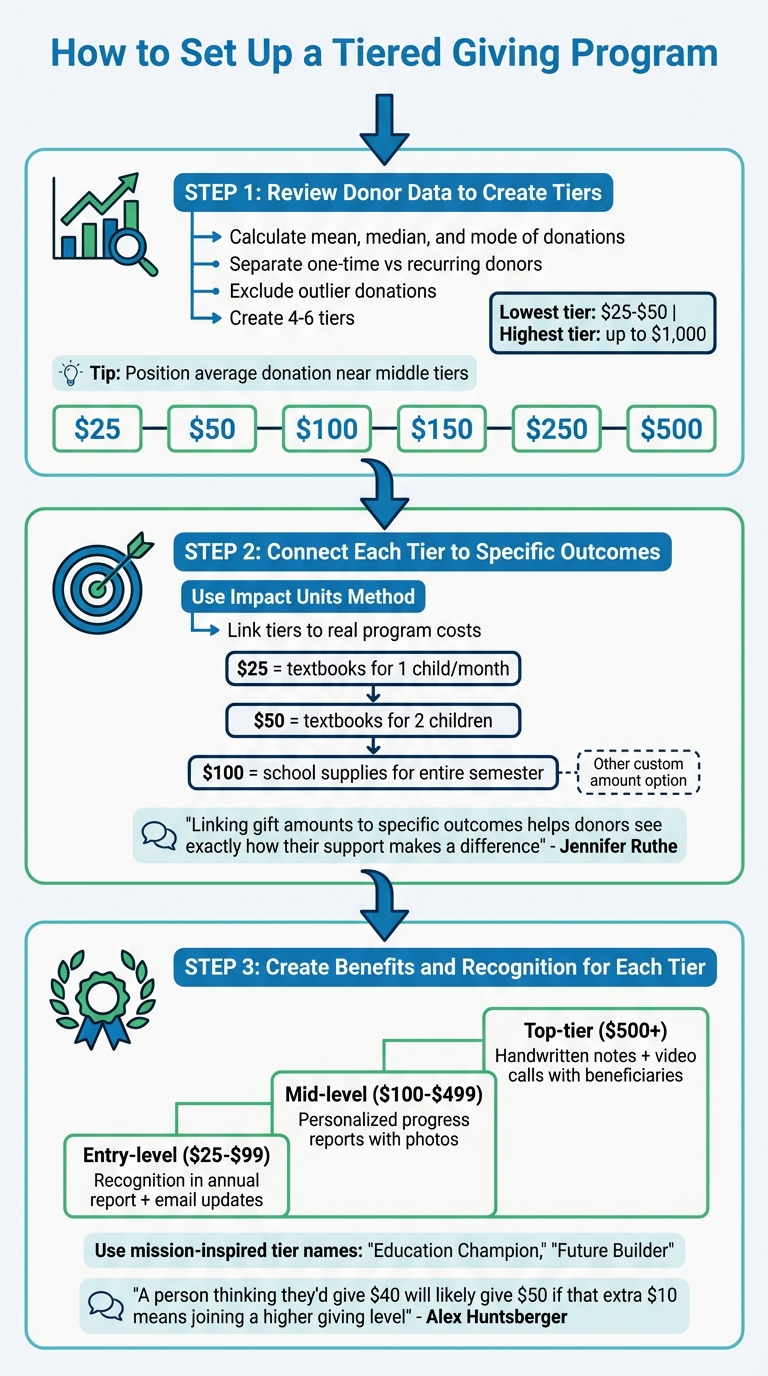
3-Step Guide to Setting Up a Tiered Giving Program for Nonprofits
Here’s a straightforward plan to create a tiered giving program: analyze donor data, connect tiers to outcomes, and grow your sponsor base by designing perks for each tier.
Step 1: Review Donor Data to Create Tiers
Start by diving into your donation records to identify patterns. Calculate the mean, median, and mode of your donations. These numbers will give you a clear picture of where most contributions fall, helping you create realistic tiers.
Separate one-time donors from recurring ones to better understand consistent giving habits. Also, exclude any unusually large donations, as they can distort your averages. For instance, if most donations range from $25 to $200, a $10,000 gift shouldn’t influence your tier structure.
Most nonprofits find success with 4–6 tiers. Research shows that the lowest tier often falls between $25 and $50, while the highest tier can go up to $1,000. Position your average donation amount near the middle of your tiers. Why? Donor psychology plays a role - people often choose the second-lowest option to avoid seeming too frugal. For example, if your average donation is $78, you might set tiers at $25, $50, $100, $150, $250, and $500, with $100 slightly above your average to encourage larger gifts.
This data-driven approach lays the groundwork for meaningful, achievable tiers.
Step 2: Connect Each Tier to Specific Outcomes
Make each tier tangible by linking it to a specific outcome. Use real program costs to craft these connections. For example, calculate how much it costs to provide textbooks, meals, or tutoring sessions, then translate those figures into relatable descriptions.
The Impact Units Method works well here. If $25 covers textbooks for one child for a month, $50 can support two children. This approach helps donors understand the direct impact of their contributions. For instance, you could say, "$25 provides textbooks for one child each month", or "$100 covers school supplies for an entire semester."
"Linking gift amounts to specific items, activities, or outcomes helps donors see exactly how their support makes a difference."
– Jennifer Ruthe, Senior Nonprofit Professional, Kindsight
Some organizations excel at this. Duke Children's Hospital, for example, uses annualized amounts to show impact - $15 per month becomes $180 annually, which can buy an infant soothing seat for their Neonatal Intensive Care Unit. Girls Who Code ties their $1,000 tier to funding a club for a school year. Always include an "Other" option, so donors can give outside the suggested tiers if they prefer.
Step 3: Create Benefits and Recognition for Each Tier
Offer tier-specific perks that grow in value without straining your budget. Digital rewards like exclusive updates, behind-the-scenes videos, or impact reports are cost-effective yet meaningful.
For entry-level donors (typically $25–$99), simple recognition in your annual report and regular email updates can go a long way. Mid-level donors ($100–$499) might appreciate personalized progress reports with photos or updates about the children they’re helping. For top-tier donors ($500 and above), consider more personalized touches like handwritten thank-you notes or video calls with beneficiaries.
"A person who was thinking they'd give $40 will likely give $50 if that extra $10 means joining a higher giving level."
– Alex Huntsberger, Neon One
Use tools like HelpYouSponsor to automate the delivery of tier-specific benefits, saving time while keeping donors engaged. Also, think about naming your tiers with mission-inspired titles like "Education Champion" or "Future Builder." These names tie back to your organization’s story and encourage donors to stay connected to your cause.
How to Share Tiered Giving Options with Donors
Once you've established your tiered giving structure, the next step is presenting it in a way that inspires action. The way you communicate these options is just as important as the tiers themselves. Research suggests that including suggested donation levels on a page can boost the average contribution by about 12%. In short, clear and engaging presentation makes a big difference.
Customize Messages for Each Tier
Craft your messaging to align with the interests and motivations of each donor group.
- Lower-level donors ($20–$100): These donors often connect with impact stories and testimonials. Show them how smaller contributions add up to meaningful change. For example, phrases like "Join hundreds of supporters making a difference with just $25" can make new donors feel like they're part of something bigger.
- Mid-level donors ($100–$500): This group values deeper insight into your work. Share behind-the-scenes content, detailed newsletters, or updates that show the tangible effects of their support. Personalize your appeals by referencing their past donations and explaining how their continued generosity drives long-term results.
- Major donors ($1,000+): These supporters deserve a more personal touch. Consider phone calls, exclusive tours, or other VIP-level interactions that acknowledge their significant contributions and build lasting relationships.
You can also use social proof to guide donor decisions. Highlight which tier is "most popular" or "most common" to subtly encourage giving at that level. Around 50% of leading nonprofits include a default suggested donation amount - often the second or third tier - to nudge donors toward a higher contribution.
Display Tiers Using HelpYouSponsor
After tailoring your messages, bring them to life visually on your website. HelpYouSponsor is a tool that makes it easy to showcase tiered giving options with clarity and impact. You can set up pre-determined amounts, like $25, $50, or $500, and pair each with specific outcomes so donors immediately see the impact of their gift. For instance, "$50 provides textbooks for two children" connects a dollar amount to a tangible result.
HelpYouSponsor also offers features to enhance the presentation of your tiers. Use bold headings and contrasting colors to make suggested amounts stand out. Add impact metrics or live progress counters to show real-time movement toward your campaign goals. Seeing progress - like a counter showing how many textbooks have already been funded - can create a sense of urgency and momentum.
Another benefit of HelpYouSponsor is its automated messaging system. After a donor contributes, they receive instant, tier-specific acknowledgments and updates. This immediate recognition resonates with tech-savvy donors while saving your team time and effort.
Finally, always include a custom donation option alongside your preset tiers. Many of the top 100 nonprofits pair 4–5 suggested tiers with a custom field for flexibility, ensuring donors can give an amount that feels right to them.
Measuring and Improving Your Tiered Giving Program
Setting up a tiered giving program is only the first step. To keep it running effectively, you need to monitor its performance and refine it based on actual data. By focusing on the right metrics, you can encourage higher contributions and improve donor engagement. Here's how HelpYouSponsor's tools can make this easier.
Track Performance with HelpYouSponsor
HelpYouSponsor offers reporting tools that give you a detailed view of how each tier is performing. Keep an eye on metrics like average gift size (mean, median, and mode) to see if your tiers are encouraging larger donations. Another key metric is tier selection frequency, which shows which donation amounts resonate most with your supporters.
Additionally, measure donor retention rates to see how many donors from each tier continue giving over time. Calculating donor lifetime value (LTV) can help you understand the long-term impact of your tiered program. If you notice a significant number of donors opting for the custom "Other" amount rather than your preset tiers, it could indicate that your suggested levels don’t align with their giving capacity.
When analyzing your data, exclude December contributions and one-time major gifts to avoid skewed results. December donations often double, and including them can lead to unrealistic benchmarks and misaligned tier suggestions.
Update Tiers Based on Results
Regularly reviewing your data - every few months - is crucial for keeping your tiers effective. If a tier has low engagement, it might be set too high. On the other hand, if a specific tier is performing exceptionally well, you could consider increasing it slightly, such as moving it from $40 to $50.
"Donation tiers must be researched, realistic, and relevant to an organization and its goals in order to be effective." - Ilma Ibrisevic, Content Writer, Donorbox
Use A/B testing to experiment with variables like the number of tiers or specific dollar amounts to find the setup that drives the most conversions. Segment your data to analyze one-time versus recurring donations separately, as recurring gifts tend to have lower individual amounts but higher overall lifetime value.
Donor surveys can also provide valuable insights into why supporters choose certain tiers and what benefits they appreciate most. Combining this feedback with automated reporting allows you to adjust tiers in a way that keeps donors engaged and encourages growth. By regularly fine-tuning your program based on both data and donor input, you can ensure your tiered giving strategy remains effective and relevant.
Conclusion
Tiered giving takes the guesswork out of donations by offering 4–6 carefully structured tiers, each tied to specific outcomes. This approach makes it easier for supporters to contribute at a level that feels right for them.
By providing clarity and structure, tiered giving not only simplifies decision-making but also helps foster long-term donor loyalty. It goes beyond increasing contributions - this method strengthens donor retention and lifetime value. Named tiers create a sense of belonging and encourage supporters to gradually increase their contributions, transforming fundraising into a community-driven effort where donors see the real impact of their generosity.
With HelpYouSponsor, implementing tiered giving becomes effortless. You can display clear impact descriptions and track important metrics like average gift sizes, tier preferences, and donor retention rates. This data helps you refine your strategy over time for even better results.
Get started with HelpYouSponsor to showcase your tiers effectively, monitor performance, and adapt based on real-world outcomes. Tiered giving can grow alongside your mission, creating a sustainable path to success.
FAQs
How do I choose the right tier amounts?
When setting donation tiers, aim for amounts that are both realistic for your donors and inspiring enough to encourage generosity. Common preset options like $25, $50, and $100 can serve as helpful starting points, as they guide donors in making decisions without being overwhelming.
Think about your overall fundraising goals and the typical giving capacity of your audience. Adding impact statements - like “$50 feeds a family for a week” - can make these tiers feel more personal and meaningful, helping donors connect their contribution to a tangible outcome.
Remember, this isn’t a one-and-done process. Test different tier levels and refine them over time to find what resonates most with your supporters and drives the best results.
What should I write for each tier’s impact?
When explaining the impact of each donation tier, tie it directly to how it helps achieve your mission and the acknowledgment donors will receive. For smaller contributions, emphasize how they provide crucial support - like a $50 donation covering supplies for a week. Mid-level donations can be positioned as enabling broader initiatives, such as a $500 gift funding a specific program. Higher tiers should focus on their role in driving major programs or advancing long-term goals. Tailor your messaging to show donors the tangible difference their contributions make at every level.
How can I tell if tiered giving is working?
To determine whether tiered giving is working, keep an eye on key donor metrics. Look at shifts in the number of donors within each tier, how often they donate, and the average amount they give. If you see growth in higher tiers or strong retention in lower ones, that's a good sign your strategy is on track.
You should also compare the total funds raised in each tier over time. Don’t forget to collect donor feedback - this can give you insights into how engaged they feel and how your approach is influencing your overall fundraising goals.