
Strengthening Donor Trust Through Better Communication
Boost donor retention with transparent, timely, and personalized communication — fast thank-yous, clear receipts, impact stories, and regular updates.

When donors give, they want to see their impact clearly. Yet, 60% of first-time donors stop contributing due to poor communication, and only 52% of Americans trust nonprofits to consistently act responsibly. The solution? Transparent, timely, and personalized communication. Here’s how to build stronger donor relationships:
- Say Thanks Fast: Donors thanked within 48 hours are 4x more likely to give again. Use personalized, immediate thank-you messages and include clear receipts.
- Show Impact: Share specific updates - like how a $50 donation provides meals or supplies. Nonprofits updating donors quarterly retain 40% more supporters.
- Personalize Everything: Tailor updates to donor interests. Tools like HelpYouSponsor help track contributions and send updates with photos or videos.
- Stay in Touch: Regular, meaningful communication - like monthly updates - keeps donors engaged without overwhelming them.
- Use Stories: Share real-life examples to connect emotionally. Stories are 22x more memorable than stats and can inspire more giving.
Clear communication isn't just nice - it's necessary to retain donors and build trust. Platforms like HelpYouSponsor make it easier to keep donors informed and engaged, turning one-time gifts into lasting support.
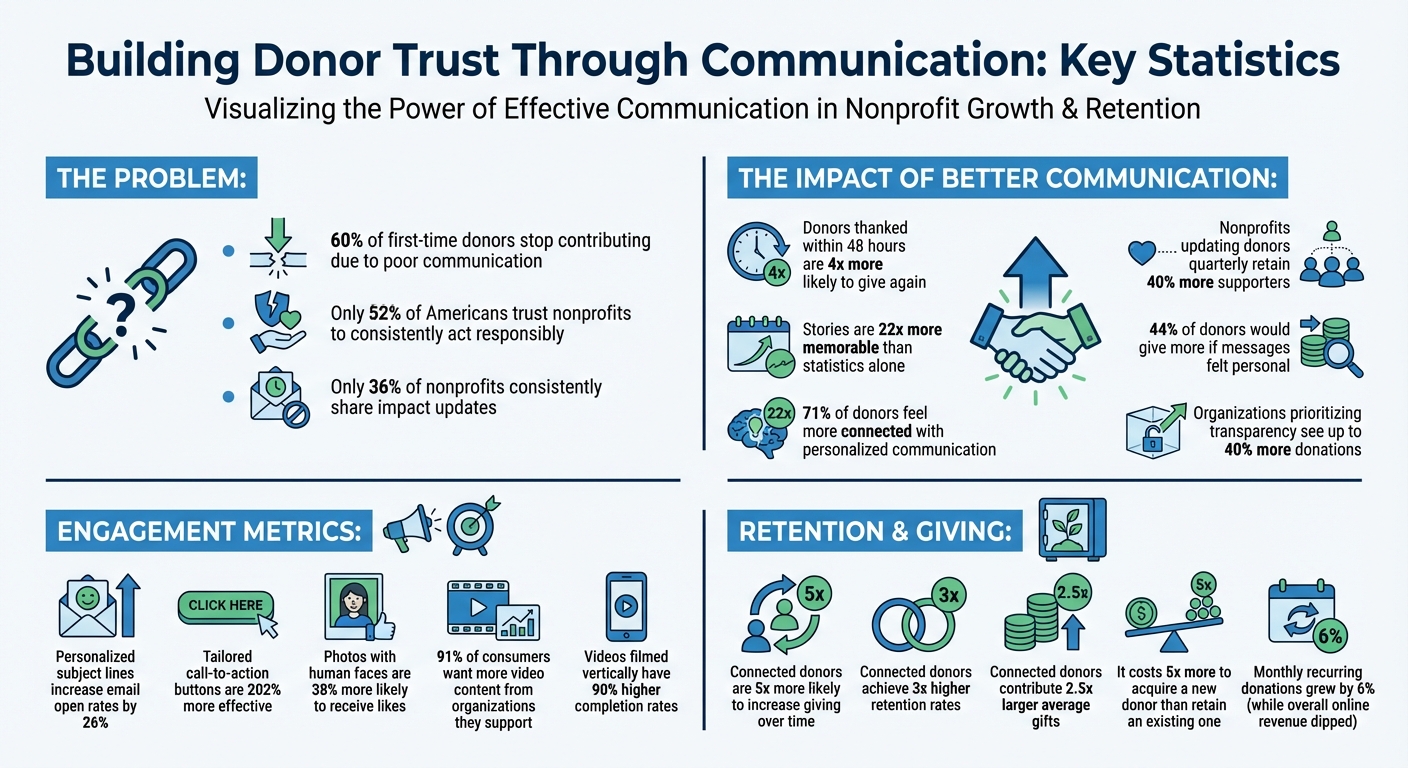
Key Statistics on Donor Trust and Communication Impact
Donor Communications Made Simple
Send Immediate Follow-Ups After Donations
The moment a donor completes their transaction is the perfect time to connect with them. This initial interaction plays a huge role in shaping their experience and can determine whether they’ll choose to give again.
Studies reveal that donors who receive a thank-you within 48 hours are 4 times more likely to contribute again. Unfortunately, many nonprofits miss this critical window, leaving donors unsure if their gift was received. Penelope Burk, author of Donor Centered Fundraising, emphasizes the importance of speed:
"Your thank you should get out the door within 48 hours. Period. No arguments… If you don't thank donors promptly, you're destroying all the rest of your hard work… Timely follow-up matters. A lot."
A quick response reassures donors that their contribution is valued and being put to good use. This immediate acknowledgment also sets the stage for more personalized communication.
Send Thank-You Messages Right Away
Using automation tools, you can send thank-you messages instantly while still keeping them personal. The goal is to make each donor feel recognized and appreciated. Include key details like their name, the donation amount (e.g., $50), and the campaign they supported. For example:
"Thank you, Sarah, for your $50 donation to our Weekend Food Bags program."
The message should come from a real person, such as your Executive Director, and avoid any additional donation requests.
To make your thank-you even more meaningful, add a short impact statement that ties the donor’s gift to a tangible outcome. For instance: "Your $50 provides three weekend food bags for children in our program." This turns a routine acknowledgment into a heartfelt reminder of the difference they’ve made.
Finally, ensure donors receive a clear receipt to reinforce trust and transparency.
Provide Clear Donation Receipts
Donation receipts are essential - not just for tax purposes but also for building trust. Platforms like HelpYouSponsor simplify the process of sending receipts that meet legal requirements while maintaining a warm tone.
Each receipt should include:
- Your organization’s full legal name
- The donor’s name
- The donation date (MM/DD/YYYY format)
- The exact amount donated
For contributions of $250 or more, include a formal IRS acknowledgment. To make your receipts more engaging, add your organization’s logo, mission statement, and a note confirming the tax-deductibility of the donation.
It’s also important to disclose whether the donor received any goods or services in return for their gift. For example, if they attended a gala, you must estimate the value of the ticket and include that information.
While not required, consider including an impact statement in the receipt. Research shows that 71% of donors feel more connected to nonprofits when they receive personalized communication. This small addition can make a big difference in how donors perceive your organization.
Share Updates on Program Impact
Donors want to see the difference their contributions make. In fact, 60% of donors are more likely to give again when they see tangible results, yet only 36% of nonprofits consistently share these updates.
Be specific about outcomes. Instead of saying, "Your donation helps children", explain exactly how it helps. For example: "Your $100 provided school supplies that helped a child learn to read this year." Nonprofits that share outcomes quarterly retain up to 40% more donors compared to those reporting just once a year. One leading nonprofit even saw sponsor confidence soar to 96% through transparency efforts. Next, we’ll explore how to personalize these updates and use digital tools for real-time communication.
Send Personalized Progress Reports
Personalized updates build trust. Go beyond simply addressing donors by name - tailor the content to reflect their specific contributions and interests. For example, if a donor sponsors a child’s education, share updates about that child’s academic progress rather than general program data.
Platforms like HelpYouSponsor make it easy to send personalized progress reports, including photos and videos that highlight the donor’s direct impact. These reports should detail real achievements, such as educational milestones, health improvements, or personal accomplishments. For instance, you could share that a sponsored child learned to read this year or include a photo of them receiving new school supplies.
Translate donations into clear results. Show how every dollar contributed to something meaningful, like providing meals for families or funding extra tutoring sessions. Whenever possible, include quotes from beneficiaries - hearing directly from those helped adds a level of authenticity that statistics alone can’t provide. Use these personal insights to create the foundation for ongoing, live updates.
Use Digital Tools for Live Updates
While personalized reports are powerful, live updates take donor engagement to the next level. Real-time updates keep donors involved between formal reports. Platforms like HelpYouSponsor let you integrate live project updates directly into your website or mobile communications. This allows donors to follow progress as it happens instead of waiting months for a newsletter.
Automate updates to trigger after key milestones. For example, when a sponsored child graduates, has a health checkup, or celebrates a birthday, the system can send a personalized message to the donor. This ensures timely communication without adding extra work for your team.
With mobile donations rising by 205% in 2024, it’s crucial to optimize updates for smartphones. Make sure photos, videos, and text display well on small screens. Short video clips - like a child receiving school supplies or a community improvement project in action - can create stronger emotional connections than text alone. These updates not only keep donors informed but also deepen their emotional investment in your mission.
Customize Messages for Each Donor
After incorporating real-time updates, the next step is tailoring messages to align with your donors' interests. Why? Because generic messages can erode trust. In fact, 44% of donors say they’d give more if the messages they received felt personal.
But personalization isn’t just about using someone’s first name. It’s about understanding what motivates each donor and crafting messages that resonate with those motivations. Take the American Cancer Society as an example. In 2022, they used machine learning to personalize donor engagement and saw a 17% boost in donation revenue along with a donor engagement rate nearing 70%. Ben Devore, their Director of Media Strategy, explained:
"Every bit of our campaign spend needs to be optimized for the best possible performance, so our key advertising goal was to reach the most probable donors, and then engage them in a way that would drive donations".
Group Donors by Interests and Giving Patterns
To make personalization effective, start by segmenting your donors into meaningful groups. HelpYouSponsor's CRM, for example, allows you to organize supporters based on their interests and giving habits. Focus on key metrics like Recency (last donation date), Frequency (how often they give), Monetary value (average donation size), and Timing (when they’re most likely to give).
But don’t stop at basic demographics. Dive deeper by tracking donor behavior. Which programs do they support? Do they volunteer in addition to donating? What pages do they visit on your site? For instance, if a donor frequently checks updates about educational initiatives, you can create a segment for "education-focused supporters." Similarly, if someone visits your volunteer page, set up an automated message offering volunteer opportunities. These insights help you understand what genuinely matters to each donor.
The University of Georgia applied this approach for its Presidents Club mailings, using advanced segmentation. The result? A staggering 910% increase in leadership donors acquired through direct mail year-over-year. Regularly refreshing your data ensures your segments remain accurate and relevant.
Once your segments are refined, you can create messages that align with each group’s values.
Write Messages That Match Donor Values
Now that your donors are grouped, it’s time to craft messages that reflect their specific interests. Use dynamic content in emails to customize sections based on donor data. For instance, send a "thank you for your loyalty" message to monthly donors, while welcoming first-time donors with a warm "welcome to the family" note.
Tailor your language to match their motivations. For community-focused supporters, share stories of local impact. For those who prioritize long-term goals, highlight enduring outcomes. As Kiki Koutmeridou, Chief Behavioral Scientist at DonorVoice, explains:
"As a fundraiser, your goal is to find the supporter identity that matters most in driving giving to your organization".
Personalized subject lines alone can increase email open rates by 26%, while tailored call-to-action buttons are 202% more effective than generic ones. Boys Town demonstrated the power of personalization in 2024 by doubling its GivingTuesday text revenue. Their secret? They nurtured their subscriber list year-round with gratitude messages, surveys, and storytelling, rather than simply asking for donations. For every donation request, aim to send three value-driven messages - whether they’re impact updates, thank-you notes, or compelling stories.
Keep in Touch Throughout the Year
Maintaining consistent communication is key to building lasting relationships with donors. Sporadic updates can leave supporters feeling disconnected, while regular engagement fosters a sense of partnership. As George Bernard Shaw aptly noted, "The single biggest problem in communication is the illusion that it has taken place". If you only reach out when you need something, donors may feel undervalued rather than appreciated for their contributions.
The good news? You don’t need to flood inboxes to stay connected. A simple schedule - like one touchpoint every 30 days - can keep your organization on their radar without overwhelming them.
Plan Your Communication Schedule
Start by mapping out your outreach for the next quarter. A tool like HelpYouSponsor’s messaging system can help you organize newsletters, impact reports, and surveys into a balanced communication calendar. Automate essential touchpoints, such as welcome messages for new donors and immediate thank-you notes, to ensure no one feels overlooked. However, avoid overloading your supporters by limiting outreach to two messages over three days, unless absolutely necessary.
Why does this matter? Retaining donors is far more cost-effective than acquiring new ones - it costs five times more to win over a new donor than to keep an existing supporter.
Mix Impact Updates with Donation Requests
Trust is built through transparency and meaningful updates. For every fundraising appeal you send, aim to share three pieces of value-driven content, such as stories or impact reports. Dedicate certain months, like February or June, to "non-ask" periods, where you provide updates on your projects without making any donation requests. This approach helps donors feel like valued partners rather than just a source of funding.
As GoodUnited puts it, "Strong donor relationships are built on conversation, not just transactions". And the numbers reflect this: while overall online revenue recently dipped, monthly recurring donations actually grew by 6%. By focusing on consistent, meaningful communication, you can strengthen connections and inspire long-term support.
Tell Stories That Connect with Donors
Building on personalized updates and impact reports, storytelling takes donor relationships to the next level by bringing your mission to life in a deeply human way.
While data establishes credibility, stories ignite emotion. In fact, stories are 22 times more memorable than simple facts, and 70% of donors give more when storytelling is done well. One of the most effective techniques is the "identifiable victim effect", where donors connect more strongly with the story of a single person. For example, sharing how one child learned to read or how one family gained access to clean water creates an emotional resonance that raw statistics simply can't achieve.
The structure of your story matters. According to Rob Burke, CMO of DonorDock:
"Your story is what inspires action, and your data is what builds trust afterward".
Start by introducing a relatable character and setting the scene to evoke emotion. Clearly define the need, and then support the story with data that demonstrates the transformation. This approach helps donors visualize their impact, turning abstract goals into real, relatable outcomes. These compelling narratives also set the stage for creating tailored email templates that celebrate key donor moments.
Create Email Templates for Key Moments
Having a library of pre-designed email templates helps you stay connected with donors during important milestones. These templates can be used for sponsorship anniversaries, program milestones, organizational achievements, or even just a heartfelt "thank you" to maintain engagement between appeals.
To make these messages feel personal, include specific details like the child’s name, a recent accomplishment, or highlights from the donor’s giving history. For instance, in sponsorship anniversary emails, you could recap the child’s progress over the past year - such as advancing to a new grade or completing a special project. When celebrating program achievements, be precise. Instead of saying, "We built a library", share that the new library now serves 150 students in a local community. Tools like HelpYouSponsor's messaging system can automate these milestone reminders, ensuring no moment is overlooked.
But don’t stop at text - visuals can take these messages to another level.
Add Photos and Videos to Your Stories
Visual storytelling transforms good stories into unforgettable ones. Photos with human faces are 38% more likely to receive likes and 32% more likely to get comments on social media. To build trust, use authentic photos of beneficiaries instead of stock images. Collect candid field photos, testimonials, and short videos to give donors a genuine behind-the-scenes look.
Video content is especially impactful. A whopping 91% of consumers want more video content from organizations they support. Since 94% of smartphone users hold their devices vertically, filming in portrait mode aligns with natural viewing habits and results in 90% higher completion rates compared to horizontal videos. Use visuals to show transformation - like a child’s first day at school versus their graduation, or a community before and after a clean water project.
To streamline your efforts, organize all photos, videos, and infographics in a central digital library. This makes it easy for your team to access and incorporate these assets into donor communications. By combining compelling visuals with personalized updates, you strengthen the multi-channel communication strategy discussed earlier, ensuring your messages truly resonate.
Conclusion
Building donor trust hinges on consistent and transparent communication. The fundraising strategies outlined - sending timely thank-yous, sharing real-time impact updates, tailoring messages to donors' values, staying in regular contact, and using engaging visuals - create an environment where trust can thrive.
The numbers speak volumes: organizations that prioritize transparency see up to 40% more donations, while donors who feel connected to your impact are 5x more likely to increase their giving over time. These donors also achieve 3x higher retention rates and contribute 2.5x larger average gifts. As donor retention expert Professor Adrian Sargeant emphasizes:
"Trust is the essential foundation of the philanthropic relationship".
A practical approach to maintaining trust is the "3-to-1 Rule": for every fundraising request, share three pieces of value-driven content - such as impact stories, progress updates, or heartfelt thank-yous. This balance helps prevent donor fatigue while keeping your mission at the forefront.
HelpYouSponsor simplifies these efforts with tools designed to automate personalized thank-you messages, track donor commitments, deliver real-time impact updates, and ensure secure communication. Starting with a free plan for up to 10 commitments per month, even small organizations can access these resources to enhance transparency and strengthen donor relationships.
Treat donor trust as your most important asset. By fostering genuine and consistent communication, you can turn one-time contributors into a dedicated community that stands behind your mission.
FAQs
What should I send in the first 48 hours after a donation?
Within 48 hours of receiving a donation, make it a priority to send a heartfelt thank-you message. This can be done through email, a postcard, or even a letter. Use this opportunity to express genuine gratitude and share how their contribution is making an impact. Including a tax receipt or gift confirmation along with a brief story or statement about the difference their support is creating can go a long way. A prompt acknowledgment not only shows appreciation but also helps build trust and deepens the donor’s connection to your mission.
How can we prove impact without sharing private details?
Transparency thrives when you share aggregated data and broad outcome metrics - think along the lines of how many individuals were served or the overall impact on a community. Instead of delving into private details, use tools like anonymized case studies, testimonials, or visual aids (like charts) to paint a clear picture of success. By focusing on general achievements and weaving them into data-driven stories, you not only foster trust but also demonstrate accountability - all while respecting the privacy of those involved.
How often should we contact donors without annoying them?
To maintain donor engagement without overstepping boundaries, aim to connect at least once a month. Consistent communication builds trust and keeps your organization on their radar without feeling intrusive. Share updates that matter - like impact stories, meaningful milestones, or tailored messages - so every interaction feels worthwhile and relevant.