
10 Standards for Child Sponsorship Programs
Ten ethical standards for child sponsorship programs covering protection, transparency, monitoring, legal compliance, and measurable impact.


Child sponsorship programs can be transformative but require strict guidelines to ensure ethical practices, protect children, and maintain donor trust. With over $944 million raised in 2018 alone, these programs hold immense potential for positive impact - but only when executed responsibly. Here’s a quick breakdown of the 10 essential standards every sponsorship program should meet:
- Child Protection Policies: Enforce safety measures, ethical storytelling, and regular audits to safeguard children.
- Background Checks: Screen all staff and volunteers to maintain safe environments.
- Monitored Communication: Moderate sponsor-child interactions on secure platforms to ensure safety.
- Community Needs Assessment: Use data to address local realities and avoid duplicating efforts.
- Measurable Goals: Set clear objectives with real-time tracking to demonstrate progress.
- Minimum Programming Standards: Align programs with proven strategies and shared guidelines.
- Financial Transparency: Provide detailed, public financial reports and allocate most funds directly to programs.
- Legal Compliance: Clearly communicate how funds are used and follow data privacy laws.
- Child Monitoring: Track health, education, and well-being through regular check-ins.
- Impact Evaluation: Conduct audits and use modern impact assessment methods to refine strategies and showcase results.
These standards ensure programs deliver meaningful outcomes while maintaining accountability and trust. Read on for detailed insights into each standard.
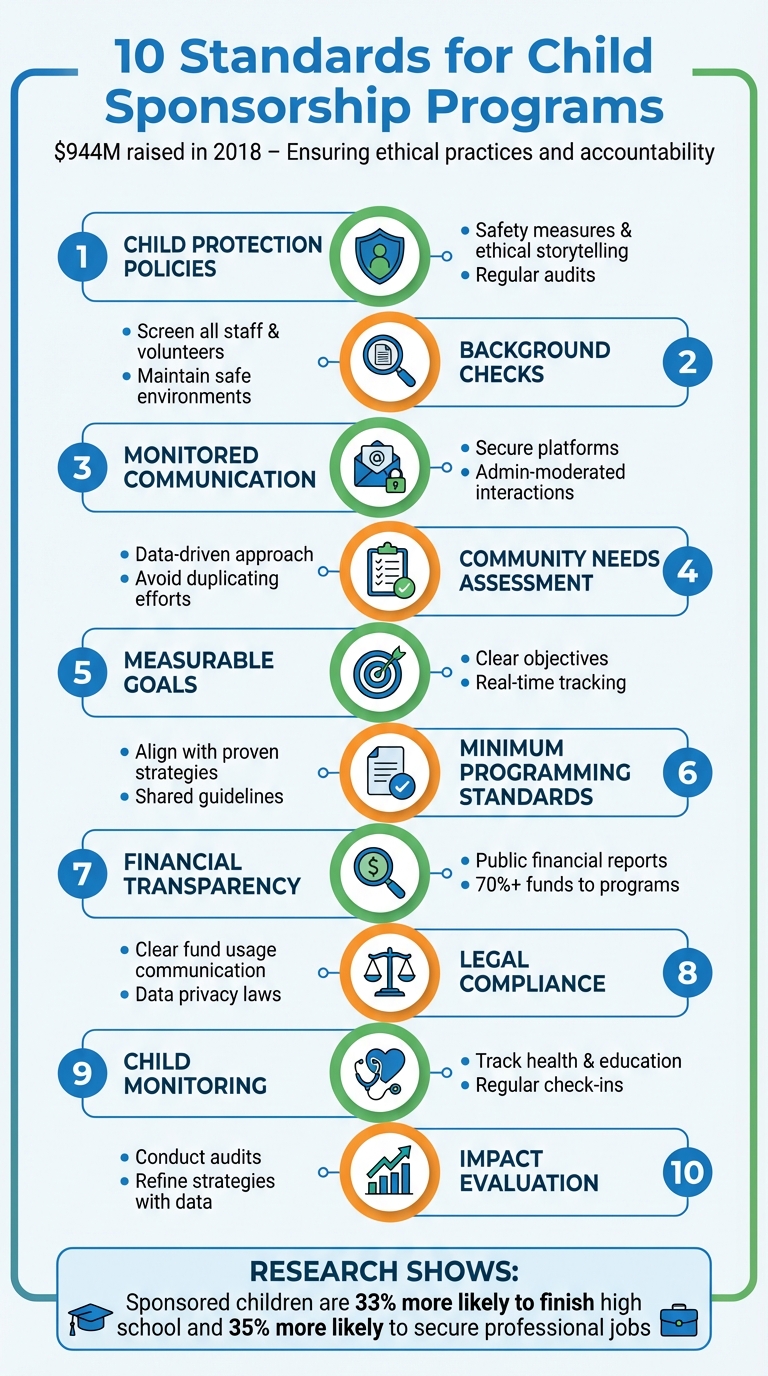
10 Essential Standards for Ethical Child Sponsorship Programs
1. Child Protection Policies
Child safety and protection measures
A solid child protection policy is the cornerstone of any child sponsorship program. Such policies need to address not only physical safety but also emotional well-being and ethical treatment throughout all program activities.
Protection efforts go beyond ensuring safe physical spaces. Programs must hire local, qualified staff who can act swiftly to safeguard children and provide support tailored to the local context. Community centers play a crucial role as safe havens, shielding children from threats like gang violence and drug exposure These centers also serve as places where mentors - trusted adults - can identify warning signs early and take action to protect children.
Another critical aspect of protection is ethical storytelling. Whether through social media posts or promotional materials displayed in churches, it’s essential to use images and narratives that respect each child’s dignity and safety. Strict guidelines must be in place to prevent exploitation while still allowing donors to connect meaningfully with the program’s mission. To ensure these policies are more than just words, organizations need to enforce them through regular audits and checks.
Transparency and accountability
Protection policies lose their value without proper enforcement. This is where independent audits and field reviews come into play, ensuring that safety protocols are followed and funds are used appropriately. For example, Children International demonstrates this commitment by directly interviewing sponsored children to confirm they are receiving the promised services and benefits.
To maintain consistency across the sector, organizations should adopt standardized guidelines developed through collective input. Jedd Medefind, President of the Christian Alliance for Orphans, emphasizes the dual potential of sponsorship:
"Sponsorship has tremendous potential for both good and harm"
By utilizing established tools, such as those from the CAFO Research Center, organizations can critically evaluate their practices and make necessary adjustments to better serve children.
Monitoring and evaluation standards
Continuous assessment is key to maintaining the effectiveness of child protection policies. Regular performance audits evaluate internal controls and staff training, ensuring that measures in place are actively safeguarding children.
The long-term impact of these efforts is clear. A 2013 study published in the Journal of Political Economy followed over 10,000 adults across six countries who had participated in Compassion International’s sponsorship program. The study revealed that sponsored children were one-third more likely to finish high school and 35% more likely to secure white-collar jobs as adults. Bruce Wydick, a Professor of Economics and International Studies at the University of San Francisco, remarked:
"The impacts that we find on secondary school completion and on employment are fairly remarkable"
These findings highlight how robust protection and support during childhood pave the way for lasting, positive change in adulthood.
2. Background Checks for Staff and Volunteers
Child Safety and Protection Measures
Background checks play a critical role in maintaining the safety of children and the integrity of programs designed to support them. For organizations working with children, thorough screening of staff and volunteers is non-negotiable. These checks not only protect vulnerable children but also ensure that resources are directed toward safe and effective initiatives.
By implementing these screenings, organizations create protective measures that foster secure environments where children can thrive. As Children International explains:
"Interventions like the ones offered through their programs help children and teens meet developmental milestones, provide them with protective factors that may counteract later negative forces"
This approach underscores the importance of background checks as a cornerstone of safeguarding efforts.
Transparency and Accountability
After completing individual screenings, organizations must reinforce safety measures through clear oversight and robust documentation. Active board involvement is key to maintaining accountability. Boards should review and approve policies to ensure they align with the organization's mission and comply with legal standards. Adopting standards developed collaboratively by experts and practitioners further strengthens this accountability.
Maintaining detailed records and applying consistent criteria ensures that background check policies are implemented fairly and effectively. External audits by Certified Public Accountants with experience in the sector provide an additional layer of verification. These audits confirm that safety protocols and organizational practices are accurately represented in financial and operational reports. This level of transparency not only builds donor confidence but also demonstrates an unwavering commitment to responsibility.
Monitoring and Evaluation Standards
Background checks shouldn't be a one-and-done process. Regular evaluations are essential to ensure that safety measures remain effective over time. Using audit toolkits, organizations can continuously assess their screening policies and practices. Additionally, tracking holistic impact metrics allows programs to confirm that their environments stay safe and supportive long after the initial vetting of staff and volunteers. Ongoing monitoring ensures that both the children and the programs continue to thrive.
3. Monitored Sponsor-Child Communication
Child Safety and Protection Measures
Ensuring the safety of children in sponsorship programs requires strict oversight of all sponsor-child communication. To achieve this, interactions should take place exclusively on secure, admin-moderated platforms where every exchange is reviewed and approved beforehand. As giveclarity.co explains:
"Think of approvals as a safety net when facilitating updated content to either the sponsor or the sponsored student"
This approach not only prevents inappropriate messages from reaching children but also helps catch errors, such as letters mistakenly addressed to previous sponsors. Automated systems should also be in place to flag or block the sharing of personal contact details like phone numbers, home addresses, or social media handles. By doing so, organizations can prevent unmonitored offline communication. Alongside these measures, strict user permissions ensure that sensitive data remains secure. As children grow older, they can be gradually granted private access to their profiles, empowering them to manage their own information responsibly.
Transparency and Accountability
Monitoring communication isn’t just about reviewing messages - it’s about ensuring every interaction aligns with safety protocols and ethical standards. Organizations should implement clear, standardized guidelines and conduct regular audits to maintain consistency. For example, in 2018, the Christian Alliance for Orphans (CAFO) united experts to establish shared standards for child sponsorship. That year, evangelical organizations collectively directed over $944 million toward sponsorship programs. Jedd Medefind of CAFO emphasized the importance of collaboration:
"It's only through intentional dialogue that we can refine our approach and spur one another on, seeking together to provide the best for children around the world"
Providing staff with practical resources, such as toolkits, and organizing regular workshops with stakeholders can help tailor monitoring systems to local needs. This cooperative strategy not only strengthens accountability but also respects the unique dynamics of each community.
Effective Program Design and Execution
Well-structured communication systems contribute significantly to the success of sponsorship programs and the overall well-being of children. Research spanning nine countries highlights how letter exchanges can boost a child’s sense of hope, happiness, and confidence. World Vision International captures the impact of these exchanges:
"Planting seeds of hope and self-belief can be just as life-changing as the education, health, food security and other support your sponsorship provides"
To make communication more effective, sponsors should be encouraged to write brief, straightforward letters. Providing prompts - like sharing updates about their family, hobbies, or offering words of encouragement - can make it easier for sponsors to engage. Mobile-responsive platforms further enhance the process by allowing real-time updates and moderation, ensuring that all correspondence is both secure and timely. By using encrypted, role-based systems, organizations can protect sensitive information while fostering the meaningful personal connections that make sponsorship programs impactful.
How does child sponsorship work? | Compassion UK

4. Community Needs Assessment
Conducting a thorough community needs assessment is crucial for ensuring sponsorship programs address the specific realities of local communities.
Transparency and Accountability
A well-structured community needs assessment evaluates key factors such as local demographics, geographic spread, racial and ethnic diversity, and the availability of social services. This process helps avoid duplicating efforts and ensures resources are used effectively. To maintain credibility and relevance, the assessment must be signed by the Board Chair and Executive Director and updated every three years to reflect changing conditions. These data-driven insights form the foundation for creating interventions that fit the unique context of each community.
Effective Program Design and Execution
When it comes to child sponsorship, a cookie-cutter approach simply doesn’t work. Children International highlights this:
"Our programmatic approach is not a one-size-fits-all strategy for ending poverty. The programs we offer are contextualized, meaning they are adaptable and flexible enough for children's needs at different ages. We also adapt them to match with the most urgent needs and available services in the communities our families call home".
By the close of 2022, 84% of children in these tailored sponsorship programs reported receiving the services they needed when they needed them. This success stems from collaborative workshops that bring together local stakeholders, subject-matter experts, and program staff. Together, they design interventions that reflect real community priorities. Save the Children US further underscores the importance of thoughtful design:
"Program design, projecting desired results into an uncertain future, is about hypothesizing what resources and interventions will most likely achieve those results. To minimize this uncertainty, a good program design draws on 1) strong contextual knowledge, and 2) the evidence base of what has worked before"
This careful planning naturally leads to the importance of ongoing monitoring and evaluation.
Monitoring and Evaluation Standards
Data collected during assessments serves as a guide for board decisions, highlights areas for staff training, and helps refine or discontinue ineffective programs. For example, social accountability models have shown tangible results: in 2022, one such initiative supported 33 government health facilities, improving healthcare access for more than 800,000 people.
When gathering feedback from beneficiaries, ethical practices are essential. This includes obtaining informed consent and safeguarding personal information. To make the findings actionable, organizations should provide an executive summary alongside the full assessment, offering stakeholders a quick overview of current and future community needs.
For nonprofits looking to simplify this process, platforms like HelpYouSponsor (https://blog.helpyousponsor.com) offer tools to manage assessments and maintain accountability effectively.
5. Measurable Program Goals
Effective Program Design and Execution
Clear goals are the backbone of any impactful program. By setting measurable objectives, organizations can transform good intentions into actionable, results-focused initiatives. Combining data-driven insights with real-life stories creates a well-rounded view of a program’s success, offering both numbers and narratives to tell the complete story.
To achieve this, organizations should focus on four key steps: setting clear objectives, collecting relevant data, analyzing the results, and taking decisive action based on findings. Tools like live dashboards allow nonprofits to track fundraising efforts and program progress in real time. This eliminates the need to wait for end-of-year reports, ensuring that adjustments can be made on the fly to keep goals on track. Such a system not only improves efficiency but also fosters transparency, which is essential for building trust with donors.
Transparency and Accountability
Donors are more likely to support organizations when they see clear, measurable outcomes. Transparent benchmarks - like the number of educational resources distributed or health screenings conducted - help donors understand how their contributions make a difference.
Regular and consistent financial and performance reporting is key. Instead of sporadic updates, nonprofits should aim for predictable reporting cycles. Pairing detailed metrics with compelling stories makes abstract goals feel more concrete, helping donors connect emotionally and intellectually. This approach not only strengthens donor trust but also ensures programs are rigorously monitored for success.
Monitoring and Evaluation Standards
Technology has fundamentally changed how organizations measure progress. Gone are the days of relying on manual spreadsheets. Centralized databases now allow real-time tracking of donor contributions and program outcomes, offering a much clearer picture of what’s working and what isn’t.
Field staff can use custom form builders to collect standardized data - whether it’s tracking student progress, health improvements, or community development milestones. This consistency across program sites ensures more accurate measurements of success. Plus, it helps organizations identify and address potential issues early, preventing small problems from becoming major setbacks. With these tools, nonprofits can fine-tune their efforts to maximize impact.
6. Sponsorship Minimum Programming Standards (SMPS)
Effective Program Design and Execution
Strong programming begins with evidence-based design - using proven strategies tailored to specific contexts. Collaborative workshops are a great way to refine these standards, bringing together local stakeholders, experts, and programming specialists to address genuine community needs rather than relying on external assumptions.
This approach reduces uncertainty by clearly defining outcomes and the resources required to achieve them. With significant global funding directed toward child sponsorship, it’s critical that programs align with both community priorities and established quality standards. These standards act as a foundation for effective programs, complementing past efforts in areas like child protection, financial transparency, and communication.
Transparency and Accountability
The Christian Alliance for Orphans (CAFO) brought together practitioners from diverse organizations worldwide to create the "Guidelines for Healthy Sponsorship Programs". These guidelines focus on three key ethical pillars: child protection policies, financial integrity, and ethical storytelling. Historically, many organizations have operated without shared principles or agreed-upon guidelines, making these standards a vital step forward.
By clearly showing how funds are used and respecting the dignity of children, organizations can build and maintain trust with donors.
Monitoring and Evaluation Standards
Ethical guidelines are just the beginning - effective programs also require strong monitoring and evaluation processes. This means conducting structured audits that include goal-setting, record collection, control testing, and thorough results analysis. The sponsorship guidelines provide practical audit tools and toolkits to help organizations assess performance and plan actionable next steps.
Dr. Bruce Wydick’s research highlights that well-managed sponsorship programs "may be among the most effective methods for mobilizing resources to benefit children in developing countries". Achieving this level of impact depends on rigorous monitoring. Combining qualitative stories with quantitative data offers a fuller picture of success. This balanced approach fosters ongoing conversations among sponsors, donors, and program leaders, helping drive continuous improvement.
7. Financial Transparency and Reporting
Transparency and Accountability
Financial transparency isn't just a best practice - it's the backbone of maintaining donor trust and ensuring program integrity. Donors deserve to know exactly how their contributions are used. To meet this expectation, the leading child sponsorship organizations share essential financial documents publicly, such as Annual Reports, independently audited financial statements, and IRS Form 990 tax returns. For tax-exempt nonprofits, this level of disclosure is not only ethical but also legally required.
"Financial transparency will help preserve the important trust community members and donors place in a nonprofit." - National Council of Nonprofits
For example, in 2025, World Vision allocated 86% of its total operating expenses directly to programs, exceeding Charity Navigator's recommended minimum of 70%. Similarly, Children International directed 80% of its operating expenses toward programs in FY 2024, earning a perfect score of 100 in accountability and transparency from Charity Navigator. Both organizations also hold key third-party accreditations, including four-star ratings from Charity Navigator, the Platinum Seal of Transparency from Candid, and recognition from the BBB Wise Giving Alliance. These achievements reflect their commitment to financial clarity, supported by independent audits and strong board oversight.
Monitoring and Evaluation Standards
Independent audits play a central role in verifying how funds are allocated and ensuring that services are delivered as promised. This process often includes on-the-ground checks, such as interviews with sponsored children and their families, to confirm that the intended support reaches its destination.
Additionally, an autonomous board carefully reviews financial reports and IRS Form 990 filings to ensure alignment with the organization’s mission, budgets, and long-term financial health. Internal safeguards - like conflict of interest policies, executive compensation reviews, and whistleblower protections - further strengthen accountability.
Considering that only 57% of online donors feel nonprofits clearly communicate how their gifts are used, these robust financial practices are essential. They not only build donor confidence but also ensure that every program is carried out ethically and effectively. Transparent financial management is the foundation for maintaining trust and delivering on promises.
8. Legal and Ethical Compliance
Transparency and Accountability
Maintaining donor trust and protecting children and communities in sponsorship programs starts with clear and honest communication. Organizations need to be upfront about how their sponsorship programs operate. For example, there's a critical difference between "direct sponsorship", where funds go directly to one child, and "community sponsorship", which supports broader initiatives. This distinction should be clearly outlined in all promotional materials, including social media posts and online donation pages.
"Clarity, in broad terms, about the type of child sponsorship and how the money will be used should be given to the donor before or alongside a 'donate now' button." - Fundraising Regulator
If your program benefits entire communities rather than individual children, use terms like "child and community sponsorship" in headlines and subheadings to avoid confusion. For TV and radio advertisements, make sure to mention the community-wide impact either verbally or through on-screen text when referencing child sponsorship. Additionally, links to FAQs or detailed program information should be placed prominently - ideally at the top or middle of landing pages - so donors can easily access them before making a contribution.
These steps not only promote transparency but also lay the groundwork for robust data protection and legal compliance across operations.
Child Safety and Protection Measures
Transparency is just one piece of the puzzle. Legal compliance also requires strong data privacy and ethical communication practices. Organizations must follow regulations like GDPR, CPRA, and PCI standards to safeguard both donor and beneficiary information. This involves implementing systems like Role-Based Access Control (RBAC) to limit access to sensitive data, encrypting information, and collecting only the data that is absolutely necessary - with informed consent from all parties. Ethical storytelling is equally important, ensuring that children’s dignity is respected while remaining within legal boundaries.
Monitoring and Evaluation Standards
Charities must keep detailed records of donations that are designated for specific purposes, ensuring that funds are used in line with the donor’s intentions. If a child leaves the sponsorship program, the organization is obligated to inform the donor. If the donor chooses not to sponsor another child, the charity must stop collecting further contributions. These practices are essential for protecting both donors and beneficiaries. Regular audits and meticulous record-keeping under these legal frameworks help uphold the integrity of child sponsorship programs.
9. Child Monitoring and Well-Being Tracking
Effective Program Design and Execution
Ensuring children's progress is closely monitored is key to timely intervention and effective program adjustments. By implementing structured tracking systems, organizations can measure success through metrics like annual health check-up rates and primary school completion. For instance, Children International sets clear goals: 90% of sponsored children receive yearly health check-ups within two years, and 95% complete primary school within five years. These targets not only promote accountability but also help staff identify and support children who may be falling behind.
Trained staff conduct regular home visits to evaluate various aspects of a child's life, including health, education, emotional well-being, and family stability. These quarterly wellness checks allow staff to collaborate with families on addressing critical needs - whether that’s ensuring access to food, school supplies, or healthcare. This hands-on approach ensures that programs are grounded in the actual needs of children and their families, rather than assumptions.
Such thoughtful program design naturally supports the development of thorough evaluation protocols.
Monitoring and Evaluation Standards
Best practices for monitoring include a combination of quarterly in-person visits, bi-annual comprehensive assessments, and monthly digital check-ins. This balanced approach ensures that resources are used effectively while still allowing for the early detection of issues such as malnutrition or school absenteeism.
Confidential records should be maintained for at least two years to track long-term impact. Monitoring frameworks should also account for family-wide benefits, helping to prevent any disparities between sponsored children and their siblings. Unbound, for example, uses a self-directed support model where local staff meet with families regularly to document progress and address priority needs.
Evaluation efforts work best when paired with strong child protection measures.
Child Safety and Protection Measures
Child safety must remain a top priority. Enforce strict zero-tolerance policies for abuse, require mandatory reporting, and ensure all staff undergo background checks and regular child protection training. Technology can also play a role in safeguarding children. Platforms like HelpYouSponsor streamline monitoring by automating 90% of tasks with secure dashboards that flag anomalies in real time. This allows staff to focus on direct interventions while ensuring compliance with data protection laws.
10. Program Impact Evaluation and Audits
Transparency and Accountability
Regular audits and thorough impact evaluations show exactly how sponsorship funds are being used to make a difference. Closing the gap between what programs do and how donors perceive their impact requires clear, verifiable evidence and open reporting.
Performance audits should focus on setting measurable goals, maintaining accurate records, testing controls, analyzing outcomes, providing honest reports, and initiating corrective actions when needed. For instance, Children International showcased financial transparency by reporting that 80% of their total operating expenses in FY 2024 were directed toward programs supporting children and youth. This level of audit-backed transparency helps build trust and ensures continued support from sponsors. These evaluations also play a critical role in refining program strategies based on impact data.
Effective Program Design and Execution
Audits don’t just ensure accountability - they also help improve program performance. By analyzing audit results, organizations can identify areas that need adjustment and achieve better outcomes. For example, Children International's Academic Reinforcement Program in 2022 tracked 20,356 children and youth globally, achieving a 92% completion rate for tutoring courses. Data like this highlights what’s working and where improvements can be made.
Similarly, their Social Accountability Program in 2022 partnered with 33 government health facilities to enhance service quality. This initiative provided improved health services to over 800,000 people in partner clinics by addressing gaps in local systems and implementing targeted solutions. These evaluations go beyond measuring direct benefits for sponsored children; they also assess broader community impacts, such as reducing risks related to violence and poverty.
Monitoring and Evaluation Standards
Modern standards for monitoring and evaluation leverage real-time data and automation to minimize errors and speed up decision-making. For example, integrating CRM systems with payment processors not only streamlines operations but also creates audit-ready financial records while adhering to PCI-compliant security standards. Automation allows staff to dedicate more time to analyzing results instead of managing data manually.
Evaluations should also consider the overall well-being of participants, including emotional health and critical life skills like self-awareness and decision-making. By the end of 2022, 84% of sponsored children in Children International programs reported receiving health services when needed. Metrics like this provide a clear picture of program reach and effectiveness. Combining these statistics with real stories from beneficiaries helps create a narrative that resonates emotionally while meeting accountability expectations.
Conclusion
Adhering to these 10 standards isn’t just about checking boxes - it’s about creating child sponsorship programs that truly make a difference. As Jedd Medefind, President of the Christian Alliance for Orphans, aptly stated:
"Sponsorship has tremendous potential for both good and harm"
In 2018, evangelical organizations directed over $944 million toward child welfare through sponsorship programs. Without careful oversight, however, these resources risk being misallocated or even causing unintended damage.
These standards create a roadmap for addressing the unique needs of communities and supporting developmental goals. They ensure ethical practices, like safeguarding children’s privacy and maintaining financial transparency. By tracking progress consistently, organizations can identify what’s effective and adjust annually to improve outcomes. This commitment to continuous improvement is what distinguishes impactful programs from those that only appear effective on the surface.
Turning these principles into action requires the right tools. HelpYouSponsor is designed to help nonprofits meet these standards with ease. The platform consolidates donor data, automates transparent reporting, and integrates secure payment systems. It also addresses workflow challenges that often make compliance a struggle. By offering scalable solutions, HelpYouSponsor simplifies the process and supports the implementation of child sponsorship trends.
FAQs
How can I tell if a sponsorship program is ethical?
An ethical sponsorship program operates with openness, places children's well-being at the forefront, and avoids any form of harm or misleading practices. Key principles to watch for include transparency, informed consent, and responsible data usage. The program should clearly outline its objectives, methods, and outcomes, all while protecting the rights and dignity of the children it supports.
Do sponsors’ gifts support one child or the whole community?
When sponsors give to a program, their contributions typically support a specific child rather than the broader community. Many initiatives prioritize building direct relationships between sponsors and individual children, focusing on improving the child’s health, education, and overall prospects. This targeted approach ensures that the sponsor's help directly impacts the life of the child they are supporting.
What financial reports should a trustworthy program publish?
Clear financial reporting is key to building trust and demonstrating accountability. A reliable program should share detailed financial reports that outline how funds are spent and allocated. By doing so, donors can see exactly where their contributions go, reinforcing confidence in the program's responsible management of resources.