
What Sponsorship Programs Need to Succeed in 2026
A practical guide for nonprofits to build successful 2026 sponsorship programs using AI personalization, secure payments, data-driven storytelling, and transparency.


Nonprofit sponsorship programs in 2026 face new challenges and opportunities driven by shifting donor expectations, digital advancements, and increased competition. Here’s what you need to know:
- Donor Preferences Have Changed: Millennials and Gen Z prioritize shared values, measurable impact, and transparency over organizational loyalty. Generic outreach no longer works.
- Technology is Essential: AI-driven personalization, mobile-optimized platforms, and integrated tools are now critical for engaging donors. Programs using AI report up to 85% higher engagement and 27% better donor retention.
- Storytelling Drives Results: Emotional, individual-focused stories paired with data can boost donations by up to 400% and improve donor retention by 45%.
- Trust and Transparency Matter: With only 52% of Americans trusting nonprofits as of 2023, clear impact reporting and secure payment systems are non-negotiable.
- Digital Trends to Watch: Recurring donations, blockchain for transparency, and micro-influencer partnerships are reshaping how nonprofits connect with supporters.
Success in 2026 hinges on adopting modern tools, delivering personalized experiences, and building trust through clear communication and storytelling.
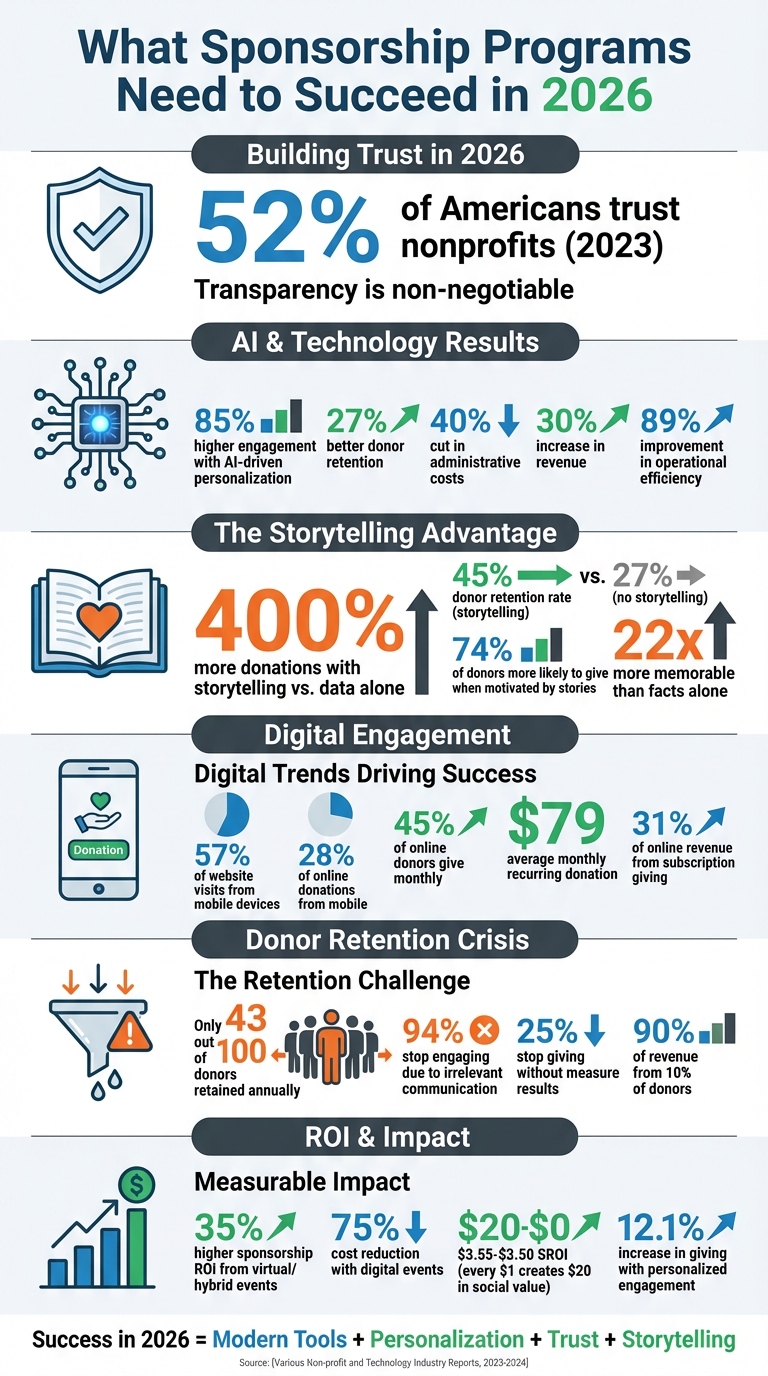
2026 Nonprofit Sponsorship Success Statistics and Key Metrics
How Successful Nonprofits are Fundraising to Grow in 2026
Technologies and Tools Your Sponsorship Program Needs
In 2026, the success of your sponsorship program will heavily depend on the technology stack you choose. Nonprofits that adopt centralized platforms, data analytics, and secure payment systems are seeing tangible benefits - AI-powered solutions, for example, have been shown to cut administrative costs by 40% and increase revenue by 30%. The shift away from scattered spreadsheets to integrated tools provides a clear, comprehensive view of operations. Let’s start with centralized platforms that make donor management more efficient.
Centralized Donor Management Platforms
A centralized donor management platform simplifies how nonprofits handle donor information. These platforms act as a single hub for storing and managing donor data, including communication history and financial records. Automated workflows take care of repetitive tasks like assigning applications and sending deadline reminders.
The results speak for themselves. In 2024, UNICEF implemented a smart-matching algorithm that boosted successful child-sponsor matches by 45% and cut administrative time by 60% through automated data analysis. Nonprofits using AI tools have also reported an 89% improvement in operational efficiency and a 76% boost in strategic decision-making capabilities.
Modern platforms often include sponsor portals that provide real-time updates and engagement metrics. AI-powered insights use predictive analytics to anticipate donor behavior, suggest ideal donation amounts, and flag donors who might stop contributing. To get started, consider running a pilot program with about 5% of your donor base to evaluate the platform’s effectiveness before scaling up. Once you’ve established a strong foundation with centralized platforms, data analytics can take donor engagement to the next level.
Using Data Analytics to Personalize Engagement
Data analytics allows nonprofits to tailor their outreach by segmenting donors based on giving history, interests, and engagement patterns as part of your donor acquisition strategies. This personalized approach can turn one-time donors into monthly supporters or encourage recurring donors to increase their contributions. It’s a proactive strategy that builds trust and loyalty by addressing donor needs before they even express them.
Why does this matter? Twenty-five percent of donors stop giving when organizations fail to show measurable results or communicate transparently about how funds are used. Cloud-based systems can track donor interactions in real time and even send personalized thank-you notes immediately after a donation.
To maintain accuracy, it’s crucial to implement strict data governance policies and conduct regular database audits. Use your CRM tools to automate the “Ask, Thank, Report, Repeat” cycle, ensuring every donor receives a personalized impact report before being asked for their next gift. With data analytics in place, the next step is securing donor trust through streamlined payment systems.
Payment Integration and Financial Transparency
Trust is non-negotiable when it comes to payment processing. In 2023, only 52% of Americans trusted nonprofits, and 69 organizations experienced data breaches in just the first nine months of the year. Your payment system must prioritize both security and simplicity.
Features like one-click donations and recurring payment options can reduce friction and increase contributions. Payment platforms should automatically generate receipts and provide impact updates immediately after a transaction. Some nonprofits are even exploring blockchain solutions, such as those offered by the Binance Charity Foundation, to track donations from start to finish, ensuring full transparency while lowering administrative costs.
To keep donor information safe, prioritize encryption, tokenization, and compliance with privacy laws like GDPR. With 45% of online donors giving monthly and averaging $79 per month, a seamless payment process can directly impact your revenue. Embedding donation buttons into social media posts and email newsletters can make giving even easier, capturing donors at the peak of their interest.
How to Use Storytelling to Attract and Keep Sponsors
Storytelling goes beyond just sharing data - it’s the bridge that turns numbers into meaningful connections with donors. It’s a proven strategy: nonprofits that master storytelling can raise up to 400% more in donations compared to those relying solely on data. Plus, organizations that prioritize storytelling boast a 45% donor retention rate, compared to just 27% for those that don’t. Clearly, stories aren’t just an extra - they’re the key to building lasting relationships with sponsors.
Why Stories Resonate with Sponsors
Stories have a unique power to connect with people on an emotional level. When you share a compelling narrative, it triggers a chemical reaction in the brain: dopamine helps sponsors stay focused and remember your message, while oxytocin boosts empathy and generosity. This is why stories are 22 times more memorable than raw facts and figures.
The impact of storytelling is undeniable. Research shows that 74% of donors are more likely to increase their contributions or donate outside their usual schedule when motivated by a story. Social media posts featuring stories generate 10 times more engagement than those without. And when you focus on an individual’s journey rather than broad statistics, you avoid "compassion fade" - a phenomenon where large numbers fail to evoke emotional connections.
How to Craft Stories That Show Your Impact
A powerful sponsorship story follows a clear structure: introduce a protagonist facing a challenge, show how your organization stepped in to help, and wrap up with a call to action. Keep the focus on one person’s journey. For example, a study found that a heartfelt story about a single individual raised nearly twice as much as a data-driven appeal that highlighted millions in need.
Here’s a real-world example: In October 2025, the EduBridge Foundation, led by CEO Unmesh Sheth, adopted a "Proof-in-90-Days" storytelling strategy for their scholarship programs. They sent plain-text updates at 30, 60, and 90 days, highlighting individual student milestones. They also implemented a "Skip-and-Support" email sequence for missed payments. The result? An 8% increase in donor retention and a 30% reduction in permanent churn.
To keep your storytelling fresh, build a story bank. Include accounts of beneficiary successes, volunteer experiences, and behind-the-scenes moments. Use simple language - aim for an eighth-grade reading level with short sentences under 20 words. Add sensory details to make the story more vivid. And always back your narrative with concrete data to reinforce trust, such as noting that the individual you’re featuring is one of 200 people helped this year.
Ethical storytelling is crucial. Always get informed consent, respect the dignity of those featured, and avoid exploitative imagery or "poverty porn". A growing trend in 2026 is asset-based storytelling, which highlights the strengths and resilience of the people you serve rather than focusing solely on their struggles.
Once you’ve crafted a compelling story, the next challenge is sharing it through the right digital channels.
Using Digital Channels to Share Your Stories
A great story deserves to be heard, and the right digital strategy can amplify its reach. Your website is the cornerstone for storytelling, but each platform requires tailored content. For example, email campaigns work well for storytelling series - try a five-part email series that combines beneficiary stories with impact data to keep sponsors engaged. On social media, use the "2-2-1" model: post twice to share valuable information, twice to express gratitude (like thanking sponsors), and once with a direct call to action.
Short-form video is a must in today’s digital landscape. Platforms like TikTok and Instagram Reels make it easy to condense compelling stories into quick, high-impact clips. Don’t forget to optimize all content for mobile devices - 28% of online donations now come from mobile users. LinkedIn is another valuable tool, as 42% of active users research organizations there, and 26% use it to find donation opportunities.
Here’s a quick guide to matching your story format with the right platform:
| Digital Channel | Best Story Format | Primary Goal |
|---|---|---|
| Concise narrative with photos | Driving donations and retention | |
| Social Media | Short-form video and compelling visuals | Building awareness and engagement |
| Website/Blog | Long-form "Hero's Journey" stories | Establishing credibility and trust |
Don’t underestimate the power of tagging sponsors in appreciation posts on platforms like LinkedIn or Facebook - it’s a great way to showcase the benefits of supporting your organization. Interactive formats like polls, quizzes, and "Ask Me Anything" sessions can also help turn passive viewers into active participants.
Personalized Donor Engagement Strategies for 2026
As technology and data analytics continue to evolve, nonprofits face a critical challenge: keeping donor engagement meaningful. Personalization has shifted from being a nice-to-have to an absolute must. The numbers tell a sobering story - nonprofits are retaining only 43 out of every 100 donors annually. Even more alarming, 94% of people who stop engaging with an organization cite irrelevant communication as the reason. The path forward is clear: treat donors as individuals by creating personalized donor journeys, not as a one-size-fits-all group. Understanding who they are and what resonates with them is key.
Segmentation and Targeted Communication
Effective segmentation is the backbone of personalized donor engagement. By categorizing donors based on their giving history, preferred communication channels, and how they were first acquired, you can avoid overwhelming them with irrelevant requests [24,27]. This approach allows you to align your outreach with their giving patterns and financial capacity.
Modern cloud-based CRMs make it easier to shift from reacting to donor actions to anticipating their needs. For example, you can set up reminders for recurring gifts or send personalized updates during urgent campaigns. For major donors, it’s worth going the extra mile - remove them from generic mass appeals and instead offer exclusive updates or handwritten notes. Some nonprofits have even created "digital development officer" roles to handle automated yet personalized communications, helping move potential major donors into more focused outreach efforts.
Once you've segmented your audience, the next step is to implement automation - without losing that human touch.
Automated Messaging That Still Feels Personal
Automation can be a game-changer, but it’s essential to balance efficiency with authenticity. One effective strategy is the "instant-then-authentic" approach. Start with an automated thank-you message sent within minutes of receiving a donation, followed by a personal follow-up - like a phone call or handwritten note - within 48 hours [25,28].
"Tools don't build relationships; you do. But the right tools, used wisely, can give you back the time and focus you need to connect meaningfully with your donors."
– Rob Burke, CMO, DonorDock
Set up alerts in your CRM to notify your team when a donor reaches a milestone or shows increased engagement. This allows for timely, personalized outreach. For instance, in October 2025, the University of Pittsburgh and Western Michigan University adopted digital development officer models. These roles used automated emails and scheduled calls to provide insider updates and identify prospects for major gifts.
Short surveys can also be a powerful tool. By asking just a few targeted questions (3–8), you can identify donors’ interests and communication preferences. High-intent responses can then be routed for personal follow-up. However, none of this works without clean data. Sync your CRM, email platform, and event systems to avoid errors or duplicates - issues that cost U.S. organizations an estimated $3.1 trillion annually.
After automated outreach, keeping donors engaged requires consistent gratitude and clear updates on their impact.
Thank-You Campaigns and Impact Updates
Expressing timely gratitude and sharing the tangible results of donations are crucial for retaining donors. People want to know exactly how their contributions make a difference.
Replace generic thank-you notes with specific impact statements. For example, instead of saying "Thank you for your generous gift", try "Your $50 provided 100 meals." Visual tools like infographics or dashboards can help illustrate the broader effects of a donor's contribution, while testimonials from beneficiaries add a personal touch.
In 2024, North Central University demonstrated the power of this approach. By leveraging the Virtuous CRM for marketing automation, the university segmented its supporters and delivered personalized content. This shift, led by David Duxbury, Associate Director of Advancement, resulted in a 12.1% increase in year-over-year giving. Reflecting on the change, Duxbury shared:
"We think of fundraising differently now, in terms of personalized touch everywhere we go. And so now that we're not spending as much time doing the manual processes and can connect more with our donors."
– David Duxbury, Associate Director of Advancement, North Central University
Lastly, don’t underestimate the power of remembering milestone moments. Automated reminders for anniversaries, such as the date of a donor’s first gift or a sponsored child’s birthday, can prompt personal outreach. These gestures show donors that you value their unique connection to your organization, beyond just their financial contributions.
Measuring Success and Adapting to Future Trends
Tracking the right metrics is what sets thriving sponsorship programs apart from those that stall. Without clear benchmarks, you might miss key insights into what’s working or where you’re losing ground. The focus should go beyond just dollars raised - it's about building meaningful connections and achieving long-term outcomes that showcase genuine impact.
Setting KPIs for Sponsorship Programs
To measure success effectively, keep an eye on both personal and digital engagement metrics. High-touch interactions like phone calls, handwritten notes, and event invitations can reveal how deeply sponsors connect with your mission. On the digital side, track Click-Through Rates (CTR) and Cost Per Acquisition (CPA) using unique UTM parameters in your CRM.
One powerful tool is Social Return on Investment (SROI), which quantifies the value your programs generate. For instance, JVS Greater Boston applied SROI tracking to their "Bridges to College" and "Skills" programs. By the second year, these initiatives delivered SROIs of $3.55 and $3.50 respectively, meaning every $1 invested created $20 in total social value. Sharing such data transforms sponsor conversations from "please support us" to "here’s the measurable difference you’ll make."
Also, keep in mind that 90% of fundraising revenue often comes from just 10% of donors. Identifying and monitoring this critical group is essential. AI-powered analytics can forecast partnership ROI even before deals are finalized, helping you focus on relationships that have the best potential for success.
Using Feedback to Improve Your Programs
Feedback is a two-way street that fosters genuine dialogue with both sponsors and beneficiaries. The Most Significant Change (MSC) method is particularly effective: collect real-life stories from beneficiaries, have stakeholders choose the most impactful ones, and use these insights to determine what truly matters to your community.
Take ImmSchools, for example. This nonprofit, which supports immigrant families in K-12 schools, formed a committee of students, parents, and educators to help refine their programs. By involving beneficiaries in shaping their "Theory of Change", they discovered that fostering a "sense of belonging" was the most critical outcome to measure. This participatory approach ensures you’re tracking what’s important, not just what’s easy to quantify.
For sponsor feedback, sometimes “old school” methods work best. Phone calls and handwritten notes often provide more honest and detailed insights than digital surveys. Show sponsors how their feedback leads to tangible improvements - it’s a key step in building long-term loyalty. Start with simple tools like Google Forms for collecting data before moving on to pricier platforms.
This continuous feedback loop doesn’t just refine current strategies - it also prepares your program to handle emerging trends.
Preparing for Future Trends in Nonprofit Sponsorship
Once you’ve nailed down metrics and feedback processes, it’s time to look ahead. The nonprofit landscape is shifting fast, with 85% of organizations updating their fundraising strategies in the past year to include digital tools. Staying competitive means embracing these changes.
AI-powered tools are now indispensable. They can identify potential sponsors, predict partnership ROI, and automate personalized donor experiences - all while keeping the human touch intact. Blockchain technology is also gaining traction, offering transparency and real-time tracking of donations. Helen Hai, Head of Binance Charity Foundation, explains:
"Donations through the BCF platform will ensure full transparency, accountability, and direct reach to end recipients".
Another growing trend is subscription-based giving, which now accounts for 31% of average online revenue. Recurring donations provide steady funding and foster stronger sponsor relationships. Pair this with a unified commerce strategy, integrating donations, merchandise, and event ticketing into a single supporter profile.
Corporate sponsors are also shifting priorities, increasingly valuing Environmental, Social, and Governance (ESG) partnerships. With 73% of consumers preferring brands that collaborate with nonprofits, aligning with ESG goals has never been more important. Virtual and hybrid events continue to prove their worth too, delivering 35% higher sponsorship ROI than in-person-only events while cutting costs by up to 75%.
Lastly, consider the rise of micro-influencer partnerships. These creators, with 10,000–100,000 followers, drive 5–10x higher engagement rates than larger influencers, making them an affordable way to reach niche audiences. With 89% of marketers planning to maintain or increase influencer spending in 2026, this strategy is here to stay.
Conclusion: Building Sponsorship Programs That Last
Creating effective nonprofit sponsorship programs that stand the test of time in 2026 hinges on three key elements: embracing digital tools, forming partnerships with shared purpose, and ensuring transparency through data and storytelling. In 2023, U.S. corporations contributed an estimated $36.5 billion to nonprofits. But keeping that momentum requires moving beyond one-off donations to ongoing collaboration aligned with shared values and ESG objectives. These principles set the stage for a streamlined, digital-first approach that resonates with today's donors.
The trends are clear - 57% of website visits now come from mobile devices, and digital events can slash costs by up to 75% while delivering a stronger return on investment. To stay relevant, nonprofits need to adopt seamless payment systems and advanced donor tracking tools. With only 52% of Americans expressing trust in nonprofits as of 2023, being transparent isn't just a good idea - it's critical for survival. Combining data-backed insights with emotional storytelling helps nonprofits build trust and keep supporters engaged long-term.
Dan Lambe, CEO of the Arbor Day Foundation, captures this perfectly:
"These partnerships will evolve and expand, but doing so with intention and clarity is important".
This calls for regular audits of your resources, maintaining accurate donor data, and leveraging platforms that consolidate everything from payment processing to impact reporting. Tools like HelpYouSponsor provide a centralized solution to manage sponsorships, automate tailored outreach, and showcase measurable results to sponsors.
Looking ahead to 2026, nonprofits that embrace technological change, listen to sponsor feedback, and nurture authentic relationships will lead the way. Whether you're collaborating with micro-influencers - who often achieve engagement rates 5–10x higher than their macro counterparts - or using digital platforms to unify your efforts, the goal remains the same: demonstrate your value, stay adaptable, and keep your mission front and center. Taking these steps now will set a new benchmark for sponsorship success.
With a clear plan and the right tools to keep sponsors engaged year-round, your program won't just succeed in 2026 - it will set the standard for excellence.
FAQs
How can nonprofits use AI to improve donor engagement in 2026?
Nonprofits have a powerful ally in AI when it comes to building stronger connections with donors. By analyzing donation patterns and applying predictive models, organizations can uncover insights like a donor's preferred giving schedule, communication preferences, and potential contribution amounts. This data allows nonprofits to group donors into categories such as "high-growth" or "at-risk", enabling automated and timely outreach that not only improves donor retention but also boosts contributions - all while cutting down on administrative work.
AI also opens the door to personalized communication. Imagine creating tailored emails, videos, or social media posts that speak directly to a donor's passions and interests. Generative AI tools can help craft stories that inspire action, while chatbots provide instant acknowledgments and on-demand support. By connecting donors with projects that align with their values, nonprofits can foster deeper engagement and long-term loyalty.
Here’s how nonprofits can start using AI effectively:
- Audit donor data: Ensure it’s accurate and comprehensive.
- Select the right AI platform: Look for tools with predictive analytics and content creation capabilities.
- Test with a pilot campaign: Start small - target around 5% of your donor base.
- Track key metrics: Focus on engagement rates, donation growth, and cost savings.
Incorporating AI into their approach allows nonprofits to deliver personalized, meaningful experiences that can transform occasional donors into lifelong champions of their cause.
What makes storytelling effective for nonprofit sponsorship programs?
Effective storytelling for nonprofit sponsorship programs thrives on three key elements: personal connection, highlighting impact, and aligning with shared values.
First, making it personal is essential. Whether it’s a handwritten thank-you note, a customized email, or an update that directly acknowledges a sponsor’s unique contributions, this approach makes sponsors feel seen and appreciated. These small, thoughtful gestures help build a genuine relationship and keep sponsors invested in the cause.
Next, it’s crucial to clearly show the impact of their support. Use visuals like photos, infographics, or concrete data to demonstrate how their contributions are changing lives or advancing the mission. This transparency not only reinforces trust but also helps sponsors see the tangible results of their generosity.
Finally, weaving the nonprofit’s mission with the sponsor’s values creates a strong sense of shared purpose. When the story reflects goals and principles that resonate with the sponsor, it deepens the emotional connection, encouraging long-term commitment and attracting potential new sponsors.
By combining these elements, nonprofits can craft stories that not only engage but also inspire action and loyalty.
How can nonprofits build trust with donors through financial transparency?
Nonprofits can build trust with donors by being transparent about how funds are used. A good starting point is to share regular, easy-to-read impact reports. These reports should clearly outline spending - like program costs, administrative expenses, and measurable outcomes - using charts and straightforward explanations. When donors see exactly how their dollars ($) are making a difference, they feel more confident and are more likely to keep supporting your mission.
Technology can play a big role in boosting transparency. Cloud-based tools can simplify expense tracking, generate detailed financial summaries, and even let donors securely access their donation history. For even greater accountability, nonprofits can explore blockchain technology, which creates tamper-proof records of contributions. This ensures every dollar can be traced from donation to its impact.
Equally important is maintaining open communication with donors. Keep them informed throughout the fundraising journey - before, during, and after their gift. This can be done through newsletters, personalized thank-you notes, or even interactive webinars. By combining clear reporting, smart technology, and consistent communication, nonprofits can strengthen donor trust and build lasting relationships.