
The Benefits of Recurring Donations: How to Secure Long-Term Support
How recurring donations create predictable revenue, higher retention, lower costs, and stronger donor engagement — plus steps to build and manage a sustaining program.

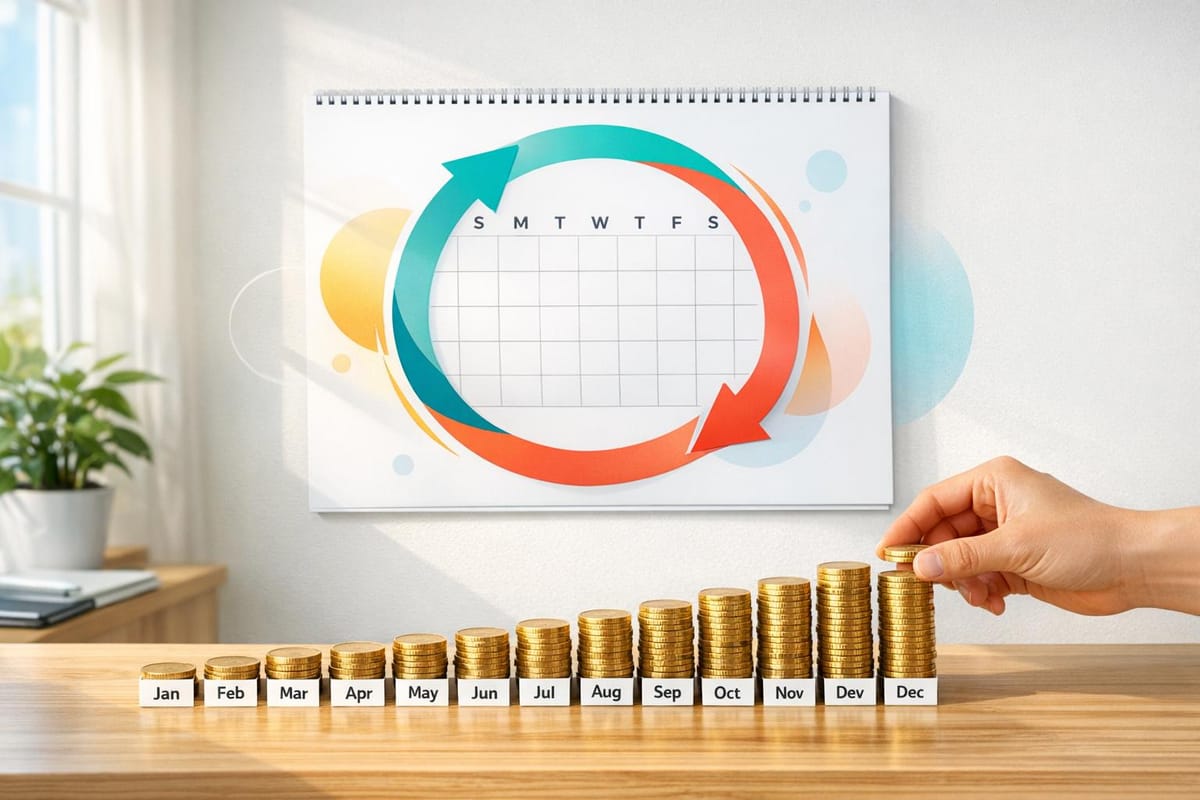
Recurring donations are the backbone of financial stability for nonprofits. These automatic contributions - monthly, quarterly, or annually - offer a predictable income stream, reduce fundraising costs, and foster longer donor relationships. Here's why they matter and how they can transform your nonprofit's funding:
- Consistent Revenue: Smooth out seasonal donation spikes (e.g., December) with dependable monthly income.
- Higher Retention: Recurring donors stay 5–8 years on average, compared to 18 months for one-time donors.
- Increased Lifetime Value: Monthly donors contribute 42% more annually and significantly boost overall revenue.
- Lower Costs: Automated systems reduce the need for constant donor acquisition and administrative tasks.
- Stronger Donor Engagement: Regular updates and impact stories keep donors connected and loyal.
For example, the Tunnel to Towers Foundation generates 75% of its online revenue through an $11/month recurring donor program. By simplifying the process, offering flexibility, and showing clear impact, nonprofits can secure lasting support. Ready to build a program that ensures steady funding and deepens donor connections? Let’s dive in.
[Webinar] Build, grow, and sustain recurring donations
Why Recurring Donations Matter for Nonprofits
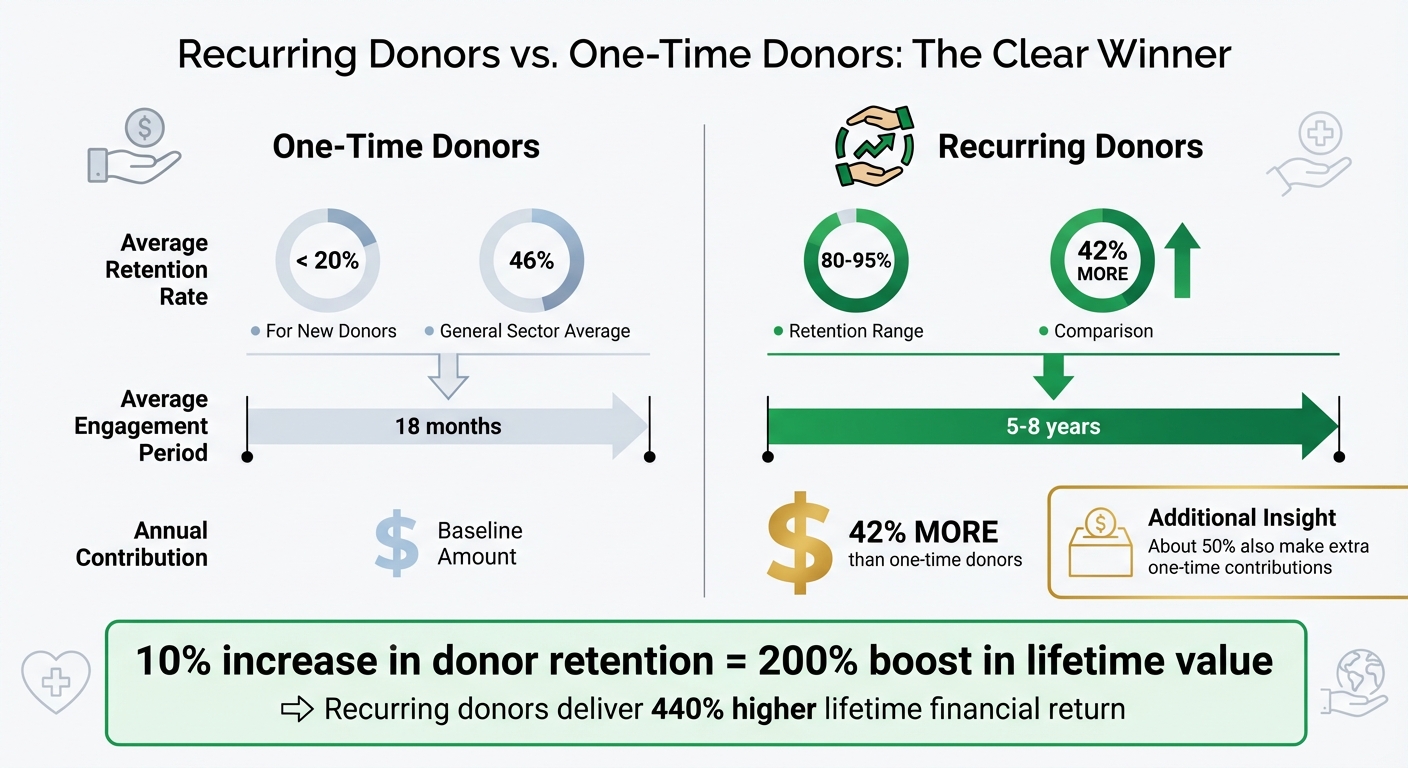
Recurring vs One-Time Donors: Retention Rates and Engagement Comparison
Recurring donations have the power to reshape the way nonprofits operate. Instead of constantly chasing one-time contributions through diverse fundraising strategies, organizations can rely on a steady, predictable income stream that supports long-term goals and sustainable growth.
Predictable Income and Budget Planning
Recurring donations provide nonprofits with a dependable monthly revenue stream, often referred to as Monthly Recurring Revenue (MRR). This stability is crucial for financial planning, especially since many nonprofits experience significant donation spikes in December - sometimes as much as 30% of their annual total. Recurring donations help smooth out cash flow, particularly during slower months like April through June, allowing organizations to confidently manage expenses such as salaries, program development, and infrastructure upgrades.
From 2018 to 2022, recurring revenue saw a 144% increase, with monthly gifts averaging between $52 and $79. These contributions now account for over 30% of digital fundraising revenue. Unlike one-time donations that require constant effort to replenish, recurring gifts accumulate over time, creating a compounding effect that strengthens financial health.
Better Donor Retention and Loyalty
Recurring donations don’t just stabilize finances - they also build stronger donor relationships. While retention rates for one-time donors often fall below 20%, recurring donors stick around at rates between 80% and 95%, with engagement lasting 5 to 8 years. In comparison, one-time donor relationships typically last just 18 months.
Automated payments make giving effortless for donors, eliminating the need for repeated asks. This shifts the dynamic from transactional to relational, fostering a sense of partnership. Interestingly, about half of recurring donors also make additional one-time contributions.
| Donor Type | Average Retention Rate | Average Engagement Period |
|---|---|---|
| One-Time Donors | Less than 20% (new donors) | 18 months |
| General Donors | 46% (sector average) | Varies |
| Recurring Donors | 80–95% | 5–8 years |
Lower Fundraising Costs
Recurring giving programs are cost-efficient by design. They reduce the need for constant donor acquisition campaigns, which are often expensive and time-consuming. Automated systems handle tasks like receipts, acknowledgments, and payment retries, freeing up staff to focus on strategic priorities rather than administrative duties.
Kim Richardson, AVP of Client Strategy at Allegiance Group + Pursuant, puts it succinctly:
"Recurring giving drives more revenue and gives your team opportunities to foster relationships for less work".
Higher Donor Lifetime Value
Recurring donors contribute significantly more over time compared to one-time donors. On average, they give 42% more annually. When combined with their extended engagement period of 5 to 8 years, their lifetime value becomes even more impactful. A mere 10% increase in donor retention can lead to a 200% boost in lifetime value.
Conversion campaigns play a key role in achieving these results. Once donors are converted to recurring contributors, their retention rates are 2.6 times higher than those of new donors. For instance, UNICEF Australia leveraged AI-driven targeting in 2021 to expand its recurring giving program, ultimately generating $12.4 million by focusing on donor conversion and retention.
Better Fundraising Results
All these advantages combine to deliver stronger overall fundraising outcomes. A prime example is the Tunnel to Towers Foundation, which generates nearly 75% of its online revenue through recurring donations. By centering its marketing efforts on a single call to action - becoming a recurring donor for $11 a month - the organization has created a reliable revenue engine.
Even during challenging economic times, recurring giving programs demonstrate resilience. In 2023, recurring revenue grew by 6%, even as one-time donations declined. This stability enables nonprofits to navigate financial uncertainties and funding cuts more effectively, ensuring they can continue fulfilling their missions.
How to Promote Recurring Donations
Building a successful recurring giving program requires thoughtful planning that removes barriers, emphasizes the impact of donations, and shows appreciation for ongoing contributors.
Make Donating Easy
Simplifying the donation process can significantly boost monthly giving rates. One effective tactic is positioning "monthly" as the default or most prominent option on donation forms. This small tweak can lead to impressive results - suggesting monthly donations can increase total gift volume by up to 636% compared to recommending one-time contributions.
The Tim Tebow Foundation provides a great example with its streamlined process, which incorporates five targeted touchpoints to convert and retain recurring donors. Keeping donation forms straightforward is key. Only ask for essential details like name, email, and payment information. Additionally, offer a variety of payment methods, such as credit/debit cards, ACH transfers, and digital wallets like Apple Pay, Google Pay, or PayPal. These options make donating quicker and reduce drop-offs by eliminating the need for manual card entry.
Another useful strategy is implementing "recurring nudges." For instance, when a donor selects a one-time gift, a pop-up could suggest converting it into a smaller monthly contribution. Using impact-based tiers instead of generic amounts can also be persuasive. For example, "Your $20/month feeds a rescued dog for a month" provides a clear and relatable reason to commit. Nonprofit fundraising expert Jenn Gaetano highlights the importance of visibility:
"Make monthly giving the first option versus a one-time gift as the first option. That's an easy way to make it visible and maybe make them realize they can even do that."
To build trust and reduce cancellations, offer self-service portals where donors can update payment details, pause donations, or adjust their contribution amounts. Automating failed payment recovery through smart retries can also help address issues like expired cards without manual follow-up. Capturing new recurring donors early is vital, as nearly one-third of first-time donors who become monthly supporters do so within the first 90 days of their initial gift.
Once the donation process is seamless, the next step is creating personalized donor journeys that show donors how their ongoing support drives meaningful change.
Show the Long-Term Impact
Donors are more likely to commit when they see the tangible results of their contributions over time. Instead of relying solely on large statistics, focus on individual stories or specific outcomes made possible by recurring gifts. For example, rather than stating "we helped 1,000 families", share the story of one family whose life was transformed through monthly donations.
charity: water excels at this by dynamically updating its donation form to show how many people will receive clean water based on the selected monthly amount. This creates a direct, measurable connection between the donation and its impact. Similarly, the American Heart Association features a heart disease survivor on its monthly giving page, urging donors to "keep a family's loved one alive" through recurring support.
Regular updates are essential to keeping donors engaged. Send text messages, emails, or videos that highlight the progress their contributions make, without asking for additional funds. For example, The Nature Conservancy brands its recurring donors as "Conservation Champions" and provides monthly updates on conservation projects, along with a year-long magazine subscription. These updates reinforce the value of their ongoing support.
Dedicated impact pages on your website can further illustrate the stability provided by monthly donations. Use before-and-after photos, infographics, or stories to showcase measurable results. Celebrate milestones like donor anniversaries with personalized messages that highlight their role in achieving your mission, using proven donor retention techniques to strengthen the bond. On average, a monthly gift is $52, which adds up to $624 annually - far exceeding typical one-time contributions.
Offer Donor Incentives
While the primary motivator should always be the impact of donations, thoughtful incentives can encourage hesitant donors to commit. The Tunnel to Towers Foundation demonstrates this well with its $11/month recurring gift program, which includes exclusive content, event access, discounts, and free merchandise. This approach has led to nearly 75% of the foundation's online revenue coming from recurring donors.
Tiered incentives tied to donation levels can also be effective. For instance, a $50/month donor might receive a branded T-shirt, while a $150/month donor could enjoy an annual lunch with the CEO. Giving your recurring program a unique identity - like "Impact Partners" or "Conservation Champions" - can make donors feel like they’re joining an exclusive community rather than just making a transaction.
Experiential perks, such as behind-the-scenes tours, early event registration, or special volunteer opportunities, work particularly well for higher-tier donors. Partnering with local businesses to offer discounts or featuring donors on a digital "Wall of Fame" can further enhance their sense of connection.
Exclusive content is another powerful incentive. Offer recurring donors "insider" status through special newsletters, behind-the-scenes videos, or quarterly impact reports that aren’t available to one-time donors. This not only strengthens their commitment but also encourages additional giving - about 25% of recurring donors make an extra one-time gift within the same year. Moreover, 84% of recurring donors become ambassadors for the cause through volunteering, advocacy, or peer-to-peer fundraising.
Finally, provide a "pause" option for donors facing financial challenges rather than outright cancellation. This flexibility maintains the relationship and makes it easier for donors to resume their support later. Since recurring donors are 1.4 times more likely to lapse in January than in other months, offering strong early-year engagement and adaptable options is crucial for retention.
Managing Recurring Donations with HelpYouSponsor
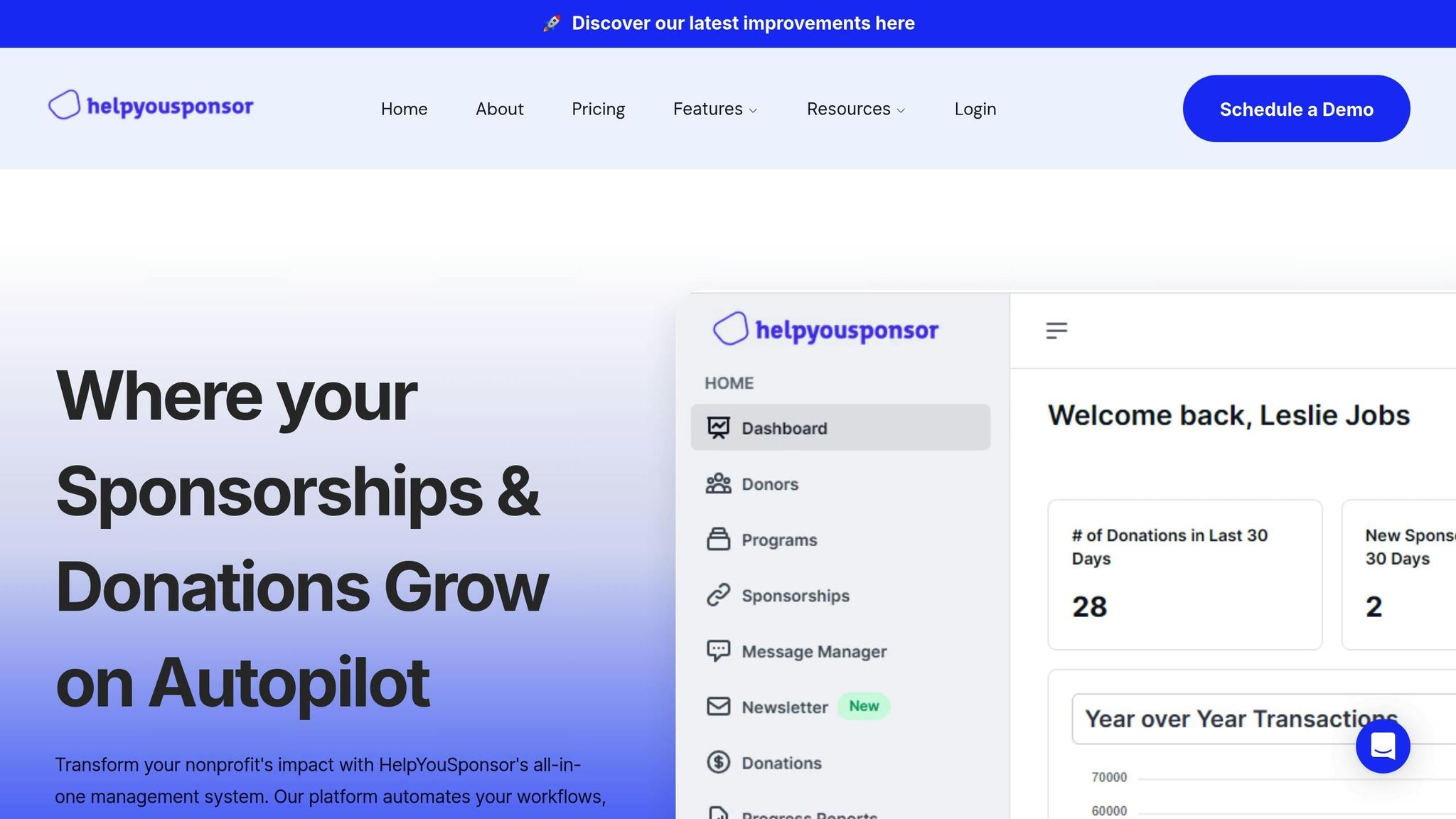
Managing recurring donations effectively is just as important as securing them in the first place. It’s the backbone of stability and helps build stronger relationships with donors. After setting up strategies to attract and retain recurring donors, the next step is ensuring these relationships are well-managed. HelpYouSponsor offers a comprehensive software solution designed specifically for nonprofits running nonprofit sponsorship programs and recurring donation campaigns. By combining donor management, payment processing, and communication tools into a single platform, it eliminates the hassle of juggling spreadsheets or disconnected systems. This integration ensures that recurring donations are handled as efficiently as they are secured.
Automated Tracking and Reports
Manually tracking donations can eat up valuable staff time and lead to missed opportunities, like overdue payments or lapses in communication. HelpYouSponsor automates these tasks, providing detailed reports on donor activity, payment history, and overall program performance. Without automation, keeping track of renewal dates and sending personalized emails becomes overwhelming as your donor list grows. HelpYouSponsor’s automated triggers handle these communications, ensuring donors receive timely, personalized updates.
The platform also helps you calculate Donor Lifetime Value (DLV) by analyzing average monthly gifts, donation frequency, and duration. This metric is crucial, especially when you consider that recurring donors deliver a lifetime financial return that’s 440% higher than one-time donors. Armed with these insights, you can allocate resources more strategically to boost your fundraising efforts.
Integrated Payment Processing
HelpYouSponsor simplifies recurring contributions with its built-in payment system, seamlessly integrated with various payment gateways. This automation reduces administrative workloads by processing monthly donations automatically. It also tackles common issues like credit card declines - around 15% of recurring donations fail due to expired or reissued cards. By addressing these declines and automating payments, the platform ensures a steady revenue stream, which is critical given that monthly giving programs often achieve donor retention rates as high as 90%.
The system also offers donors flexibility, allowing them to contribute via credit cards, ACH transfers, or digital wallets. This versatility makes it easier for supporters to give in a way that suits them best.
Custom Sponsorship Pages and Donor Messages
HelpYouSponsor enables nonprofits to create custom sponsorship pages that integrate directly into their websites. These pages showcase sponsorship opportunities in a visually appealing way without requiring technical know-how. Additionally, the platform’s automated messaging system sends personalized thank-you notes, payment confirmations, and updates on the impact of donations. For example, you can highlight messages like, “Your $35/month feeds a family of four for a year,” helping donors see the tangible results of their contributions.
This level of communication not only keeps donors engaged but also reduces the administrative burden on your team. With regular, personalized updates, you can focus more on building meaningful relationships. Plus, the donor account portal allows supporters to update payment details or adjust their contributions themselves, minimizing cancellations caused by outdated information.
Tracking and Improving Your Recurring Donation Program
Creating a recurring donation program is just the starting point. The real challenge lies in keeping an eye on its performance and tweaking your approach based on the numbers. Without tracking the right metrics, you might miss out on spotting problems or finding ways to grow. Tools like HelpYouSponsor’s reporting features can give you the insights you need to make smarter decisions and improve outcomes over time.
Important Metrics to Track
One of the key figures to monitor is Monthly Recurring Revenue (MRR) - this is the steady monthly income generated from all active donors. Another critical metric is the churn rate, which measures how many donors or how much revenue is lost when recurring gifts are canceled or fail. Breaking churn into two categories - voluntary (donors who cancel) and involuntary (failed payments or expired cards) - can help you decide on the best recovery strategies.
The donor retention rate is another vital indicator, showing how many recurring donors stick around over time. This metric is a solid way to gauge the health of your program. For context, top nonprofits generate 33.5% of their revenue from recurring donors, while the average nonprofit only reaches 12.88%. You’ll also want to calculate Donor Lifetime Value (LTV), which estimates how much a donor will give throughout their relationship with your organization. Even a small 10% boost in retention can double donor lifetime value.
Other metrics to keep in mind include the average recurring gift size, which reflects donor engagement and can highlight opportunities for upselling. Lastly, track your conversion rate - the percentage of one-time donors transitioning into recurring donors. Interestingly, nearly one-third of first-time donors who become recurring supporters do so within the first 90 days of their initial gift.
With these numbers in hand, you can start making smarter, data-driven changes.
Using Data to Improve Your Approach
HelpYouSponsor’s reporting tools make it easier to identify trends and fine-tune your strategy. For example, you can use these tools to flag expiring plans and spot one-time donors who are likely to convert into recurring supporters. Another useful method is RFM analysis (recency, frequency, and monetary value), which helps you find high-potential donors and craft personalized appeals to encourage conversions.
Retention is another area where data can make a big difference. Use donor history to segment those who’ve been active for over a year and send them a tailored upgrade request - perhaps asking for an additional $5 per month. These small, personalized touches can go a long way in improving donor loyalty.
Once data shapes your strategy, it’s time to test and refine your campaigns.
Testing Different Campaign Approaches
Experimenting with different approaches can reveal what works best for your audience. For instance, A/B testing can help you fine-tune elements like donation form language, email subject lines, or suggested gift amounts. A great example is the Tunnel to Towers Foundation, which unified its messaging with a consistent $11 per month ask across various channels like social media and direct mail. This approach helped them achieve a remarkable milestone - nearly 75% of their online revenue now comes from recurring donations.
You can also try tactics like "recurring nudges" - animated prompts that encourage one-time donors to opt for smaller monthly contributions instead. The Wilderness Society used machine learning to identify ideal prospects for a calling campaign, leading to 48 new recurring donors by focusing on those most likely to convert.
Impact statements are another area worth exploring. For example, showing donors how their monthly gift translates into real-world outcomes - like "$25 per month feeds 5 families" - can make the benefits of recurring giving more tangible and compelling.
Conclusion
Recurring donations offer nonprofits a steady and reliable income stream while fostering long-term donor relationships. With retention rates that lead the sector, recurring donors contribute 42% more annually and typically stay loyal for over eight years. Even a modest 10% boost in retention can result in a 200% increase in a donor's lifetime value.
The strategies outlined in this guide - ranging from simplifying the donation process to implementing effective tracking systems - equip nonprofits to build lasting support. Offering flexible giving options and keeping donors updated with personalized communication can drive meaningful outcomes.
"Predictable revenue creates stability - for both your mission and the people it serves."
- Alex Huntsberger, Neon One
This principle aligns perfectly with the tools offered by HelpYouSponsor. Their platform includes automated tracking, integrated payment solutions, and user-friendly donor engagement features. Whether you're starting with the Free Plan (allowing up to 10 commitments per month) or expanding with usage-based pricing, HelpYouSponsor scales to meet your organization's evolving needs.
FAQs
What’s the best monthly gift amount to suggest?
The best monthly gift amount varies based on your organization and the donors you aim to reach. Many nonprofits suggest amounts between $10 and $50 per month, as these figures are manageable for many supporters while ensuring a consistent and reliable income. To find the right fit for your program, think about both your donors' ability to give and your organization's financial goals.
How can we reduce failed recurring payments?
To minimize failed recurring payments, implement automated retry strategies for transactions that fail due to temporary issues, often referred to as soft failures. These can usually be resolved through retries. Additionally, keep donors informed about upcoming payments and offer simple ways for them to update their payment details. Sending reminders or notifications ahead of potential payment failures can make a big difference. By combining retries, transparent communication, and active donor engagement, you can boost payment success rates and maintain steady financial support for your organization.
Which metrics matter most for recurring giving?
Key metrics to watch in recurring giving programs are donor retention rates, growth in the donor base, and lifetime donor value. Retention rates are especially important since keeping donors engaged over time dramatically increases the total contributions they make. Monitoring donor base growth offers insight into how well your program is attracting and engaging supporters. Plus, improving retention doesn’t just keep donors around - it can actually double their lifetime value. Together, these metrics provide a clear picture of your program’s health and help create steady, long-term revenue for your nonprofit.