
The Importance of Real-Time Data in Nonprofit Management
Real-time data lets nonprofits act instantly—optimizing fundraising, donor engagement, and finances with live dashboards and automated workflows.


Real-time data is transforming nonprofit management by enabling faster, smarter decisions. Instead of relying on outdated reports, nonprofits can now monitor campaigns, donor behavior, and finances instantly. This allows teams to adjust strategies mid-campaign, improve donor engagement, and optimize resource allocation. Key benefits include:
- Immediate insights: Identify and address issues as they happen.
- Improved donor engagement: Build stronger relationships with personalized outreach and updates.
- Streamlined operations: Automate data entry, saving time and reducing errors.
- Enhanced financial tracking: Monitor budgets, grants, and spending in real time.
For example, nonprofits using automated dashboards have increased donor retention, boosted recurring donations, and saved hundreds of staff hours annually. Tools like HelpYouSponsor simplify these processes, making real-time data accessible even for small organizations. By leveraging these systems, nonprofits can operate more efficiently and better achieve their missions.
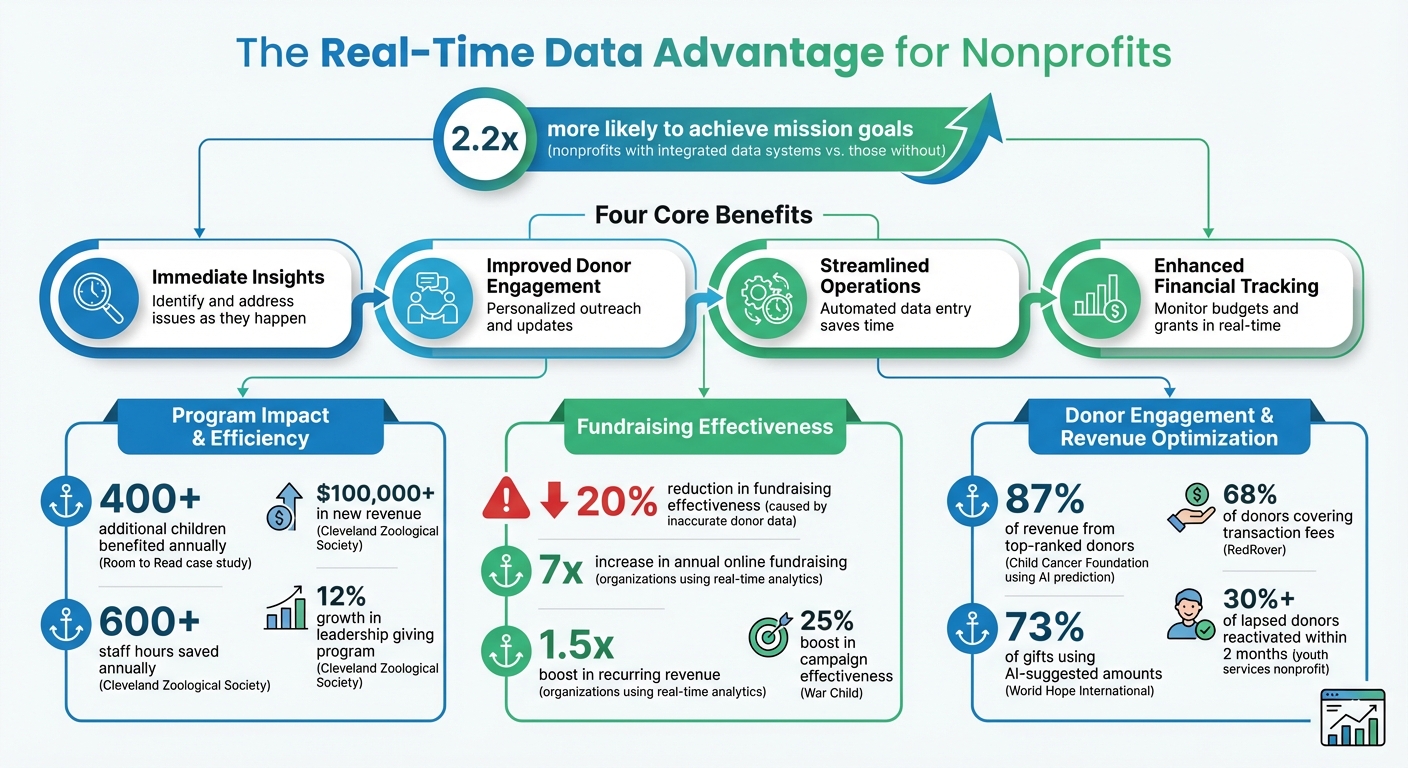
Real-Time Data Impact on Nonprofit Performance: Key Statistics
Unify Your NonProfit Data & Analytics With Microsoft Fabric To Scale Your Fundraising
Using Real-Time Data to Make Better Decisions
Nonprofits relying on outdated reporting systems often burden staff with time-consuming manual tasks. By contrast, real-time data delivers immediate insights, enabling organizations to tackle challenges as they emerge.
For instance, when a fundraising campaign starts losing momentum, waiting for quarterly reports won't help. Real-time tools allow teams to spot engagement drops within days and adjust strategies accordingly. If email open rates suddenly dip, they can experiment with new subject lines or messaging right away, rather than analyzing the issue after the campaign ends. This kind of responsiveness can completely reshape how nonprofits manage their fundraising efforts.
"The ability to make those adjustments on the fly is something I can't imagine doing without today." - Cherian Koshy, Vice President, Kindsight
The shift from static reporting to continuous intelligence is more than just a tech upgrade. It changes how decisions are made, moving away from relying on outdated data to making choices based on current conditions.
How Live Dashboards Work
Live dashboards bring all your data into one place, giving teams a unified view of operations. This eliminates the need to jump between multiple tools to piece together the bigger picture.
These dashboards excel at providing both broad overviews and detailed insights. Leaders can start by reviewing overall campaign performance, then drill down to see exactly where donor engagement is dropping off. For example, they might identify a specific stage in the donor journey where interest wanes and take steps to address it.
Modern AI-powered dashboards simplify setup by ensuring data is clean from the start. Using unique stakeholder IDs, these systems automatically link information across programs and time periods, eliminating the need for manual data cleaning - work that used to consume entire days.
What sets advanced dashboards apart is their ability to combine numbers with context. Instead of just showing that donor retention dropped by 15%, AI tools can analyze survey responses to uncover the reasons behind the decline - like scheduling conflicts that prevented volunteers from attending events. This blend of "what happened" and "why it happened" equips organizations to make more informed decisions.
"A dashboard that displays numbers without analysis is a chart, not a reporting system." - Unmesh Sheth, Founder & CEO, Sopact
When creating dashboards, prioritize metrics that inform specific actions rather than overwhelming users with every available data point. For example, a youth services nonprofit used unified data to identify lapsed donors who had previously attended events or engaged with specific programs. By tailoring their outreach to these connections, they reactivated over 30% of these donors within two months.
These tools set the stage for quick and effective strategy adjustments.
Adjusting Fundraising Strategies Based on Data
Real-time metrics empower nonprofits to refine their fundraising strategies on the fly. Key indicators like conversion rates, average gift size, and donor retention rates show whether an appeal is resonating with supporters. If these numbers start to decline, teams can pivot quickly to save a campaign.
Engagement metrics such as email open rates, click-through rates, and social media interactions reveal how well messages are connecting with audiences. For example, if an email campaign underperforms in its first few hours, teams can test new subject lines or adjust the call-to-action before sending it to the rest of the list.
Donor behavior patterns also offer valuable opportunities for personalization. Monitoring giving frequency, gift size, and monthly contributions allows nonprofits to craft targeted outreach. For instance, identifying long-time monthly donors who haven’t increased their contributions in over a year provides a chance to send tailored "upgrade" appeals that acknowledge their loyalty while inviting greater involvement.
However, real-time systems are only as good as the data they rely on. Inaccurate donor information can reduce fundraising effectiveness by 20%. Regular data cleaning - removing duplicates and updating outdated contact details - ensures dashboards reflect reality and that automated communications reach the right people.
Advanced tools now include predictive features that estimate donor behavior, such as the likelihood of a donor lapsing or their potential as a major gift prospect. These insights enable teams to act proactively, reaching out to at-risk donors before they disengage or cultivating major gift opportunities at just the right moment.
"By having data sooner, the Finance team can now focus on insightful and timely analysis. This helps our business partners benefit more children, more quickly." - Room to Read
Real-time alerts for significant donor events, like a sudden increase in giving capacity or a major life change, open the door for timely, personalized outreach. These moments of connection build stronger relationships - something generic quarterly updates simply can't achieve.
Improving Resource Allocation and Financial Management
Nonprofits often juggle multiple funding sources, making it challenging to track how every dollar is spent. Real-time data integration bridges the gap between fundraising platforms, accounting systems, and payroll software, removing the need for tedious manual data entry. This seamless connection gives finance teams instant insight into restricted and unrestricted funds, ensuring donations are used exactly as donors intended. With this level of integration, organizations can achieve precise financial tracking and smarter resource allocation.
The benefits are clear. In August 2025, Room to Read implemented automated data integration using DataBlend, connecting their financial systems to eliminate manual processes. This shift freed up staff time for strategic analysis, enabling programs that now benefit over 400 additional children each year. In fact, nonprofits with integrated data systems are 2.2 times more likely to report achieving their mission goals compared to those relying on disconnected tools.
"By having data sooner, the Finance team can now focus on insightful and timely analysis. This helps our business partners benefit more children, more quickly." - Room to Read
Inaccurate donor data can cut fundraising effectiveness by 20%, while grant compliance remains a major stressor for 54% of nonprofit leaders. Real-time integration addresses these challenges by syncing payroll data directly into accounting systems, enabling precise tracking of labor costs across specific programs, departments, and grants. This level of accuracy is critical when funders demand detailed reports on how their contributions support specific initiatives.
Tracking Budgets and Sponsorship Commitments
By linking donor management platforms to accounting systems, nonprofits revolutionize how they monitor cash flow and expenses. Leaders gain real-time financial visibility, empowering them to make prompt and informed decisions. When sponsorship commitments roll in, automated data flows categorize contributions by program or project, reducing the risk of overspending due to outdated information.
Integrating payroll and HR data - like salaries, benefits, and time allocations - into accounting systems also supports accurate budgeting and grant forecasting. This approach reveals exactly how much staff time each program consumes, helping organizations allocate resources where they’ll have the most impact. It also highlights which initiatives are running efficiently and which might need adjustments before financial issues arise.
"I was spending the better part of a day doing manual processes between Sage Intacct and Workday Adaptive Planning. As a nonprofit, we need to show data in different ways. I need to generate reports for the Board of Directors, Program Leadership, Government Funders, etc. They all have different requirements and need customizations." - Birch Family Services
Automating data entry not only saves time but also reduces human error, reinforcing donor trust and ensuring compliance. With financial data updating automatically, teams can shift their focus from reconciling discrepancies to analyzing trends and developing strategies. This efficiency promotes transparency and accountability across all financial operations.
Maintaining Transparency and Accountability
Efficient resource allocation is just the beginning - automated integration takes transparency and accountability to the next level. Real-time financial tracking turns regulatory compliance into a routine task rather than a last-minute scramble. When fundraising and accounting systems are continuously synced, organizations can quickly generate the documentation needed for IRS Form 990 filings and state requirements. This readiness eliminates the stress of gathering scattered data as deadlines approach.
"Access to real-time financial data and consistent report visibility allows an organization to quickly produce the data needed for Form 990 or any other reporting requirement." - Jo-Anne Williams Barnes, CPA and CEO, JFW Accounting Services
Multi-dimensional dashboards offer stakeholders tailored insights. Board members can focus on overall financial health, accounting managers can drill into program-specific expenses, and donors can see exactly how their contributions are being used. This level of customized transparency builds trust without adding extra work for staff.
Automated fund tracking ensures donations are categorized correctly, whether restricted to specific programs or available for general operations. This accuracy is crucial for grant compliance, as funders expect detailed reports on how their money supports agreed-upon activities. During audits, real-time system synchronization means reconciliations are already complete, speeding up the process and reducing the chance of discrepancies that could delay financial closures.
Making Operations More Efficient with Real-Time Data
Real-time data isn’t just about better financial management - it’s a game-changer for day-to-day operations. When tools like fundraising platforms, accounting software, and payroll systems sync automatically, teams can say goodbye to hours spent on manual data entry or hunting through spreadsheets. Instead, they can focus on the big-picture work: analyzing trends, measuring program success, and strengthening donor relationships.
This instant visibility also keeps nonprofits nimble during campaigns. Teams don’t have to wait until the end of a drive to assess performance. For example, one organization noticed a spike in small, first-time donations through real-time monitoring. Acting quickly, they ramped up outreach efforts and successfully converted many of those donors into monthly contributors. This ability to adjust on the fly - powered by continuous data flow - helps nonprofits stay on top of key performance metrics, making improvements measurable and actionable.
Monitoring Key Performance Indicators (KPIs)
With smoother operations, tracking real-time KPIs becomes even more impactful. Instead of relying on outdated monthly reports, teams can monitor critical metrics like sponsorship retention, donation patterns, and program participation as they unfold. This immediate feedback loop helps organizations catch issues early - whether it’s a drop in donor engagement or a lagging program - and address them before they escalate.
Real-time KPI tracking also enhances communication with stakeholders. When board members or funders ask for updates, staff can provide live data from dashboards rather than scrambling to compile fragmented reports. This level of transparency not only builds trust but also demonstrates efficient resource management. For child sponsorship programs, keeping tabs on metrics like sponsor retention, communication frequency, and program outcomes ensures consistent support for children and keeps sponsors engaged.
"It's about operating with agility and making data-driven decisions in the moment. These approaches haven't just improved how we raise funds; they've helped us connect with donors on a deeper level, improve our efficiency, and think more strategically about sustainability." - Cherian Koshy, Vice President, Kindsight
Automation also plays a key role in mid-campaign adjustments. If real-time data shows low email open rates or weak engagement with messaging, teams can experiment with new subject lines or tweak their outreach strategy immediately. This kind of agility transforms data into a powerful advantage, helping nonprofits make the most of every opportunity.
Getting Real-Time Insights with HelpYouSponsor
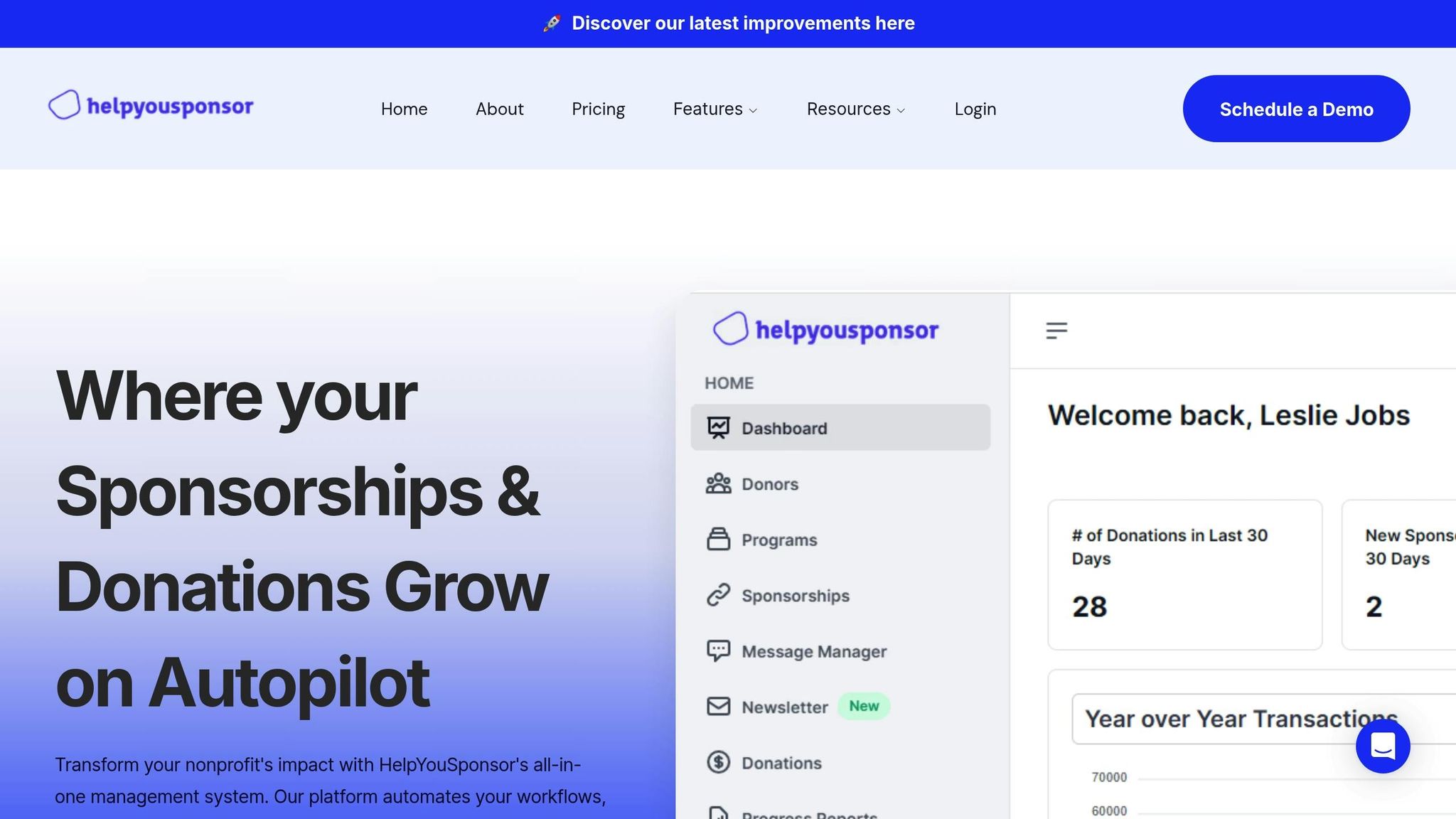
HelpYouSponsor simplifies sponsorship and donation management by consolidating everything into one easy-to-use dashboard. This integration reduces errors and saves countless administrative hours. Teams can instantly see which sponsors are actively engaged, which commitments are nearing renewal, and how donations are distributed across various programs.
The platform’s donation tracking features automatically categorize contributions by program, donor, or restrictions, ensuring funds are used as intended. When a new sponsorship commitment comes in, it’s reflected immediately in financial reports and dashboards, allowing for quick, informed decisions about resource allocation. Automated receipts and thank-you messages further strengthen donor relationships while freeing up staff for higher-level outreach.
For nonprofits managing child sponsorships, medical campaigns, or construction projects, HelpYouSponsor’s real-time insights make it easier to track progress and communicate impact to donors. The platform is designed to grow with organizations, offering a free plan for small nonprofits managing up to 10 commitments per month, with scalable pricing for larger programs. This flexible approach ensures that even smaller organizations can access the tools they need to operate efficiently and maintain donor trust. By integrating all systems into a single, real-time view, nonprofits can streamline their operations while adopting a data-driven approach that improves both decision-making and donor engagement.
Case Studies: How Real-Time Data Changed Nonprofit Results
Real-time data is reshaping how nonprofits operate, offering tools like live dashboards, predictive analytics, and automation to drive measurable improvements in sponsorship retention and fundraising outcomes. Let’s look at some compelling examples of how instant insights have transformed results.
Increasing Sponsorship Retention Rates
Real-time data has proven to be a game-changer for sponsorship retention. In 2025, the Cleveland Zoological Society replaced outdated systems with a responsive platform that provided real-time donor activity insights. By automating tasks like birthday emails and instant gift notifications, they expanded their leadership giving program, "The Pride Donor Circle", by 12% in a single year. This change brought in over $100,000 in new revenue, added 78 leadership-level donors, and saved staff more than 600 hours annually.
War Child offers another example of how predictive analytics can make a difference. Over a three-year period ending in 2025, the organization unified donor data and replaced manual spreadsheets with real-time health scores. This allowed them to identify at-risk donors before they stopped contributing. By experimenting with different email cadences, they boosted campaign effectiveness by 25% and significantly reduced donor churn.
The Child Cancer Foundation also saw impressive results in 2025 by using an AI-powered donor prediction system. This tool identified lapsed donors most likely to re-engage, enabling targeted outreach. Remarkably, 87% of the revenue from their lapsed donor appeal came from the top-ranked donors identified by the system.
Raising Fundraising Success by 20-30%
Real-time insights don’t just improve retention - they can also supercharge fundraising efforts. World Hope International, for instance, adopted predictive AI to personalize donation amounts based on factors like donor device, location, and behavior. This approach led to 73% of all gifts being made using these AI-suggested amounts.
RedRover achieved similar success by implementing real-time adaptive cost coverage. This change encouraged 68% of donors to cover transaction fees, increasing net revenue.
"Today, data shows that 68% of our donors now cover the cost of transaction fees, resulting in additional revenue that we can put back into services." - Erin Bialecki, Director of Development and Communications
The Community FoodBank of New Jersey also benefited from AI-driven tools. By introducing a recurring upsell feature that suggests monthly giving at the ideal moment during checkout, they saw a significant rise in recurring donations.
Organizations leveraging real-time fundraising analytics often report a 7× increase in annual online fundraising and a 1.5× boost in recurring revenue.
These examples highlight how real-time data can elevate fundraising performance and deepen donor engagement, offering nonprofits a powerful way to achieve their mission more effectively.
Conclusion: Why Real-Time Data Matters for Nonprofit Management
Having real-time data at your fingertips allows nonprofits to make quicker, more informed decisions, adapt campaigns on the fly, and clearly show donors the impact of their contributions. Instead of waiting weeks for financial reports, access to up-to-the-minute data empowers organizations to act immediately. In fact, nonprofits using integrated data systems are 2.2 times more likely to achieve their mission goals.
These benefits go beyond operations - they directly impact the bottom line. For example, inaccurate donor data can slash fundraising effectiveness by 20%. Meanwhile, automating data workflows not only reduces errors but also frees up resources, enabling nonprofits to serve significantly more beneficiaries each year.
"By having data sooner, the Finance team can now focus on insightful and timely analysis. This helps our business partners benefit more children, more quickly... Our automation through DataBlend can result in over 400 more children benefiting each year from Room to Read programs." - Room to Read
This kind of real-time data integration doesn’t just improve internal efficiency - it builds trust with donors and creates operational clarity. Whether it’s tracking labor costs by grant, monitoring daily campaign performance, or sending instant thank-you messages after donations, nonprofits can eliminate guesswork and foster stronger donor relationships.
Real-time data also enhances donor engagement and campaign agility. Tools like HelpYouSponsor make these strategies accessible by combining sponsorship management, fundraising, and engagement into a single platform. Starting with an automated dashboard can help your nonprofit make data-driven choices that improve efficiency and advance your mission.
FAQs
What counts as “real-time” data for a nonprofit?
For nonprofits, real-time data refers to information that updates instantly or within moments, allowing for swift decision-making and responses. Examples include live donation tracking, real-time donor engagement metrics, and dashboards showcasing current fundraising totals or campaign performance. This kind of data empowers nonprofits to tweak strategies on the fly, enhance communication efforts, and uphold transparency - key factors in meeting supporters' rising expectations while maximizing their effectiveness.
Which metrics should we track live during a campaign?
Tracking real-time metrics such as donation amounts, total funds raised, average gift size, and donation frequency is crucial for gauging your campaign's momentum. Additionally, keeping an eye on donor engagement metrics - like retention rates - and campaign-specific KPIs, such as click-through rates and mobile conversions, provides a clearer picture of performance.
It's equally important to ensure that operational metrics like data accuracy are dependable. These insights empower nonprofits to fine-tune strategies, enhance donor engagement, and make the most of their fundraising efforts throughout the campaign.
How do we keep real-time donor and finance data accurate?
To keep donor and financial data accurate in real time, nonprofits should connect systems like donation platforms, CRMs, and accounting software. This integration helps streamline the flow of data and minimizes manual mistakes. Implement automated validation rules to verify details like timestamps, donation amounts, and donor information. Regularly test data pipelines to ensure everything runs smoothly. Using automation tools for tasks such as data entry and creating dashboards for real-time monitoring can also help maintain consistency and quickly resolve any discrepancies.