
Why Payment Gateway Integration Is Critical for Modern Nonprofit Donations
Integrate payment gateways to streamline nonprofit donations—secure transactions, enable modern payments, automate recurring gifts, and improve reporting.

Payment gateway integration is no longer optional for nonprofits - it’s essential for streamlining donations, improving donor experiences, and ensuring secure transactions. With 64% of donors preferring to give online in 2024, nonprofits that fail to modernize risk losing support. Here’s why integrating payment gateways matters:
- Simplifies Donations: Automated systems reduce errors, speed up processing, and make recurring donations effortless.
- Boosts Donor Trust: Features like encryption, PCI compliance, and fraud detection ensure secure transactions.
- Supports Modern Payment Methods: Options like Apple Pay, Google Pay, and ACH transfers cater to donor preferences.
- Improves Reporting: Real-time data eliminates manual tracking, helping nonprofits make informed decisions.
- Saves Time: Automation frees up staff to focus on mission-critical tasks instead of tedious admin work.
Platforms like HelpYouSponsor simplify this process by offering integration with popular gateways like Stripe and PayPal, automating receipts, and providing tools for donor management. If your nonprofit hasn’t embraced payment gateway integration yet, now’s the time to act.
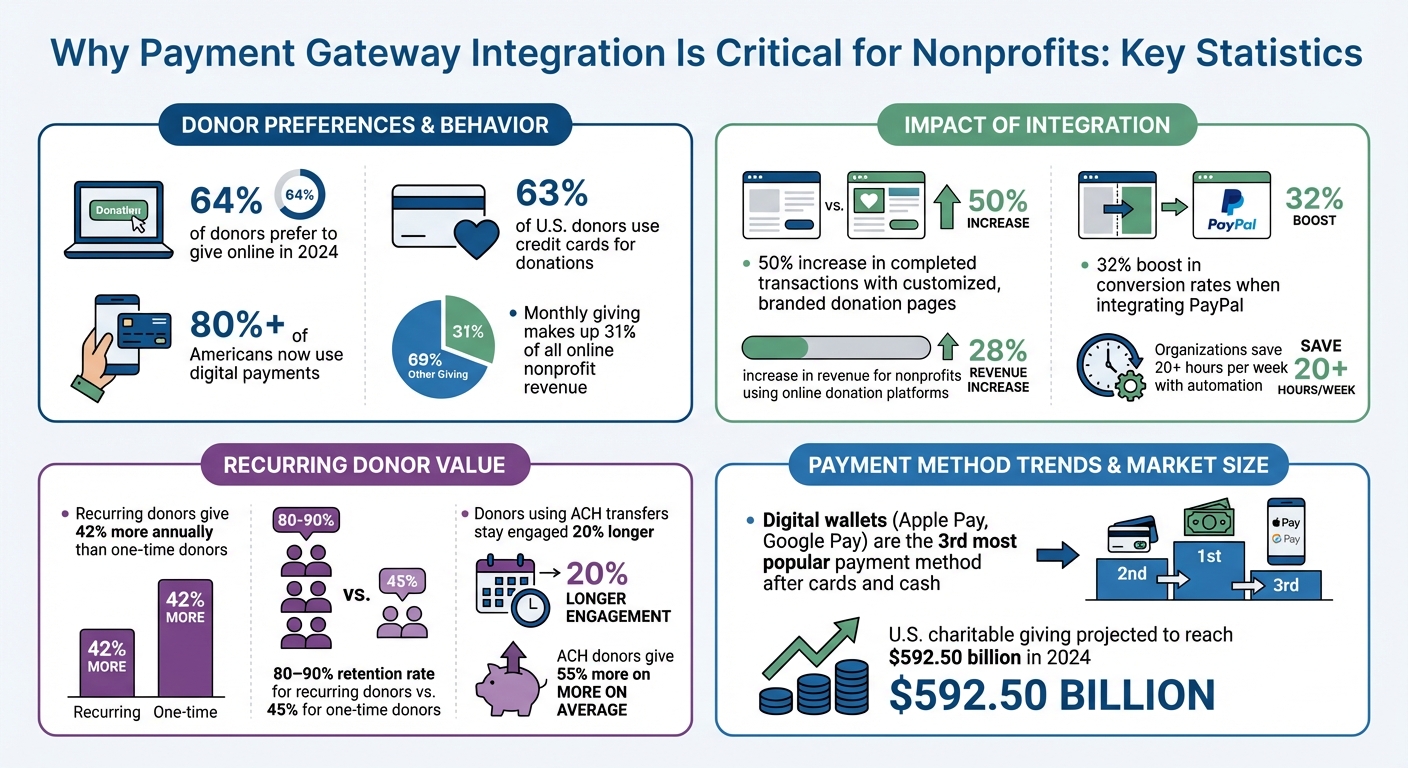
Payment Gateway Integration Impact on Nonprofit Donations: Key Statistics
Problems Nonprofits Face Without Payment Gateway Integration
Donors Abandon Complicated Donation Processes
If your donation process feels like a maze, donors are likely to give up halfway through. Long, confusing forms or too many redirects discourage people from completing their donations, leading to higher drop-off rates. Here's a telling statistic: donation pages that are customized and branded - rather than plain and generic - see a 50% increase in completed transactions. On top of that, outdated systems without visible security features, like HTTPS or PCI compliance, make donors think twice about entering their credit card details. And if your system doesn't support modern payment methods like Apple Pay or Google Pay - now the third most popular payment method after cards and cash - you risk alienating donors who expect quick, mobile-friendly options.
Manual Data Entry Creates Errors and Wastes Time
Without proper integration, your team ends up manually transferring donor details, donation amounts, and contact information into your CRM or accounting software. This process isn't just tedious - it’s error-prone. Finance teams often spend hours trying to reconcile bank deposits with separate spreadsheets and transaction logs. Manually piecing together financial data increases the risk of mistakes in reports and donor records. Instead of focusing on impactful work, your team gets bogged down in repetitive, time-consuming tasks.
Poor Security Measures Damage Donor Confidence
Donors won’t share their payment details unless they trust your platform’s security. Systems that lack encryption, tokenization, or PCI Level 1 certification leave your organization vulnerable to fraud. For example, card testing - where scammers use small donations to test stolen card details - is a common threat for nonprofits. Nonprofits are frequent targets of such schemes, which lead to costly chargeback fees and damage to your reputation. With over 80% of Americans now using digital payments, donors expect the same level of security from nonprofits as they do from major e-commerce platforms.
Few Payment Methods Limit Your Donor Reach
Restricting payment options can shrink your donor base. For instance, donors using electronic bank transfers (ACH) tend to stay engaged 20% longer and give 55% more than those using other methods. Younger donors, in particular, lean toward digital wallets like Apple Pay and Google Pay, so not offering these options can mean missing out on a key demographic. Additionally, systems that don’t support multi-currency transactions make it impossible to tap into international donations. When donors can’t use their preferred payment method, they’re likely to move on to nonprofits that make giving easier.
Disconnected Systems Make Reporting and Planning Difficult
When your payment, CRM, and accounting systems don’t talk to each other, you’re left with fragmented data. This creates blind spots in donor activity, making it hard to track campaign performance or donor engagement across events, peer-to-peer fundraising, and online forms using modern fundraising strategies. Without a clear view of these metrics, it’s nearly impossible to spot trends, predict revenue, or allocate resources effectively. On the flip side, nonprofits that use online donation platforms report a 28% increase in revenue, but that’s only achievable when those platforms are seamlessly integrated with the rest of their tech stack. This highlights how critical integration is for eliminating inefficiencies and improving decision-making.
Benefits of Payment Gateway Integration for Nonprofits
Automated Recurring Donations Provide Steady Revenue
Recurring donations are a game-changer for nonprofits, offering a reliable stream of income. Did you know that monthly giving now makes up 31% of all online nonprofit revenue? That consistency simplifies budgeting and helps with long-term program planning. Plus, recurring donors are incredibly valuable - they give 42% more annually and stick around at rates of 80%-90%, compared to just 45% for one-time donors.
Modern payment gateways handle the heavy lifting by automating billing, retrying failed transactions, and sending receipts. This reduces manual errors and frees up staff for other priorities. Even better, smart retry systems recover revenue from failed payments, ensuring nonprofits don’t miss out. It’s not just about stabilizing income - it’s about creating a frictionless experience for donors, which encourages long-term support.
Secure, Easy-to-Use Systems Improve Donor Experience
Security and ease of use are just as important as automation when it comes to keeping donors happy. For instance, integrating PayPal can boost conversion rates by 32%. Payment gateways let donors choose their favorite payment methods, whether it’s credit cards (used by 63% of U.S. donors), ACH bank transfers, or digital wallets like Apple Pay and Google Pay.
Advanced security features like PCI Level 1 compliance, tokenization, and encryption reassure donors that their information is safe. Self-service portals add another layer of convenience, letting donors update their payment details or adjust contributions without hassle. And branded email receipts provide immediate confirmation, adding a professional touch. Together, these features create a seamless and secure donation process.
Real-Time Data Improves Tracking and Reporting
With real-time data, nonprofits gain a clearer picture of their fundraising efforts. Automated systems eliminate the need for manual reconciliation, giving instant insights into trends like conversion rates, average donation sizes, and donor behavior. This means you can tweak your messaging or suggested donation amounts on the fly, even in the middle of a campaign.
Organizations that use online donation platforms typically see a 28% increase in revenue. Real-time tracking also flags issues like failed payments or expiring credit cards, so you can address them quickly. Plus, knowing exactly when funds will be deposited helps with cash flow planning. These insights don’t just improve operations - they build trust with donors by showing accountability and transparency.
Trust and Convenience Encourage Donors to Give Again
First impressions matter, especially when it comes to encouraging repeat donations. Donors who use electronic bank transfers are more likely to stick around - 20% longer, in fact - and they give 55% more on average. Digital wallets like Apple Pay and Google Pay make the process even easier, allowing one-tap donations secured with biometric authentication.
Fraud prevention tools, powered by machine learning, add another layer of confidence by blocking suspicious activity in real time. Combine this with precise, real-time reporting, and you’ve got a system that strengthens donor loyalty. With 64% of donors preferring to give online, prioritizing secure and convenient systems is key to sustained fundraising success.
Bonus Episode: Mastering Payment Processing: Essentials for Safe Online Giving
How HelpYouSponsor Simplifies Payment Gateway Integration
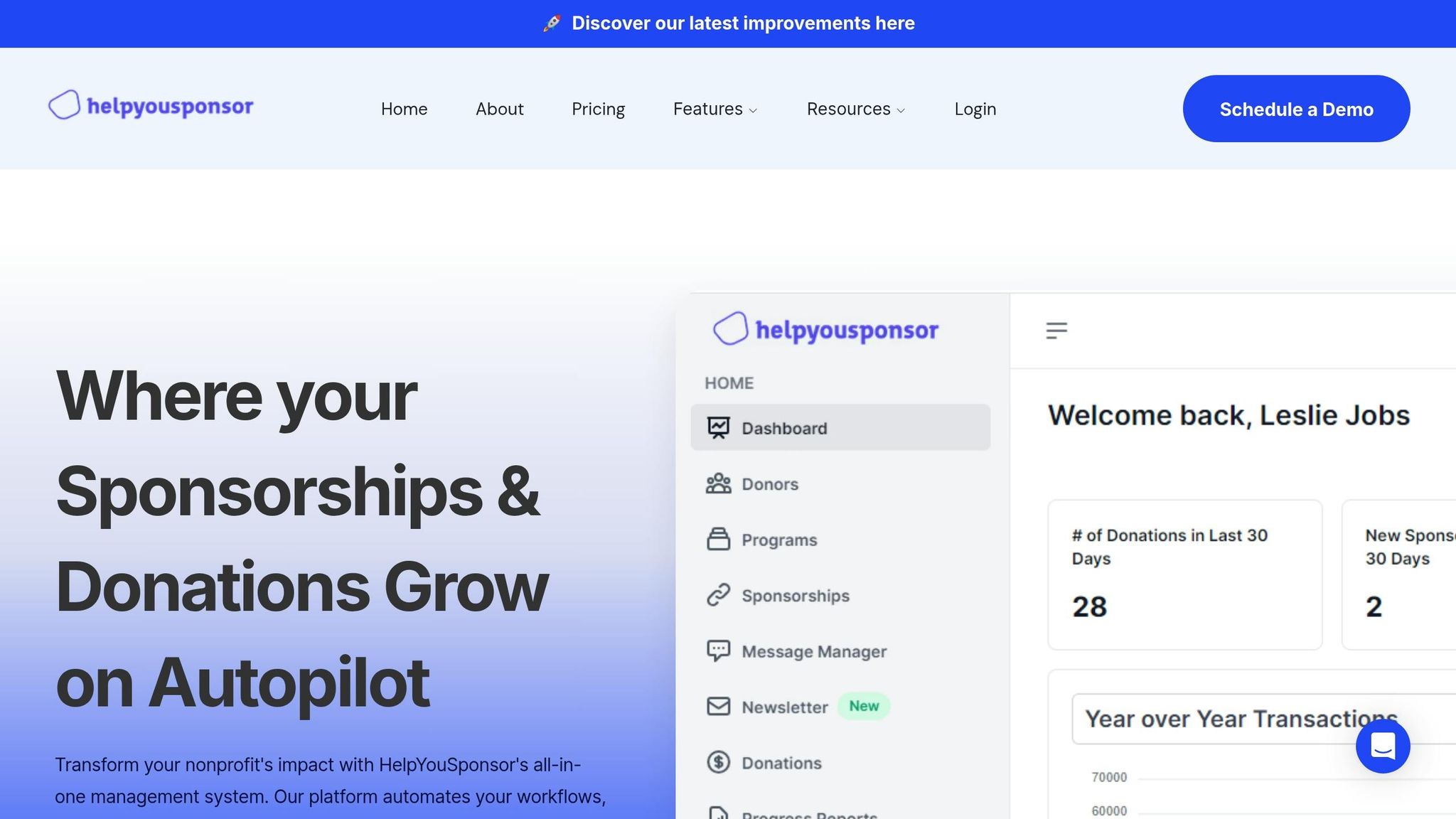
HelpYouSponsor makes it easier than ever to set up secure and streamlined donation systems with its unified platform. It's designed to simplify the entire process, from managing donor data to automating receipts.
Unified Sponsorship and Donation Management
With HelpYouSponsor, everything you need for sponsorship and donation management is in one place. The platform centralizes donor information, tracks transactions, and automates receipts to save time and reduce hassle. It supports popular payment gateways like Stripe, PayPal, Flutterwave, QPayPro, and Authorize.net, and even allows you to run a credit card gateway alongside PayPal for added donor convenience.
Getting started is quick. Just head to the "Payment Gateways" settings, connect your preferred gateway, and you’re ready to accept donations. For Stripe users, the process is even smoother - connect your Stripe account via Stripe Connect and grab your API keys (Publishable and Secret) directly through the HelpYouSponsor interface. The platform has already helped over 1,500 users manage more than $19 million in donations, automating 90% of sponsorship management tasks along the way. This efficiency makes it an excellent choice for programs like child sponsorship.
Designed for Child Sponsorship and Diverse Fundraising Initiatives
HelpYouSponsor isn’t just for one type of fundraising. While it’s tailored for child sponsorship programs, it’s also built to handle a variety of fundraising efforts, including medical surgeries, building projects, pastor support, and village development. The platform takes care of the details, automatically generating receipts, thank-you messages, and updates when a recipient’s status changes - all without manual input.
Donors also benefit from the platform’s features. They can update payment information, manage their sponsorships, and even communicate with recipients through a 24/7 messaging channel. For organizations, this streamlined approach saves an average of 20+ hours each week and boosts sponsorship rates by 3.8x.
Scalable Pricing for Every Stage
HelpYouSponsor offers flexible pricing to match your needs.
- The Free plan supports up to 10 commitments per month and includes unlimited donors and recipients.
- The Pro plan costs $50/month and can handle up to 63 commitments monthly.
- For larger programs, the Max plan charges $0.80 per commitment, offering unlimited volume, custom integrations, and priority support.
Every plan includes unlimited users and comes with a 30-day money-back guarantee. As the team at HelpYouSponsor puts it:
"Every minute spent on administration is a minute not spent changing lives".
To make things even easier, HelpYouSponsor integrates with QuickBooks for automatic financial syncing and connects to thousands of other apps via Zapier. This ensures your payment gateway works seamlessly alongside your existing tools.
Steps to Implement Payment Gateway Integration with HelpYouSponsor
Select a Payment Gateway That Works With HelpYouSponsor
HelpYouSponsor is compatible with several payment gateways, including Stripe, PayPal, Authorize.net, Flutterwave, and QPayPro. To streamline donations, activate one primary credit card gateway (like Stripe or Authorize.net) and consider adding PayPal as a secondary option for flexibility.
For U.S.-based nonprofits, Stripe is a popular choice. It supports transactions in over 135 currencies across 195 countries and offers reduced fees for 501(c)(3) organizations. To qualify for these discounts, provide your Employer Identification Number (EIN) or IRS designation letter.
If you opt for Authorize.net, ensure that the Customer Information Manager (CIM) feature is enabled to securely store donor credit card details. For those using PayPal, confirm that your organization's base currency is supported before activating it.
Choosing the right gateway ensures seamless donation processing and accurate financial tracking, which are essential for modern fundraising.
Set Up Your Account for US-Based Operations
Once you've selected your gateway, tailor your account settings for U.S. operations. Configure the system to use USD, MM/DD/YYYY date formats, and comma separators for numbers.
For Stripe users, retrieve your API keys (Publishable and Secret) from the Stripe Developer dashboard. Use the "Setup Stripe Connect" feature in HelpYouSponsor for an easy integration. Make sure your Stripe account is switched to live mode when you're ready to accept donations.
If PayPal is your choice, gather your Client ID, Secret, and Webhook ID. Set the Webhook URL to:
https://api.helpyousponsor.com/v1/paypal/webhookapi.helpyousponsor.com
Then, select the "Payment Sale Completed" event type under "Payments & Payouts".
Connect and Test Your Donation System
Integrate your chosen gateway with HelpYouSponsor by navigating to "Payment Gateways" under the "Settings" menu in the HelpYouSponsor sidebar. Enter the required credentials and enable the "Use Credit Card Processing" option in your Order Page settings.
Before going live, test your system by making a small donation. Use the Test mode provided by your payment gateway to simulate the entire process without handling actual payments. This ensures the API and webhook connections are functioning correctly.
Go Live and Track Your Results
After successful testing, switch to live mode to begin processing real donations. HelpYouSponsor will handle transaction tracking, generate donor receipts, and sync data automatically. For a complete view of your fundraising efforts, manually record offline donations like checks or cash in your dashboard.
To optimize your system, enable the fee coverage option and activate Stripe's intelligent retry feature to reduce payment failures and donor churn. Keeping an eye on these metrics in real time builds donor trust and ensures your system runs smoothly.
Conclusion
Integrating a payment gateway isn't just about adding new tech - it's about transforming how nonprofits connect with donors and sustain their missions. With 64% of donors preferring to give online and monthly donations making up 31% of online revenue, the real question isn't if you should integrate, but how quickly you can make it happen. Acting fast is crucial in today’s competitive fundraising environment.
The benefits go far beyond convenience. Automation frees up your team to focus on your mission, while integrated systems provide the security donors expect - features like PCI-compliant processing, encryption, and fraud detection. These tools build the trust necessary for long-term donor relationships. As Stripe puts it:
Charity payment processing makes it possible for nonprofit organizations to accept donations. It converts someone's desire to help into measurable impact.
Donors who give through electronic bank transfers stay 20% longer and contribute 55% more. Considering charitable giving in the U.S. is projected to hit $592.50 billion in 2024, even small improvements in donor retention and conversion rates can create a huge impact on your mission.
Operationally, integration makes life easier. For example, HelpYouSponsor simplifies payment gateway integration while combining it with sponsorship and donation management. Whether you’re handling your first $10 donation or managing thousands of recurring contributions, the right infrastructure ensures every dollar is processed securely and efficiently.
At the end of the day, successful nonprofits make giving easy, build trust, and eliminate unnecessary hurdles - exactly what payment gateway integration delivers.
FAQs
What’s the fastest way to reduce donation form drop-off?
The fastest way to cut down on donors abandoning your form is by using a single-step donation form. Multi-step forms can frustrate users, causing them to leave before completing their donation. Instead, aim for a straightforward and easy-to-navigate process that keeps donors focused and encourages them to finish their contributions.
Which payment methods should a US nonprofit offer in 2026?
Nonprofits in the US looking to streamline donation processing by 2026 should prioritize offering versatile payment options. These should include credit and debit cards, ACH bank transfers, and digital wallets like PayPal and Stripe. By providing these choices, organizations can make donating more convenient and flexible, ensuring a smooth and hassle-free experience for donors.
How do we keep donor payments secure and PCI-compliant?
To keep donor payments safe and meet PCI compliance, nonprofits need to focus on secure donation processing methods. This involves encrypting sensitive data, following PCI DSS standards, and adopting best practices like safeguarding cardholder details, ensuring systems remain secure, and routinely checking for potential vulnerabilities.