
How Nonprofits Use Impact Stories to Attract Sponsors
Nonprofits pair emotional impact stories with data and visuals to secure and sustain corporate sponsorships—tactics, case studies, and tools explained.

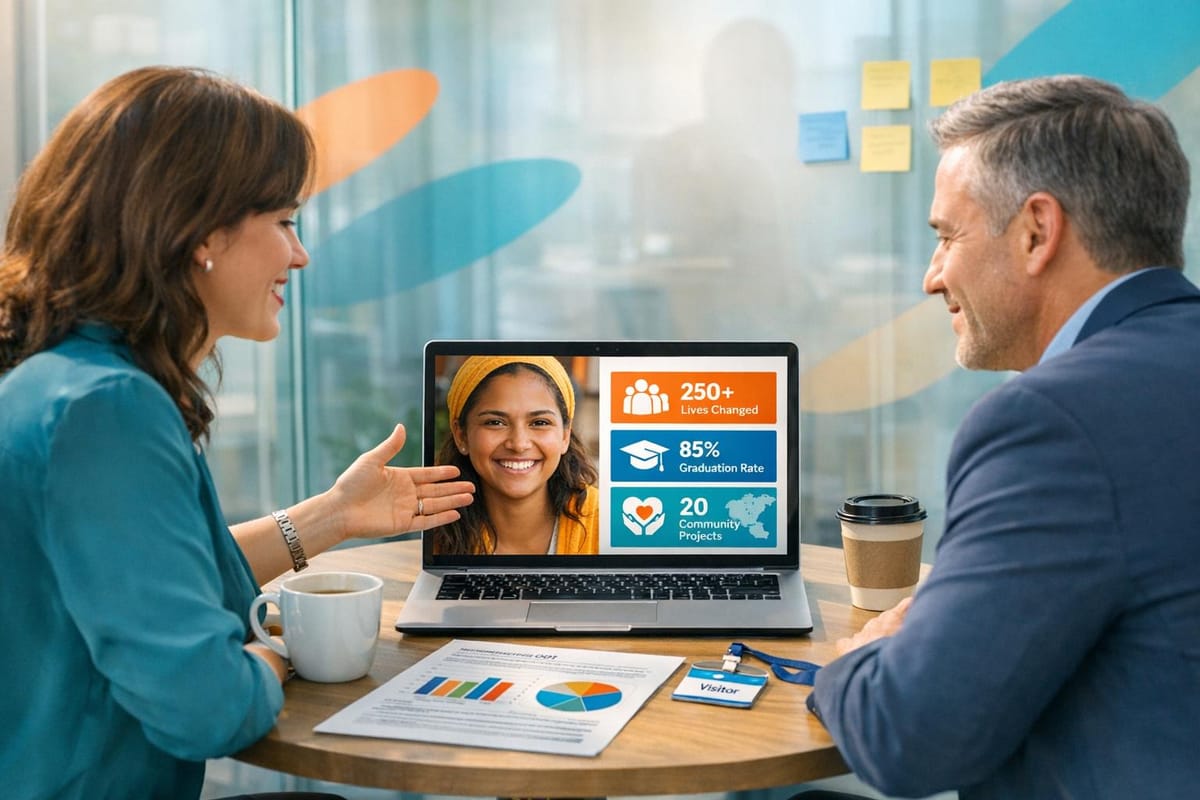
Nonprofits are using impact stories to build stronger connections with corporate sponsors. These stories combine emotional narratives with measurable outcomes to inspire support and demonstrate results.
Key Takeaways:
- Emotional Connection: Personal stories, like a child benefiting from a donated bicycle, create empathy and motivate sponsors to act.
- Data Matters: Sponsors prioritize measurable results, such as improved employment rates or community impact, to justify their investments.
- Successful Examples:
- Team Rubicon partners with brands like MTN DEW and T-Mobile, showcasing veterans aiding disaster recovery efforts.
- The Trevor Project secures sponsorships through stories of LGBTQ+ youth support, paired with awareness campaigns.
- Heifer International highlights how farming initiatives help families achieve financial independence.
Why It Works:
- Emotional stories engage sponsors by humanizing causes.
- Data-backed results validate the nonprofit's effectiveness.
- Combining both elements turns sponsorships into long-term partnerships.
Platforms like HelpYouSponsor streamline storytelling and sponsorship management, saving time and enhancing communication with sponsors. The most impactful approach blends real-life stories with clear evidence, ensuring sponsors see the value in their contributions.
Impact Storytelling Statistics: How Nonprofits Attract Corporate Sponsors
Nonprofit Storytelling: Showing Impact When Results Aren't Quantifiable
Why Impact Stories Work for Corporate Sponsors
Corporate sponsors aren't just handing over money - they're looking for partnerships that align with their values and show measurable results. Impact stories resonate because they engage the brain through "narrative transportation." This process allows readers to emotionally connect with the story, turning abstract concepts into relatable experiences. For instance, when a sponsor reads about someone overcoming a challenge, it brings a nonprofit's mission to life and provides social proof that their work is making a difference. Let’s take a closer look at how personal stories foster emotional connections with sponsors.
The Emotional Appeal: Humanizing Your Mission
Personal stories help connect corporate values with nonprofit objectives. A great example is New Leash on Life USA, which shares powerful narratives about incarcerated individuals training at-risk dogs. These stories are packed with sensory details: the sound of a dog’s first bark of trust or the pride shining on a participant’s face during a graduation ceremony. These vivid moments pull sponsors into the experience, fostering empathy that motivates action through effective donor stewardship.
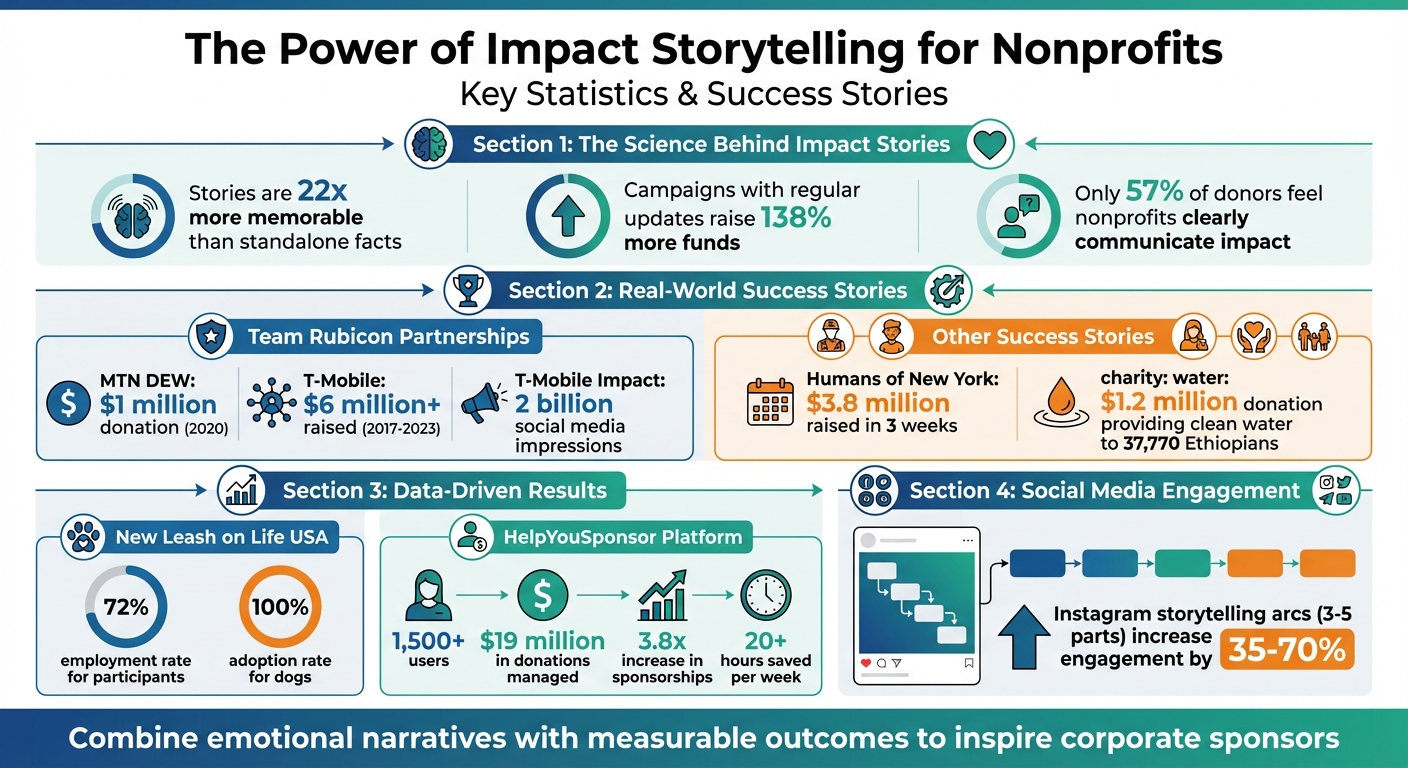
Research backs this up: sadness can increase the time people spend helping others, while empathy encourages both time and financial contributions. Take Humans of New York, for example. By highlighting stories of children battling cancer, they raised an astonishing $3.8 million in just three weeks. This success taps into what experts call the "identifiable victim" technique, where a single, relatable story can inspire large-scale support.
Once an emotional connection is made, nonprofits can strengthen it by presenting data that proves their impact.
Data-Driven Impact: Showing Measurable Results
While emotion grabs attention, data seals the deal. Corporate sponsors need hard numbers to justify their investment to stakeholders. For instance, New Leash on Life USA doesn’t just tell compelling stories - it backs them up with impressive metrics: a 72% employment rate for participants and a 100% adoption rate for dogs. These figures give emotional stories the credibility sponsors need.
The most effective strategy blends emotion and data seamlessly. Start with a story that sparks empathy, then follow it with metrics that validate the nonprofit’s success. Consider the example of charity: water. When they shared 9-year-old Rachel Beckwith’s story about her wish to provide clean water, it inspired $1.2 million in donations. The result? Clean water access for 37,770 Ethiopians. This combination of emotional storytelling and concrete results demonstrates to sponsors that their contributions have a real, measurable impact.
Case Studies: Nonprofits Using Impact Stories to Secure Sponsorship
Examples from the nonprofit world show how powerful storytelling can turn engagement into sponsorships. These case studies highlight how blending emotional narratives with measurable impact can attract corporate partners.
Team Rubicon: Veteran-Led Disaster Relief Stories
Team Rubicon's sponsorship strategy revolves around a compelling story: veterans and first responders, known as "Greyshirts", continuing their service by aiding communities after natural disasters. This narrative resonates with companies eager to support everyday heroes.
In August 2020, MTN DEW launched its second "Fuel The Mission" campaign with a $1 million donation. The campaign featured one-liter bottles and multipacks nationwide, spotlighting "low attention disasters" often ignored by mainstream media. MTN DEW also collaborated with craftsmen Nick Terrel and Jason Podlaski to create custom goods from salvaged disaster materials. Nicole Portwood, Vice President of Marketing at MTN DEW, explained the campaign's purpose:
"Dew Nation has always honored heroes who serve communities across the country, so we wanted to shine a light on the ultimate doers on the front lines of disaster relief – Team Rubicon."
T-Mobile's "Home Runs for Hurricane Recovery" campaign, launched in 2017, pledged $10,000 per home run and $1 for every social media post, raising over $1 million by 2018. By 2023, T-Mobile had raised more than $6 million for Team Rubicon's disaster recovery efforts. The campaign also generated 2 billion social media impressions in its first year, including 46.5 million on Twitter and 776,000 direct mentions. Art delaCruz, CEO of Team Rubicon, acknowledged the partnership's importance:
"T-Mobile's support of our mission has been critical to Team Rubicon's growth and impact since we first joined forces."
The Home Depot Foundation has partnered with Team Rubicon for over a decade, contributing millions in grants and volunteer support. In 2022, they mobilized 150 volunteers for Hurricane Ian relief in Florida, utilizing their nationwide supply chain to deliver materials to Greyshirts. Jake Wood, Team Rubicon's Co-Founder and Executive Chairman, emphasized the shared values behind the partnership:
"Culture really matters to us, and we've found a real alignment in values, beliefs, and purpose for doing this with Team Depot."
The Trevor Project: Stories of LGBTQ+ Youth Support
The Trevor Project uses personal testimonials to connect with sponsors, focusing on their crisis intervention work for LGBTQ+ youth. These stories, centered on acceptance and suicide prevention, have been instrumental in securing corporate backing.
In June 2019, SoulCycle partnered with The Trevor Project for Pride Month, launching the "Ride as you are. Love as you are" campaign. A portion of proceeds from a special class pack - 10% - was donated directly to the nonprofit.
Abercrombie & Fitch also teamed up with The Trevor Project, designing a limited-edition, gender-neutral clothing line for Pride. Alongside a $200,000 donation, the collection helped raise awareness of the nonprofit's mission and encouraged conversations about inclusivity.
Heifer International: Transforming Farmers' Lives
Heifer International focuses its sponsorship efforts on stories of sustainable farming and poverty reduction. Their narratives highlight how providing livestock and agricultural training can transform entire communities, moving families from poverty to self-sufficiency.
The organization has successfully partnered with agricultural cooperatives by aligning with shared goals of sustainable farming and economic empowerment. By showcasing measurable outcomes, such as families achieving financial independence through farming, Heifer International provides sponsors with clear evidence of their impact.
Storytelling Techniques to Attract Corporate Sponsors
Nonprofits can take their storytelling to the next level by using emotional appeal and data-driven insights to connect with corporate sponsors in meaningful ways.
Highlighting Shared Values and Mission Alignment
The best sponsorships come from a shared sense of purpose. To stand out, connect your nonprofit’s story to the sponsor's mission. For instance, if a company prioritizes family values, reference that directly in your pitch: "Your mission statement mentions family, which reminded me of this client testimonial". This approach transforms standard outreach into a personalized conversation about mutual goals.
Take Jack Link's Protein Snacks and Team Rubicon as an example. Jack Link's sponsored a national survey on the long-term effects of natural disasters, helping Team Rubicon educate donors about disaster relief misconceptions. They even matched donations dollar-for-dollar on National Jerky Day. This partnership worked because both organizations shared a commitment to educating the public and providing practical support.
Using Stories of Beneficiary Impact
Stories of those directly impacted by your nonprofit make your mission tangible. The key is to highlight resilience and potential - not just hardships. As Sandy Rees, Founder of Get Fully Funded, puts it:
People give to things with 'eyes and teeth'
. In other words, donors and sponsors connect more with real people than abstract causes.
Craft these stories with a clear structure: introduce a relatable character, present their problem, show how your nonprofit provided a solution, and share the positive outcome. For example, rather than saying, "We help children get to school", share Carlos’s story. Carlos, a 10-year-old, used to walk two hours to school every day. Thanks to your bicycle program, his commute is now just 30 minutes, giving him more time to study and play with friends. Campaigns that keep sponsors updated on beneficiaries' progress tend to raise up to 138% more funds than those without updates.
Pair these human-centered stories with visuals and data to make an even stronger case.
Adding Visual and Data-Driven Elements
Visuals are powerful tools for storytelling. Research shows that stories are remembered up to 22 times more than standalone facts, and visual stories are even more impactful. Carly Euler, Marketing Manager at MemoryFox, explains:
A story told by visuals pulls at the heartstrings in a big way
.
However, visuals alone aren’t enough. Combine them with data to add credibility. Juliet Ruggiero, Program and Marketing Coordinator at IMPACT Parks, emphasizes the importance of turning raw numbers into narratives that reveal insights about broader campaigns. Use the "1, 2 Combo" strategy - pair emotional impact stories with specific data points - to strengthen sponsorship applications.
Maximize your reach by repurposing one strong impact story across multiple formats: blog posts, email campaigns, social media updates, and video clips. Short teaser videos and branded landing pages can highlight beneficiary progress. Tagging sponsors on social media when sharing these stories not only showcases your work but also boosts their brand visibility. On platforms like Instagram, using 3–5 part storytelling arcs in Reels can increase engagement by 35% to 70% compared to single posts.
How HelpYouSponsor Supports Storytelling and Sponsorship Management
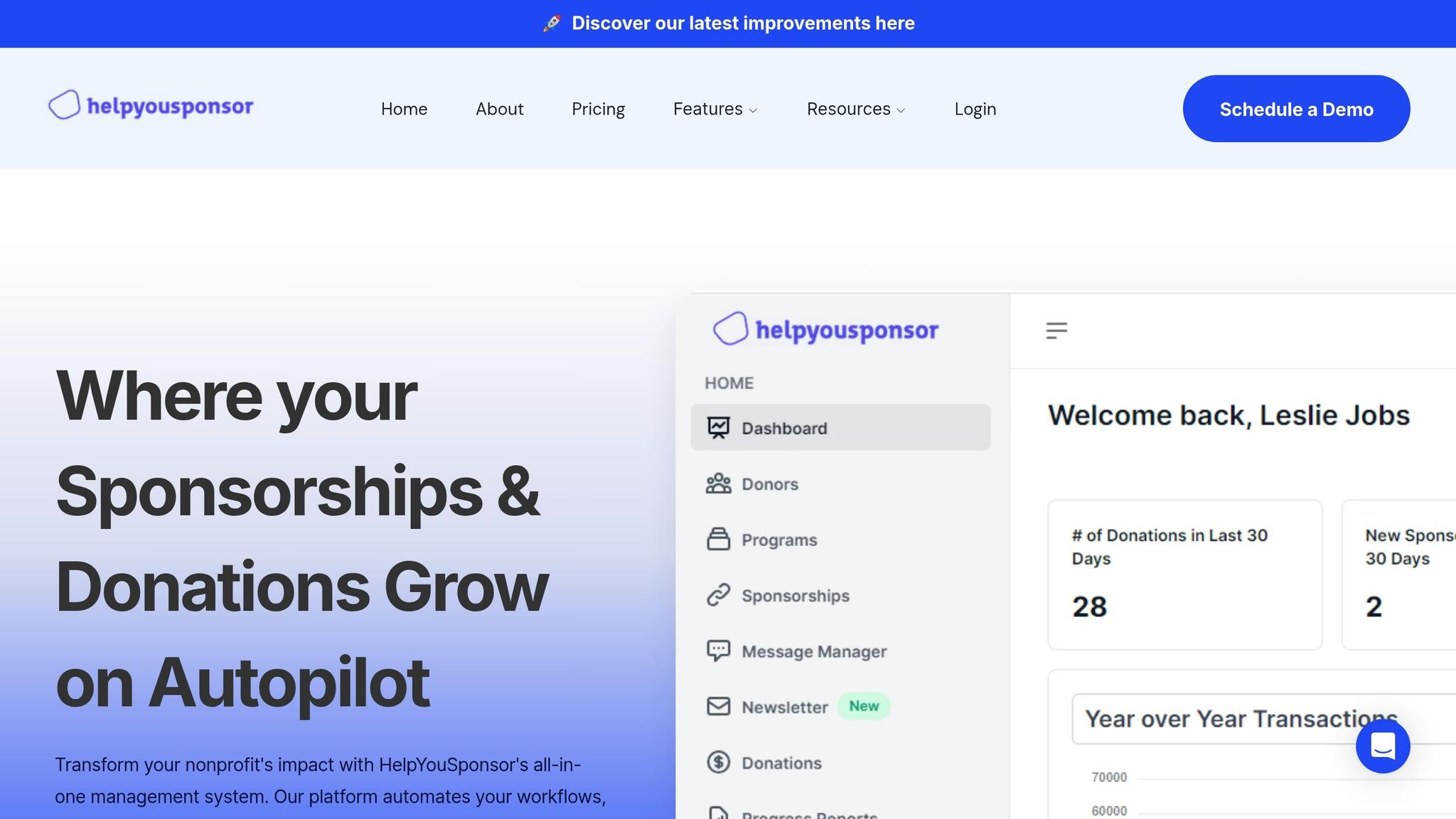
HelpYouSponsor combines the art of storytelling with practical tools for sponsorship management, helping nonprofits communicate their mission effectively while handling sponsorships with ease. By integrating these two aspects, the platform empowers organizations to share their impact in ways that resonate with corporate sponsors while streamlining administrative tasks.
Managing Sponsorships More Efficiently
Administrative tasks can eat up countless hours, but HelpYouSponsor simplifies the process, saving nonprofits over 20 hours each week. The platform has helped more than 1,500 users manage over $19 million in donations, boosting sponsorships by 3.8x. It automates key processes like sponsor-recipient matching, real-time tracking, and communication - whether the focus is on child sponsorships, medical funding, or construction projects.
Improving Storytelling Through Data Integration
A common challenge for nonprofits is clearly communicating the impact of donations - only 57% of online donors feel this is done effectively. HelpYouSponsor tackles this with automated impact reporting, which delivers personalized updates to sponsors. The platform also includes tools for sharing recipient stories, complete with photos and progress updates, to create the emotional connections that corporate sponsors value.
Nonprofits can set up 4–6 preset donation tiers with clear explanations of how contributions are used, making the impact immediately understandable. Additionally, "Trip Pages" act as branded, mobile-friendly fundraising hubs that showcase project goals, stories, and real-time progress, turning data into engaging narratives.
These features not only enhance storytelling but also strengthen donor engagement, helping nonprofits grow and thrive.
Features Designed for Nonprofit Growth
HelpYouSponsor includes tools that keep sponsors connected and engaged. Its integrated messaging system and automated email campaigns ensure consistent communication, while customizable dashboards provide real-time tracking and detailed progress reports. A donor self-service portal reduces administrative burdens, and website integration makes it easy to showcase sponsorship opportunities directly on your site. Plus, smooth payment gateway connections simplify donation processing.
Conclusion
Impact storytelling has shown to be a powerful way for nonprofits to engage and keep corporate sponsors. Research highlights that visual stories are 22 times more memorable than standalone facts, and nonprofits that share regular updates can see funding increases of up to 138%. By blending emotional narratives with measurable results, organizations can present the kind of persuasive case that sponsors need to validate their investment.
As Sandy Rees insightfully states:
People give to things with 'eyes and teeth'.
This underscores the importance of humanizing your mission with real beneficiary stories while pairing them with solid data. Whether it’s Team Rubicon’s efforts deploying veterans to disaster zones or Heifer International’s work improving farmers’ livelihoods, the most effective stories combine emotion and evidence.
Technology further supports impact storytelling. Platforms like HelpYouSponsor simplify the process with features like mobile uploads, automated reporting, and personalized communications. This allows nonprofits to share timely and genuine content without getting bogged down by administrative tasks.
FAQs
How do you turn one impact story into sponsor-ready proof?
To craft a sponsor-ready impact story, focus on making it specific, measurable, and emotionally engaging. Start by highlighting the journey of one individual - this personal touch helps build a connection with your audience. Use visuals like photos or videos to make the story more vivid and relatable.
Don’t forget to include measurable outcomes or concrete evidence of positive change. This demonstrates your nonprofit’s effectiveness and builds credibility. By blending emotional appeal with clear, tangible results, you create a story that resonates deeply with potential sponsors.
What metrics do corporate sponsors care about most?
Corporate sponsors focus on metrics that highlight measurable impact, visibility, and audience engagement. They’re particularly interested in data that proves how a sponsorship aligns with their brand values while effectively connecting with their target audience. This information helps them evaluate their return on investment and gauge the success of the partnership.
How can HelpYouSponsor automate sponsor updates and reporting?
HelpYouSponsor simplifies the process of keeping sponsors informed by offering features like real-time dashboards, automated updates, and data synchronization. These tools cut down on manual tasks, improve accuracy, and ensure sponsors receive timely updates about their impact. By using these features, nonprofits can save time, stay organized, and build stronger relationships with their sponsors.