
How Nonprofits Use Automation to Manage Sponsorships
Learn how automating sponsorships reduces errors, saves staff time, boosts donor retention and fundraising, and integrates payments and CRM workflows.

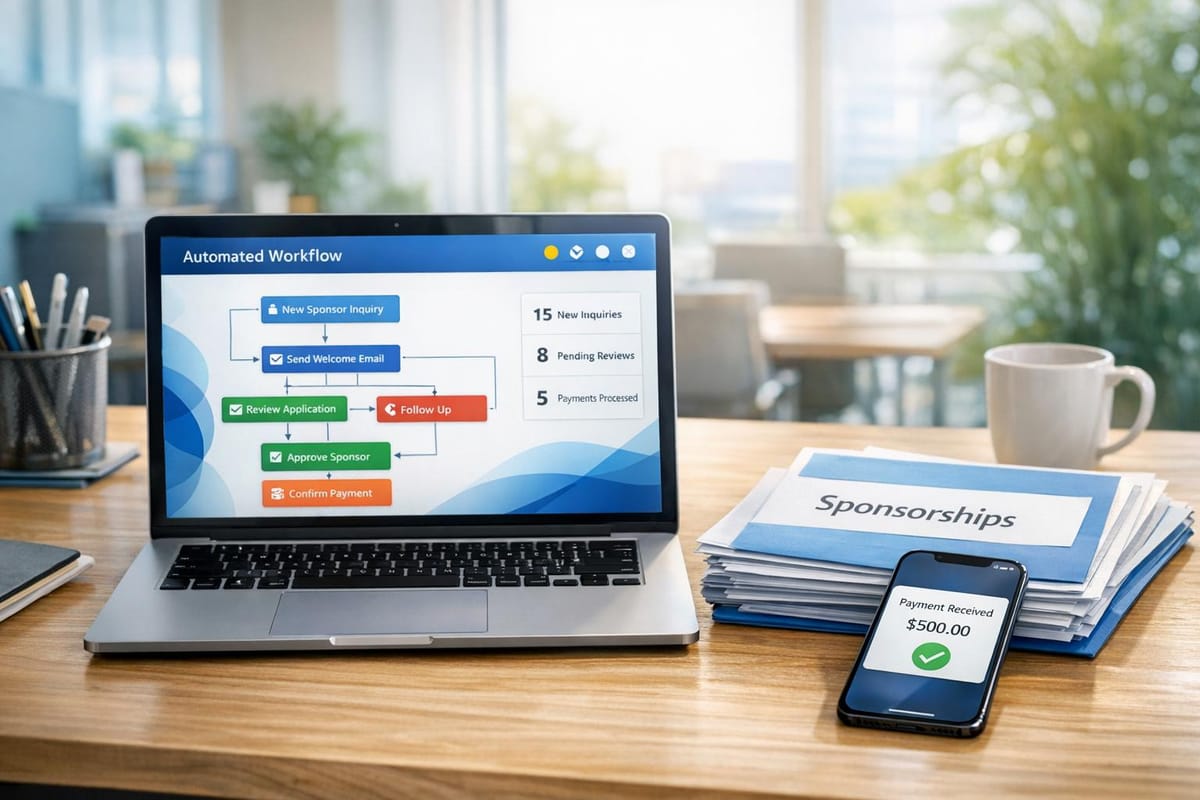
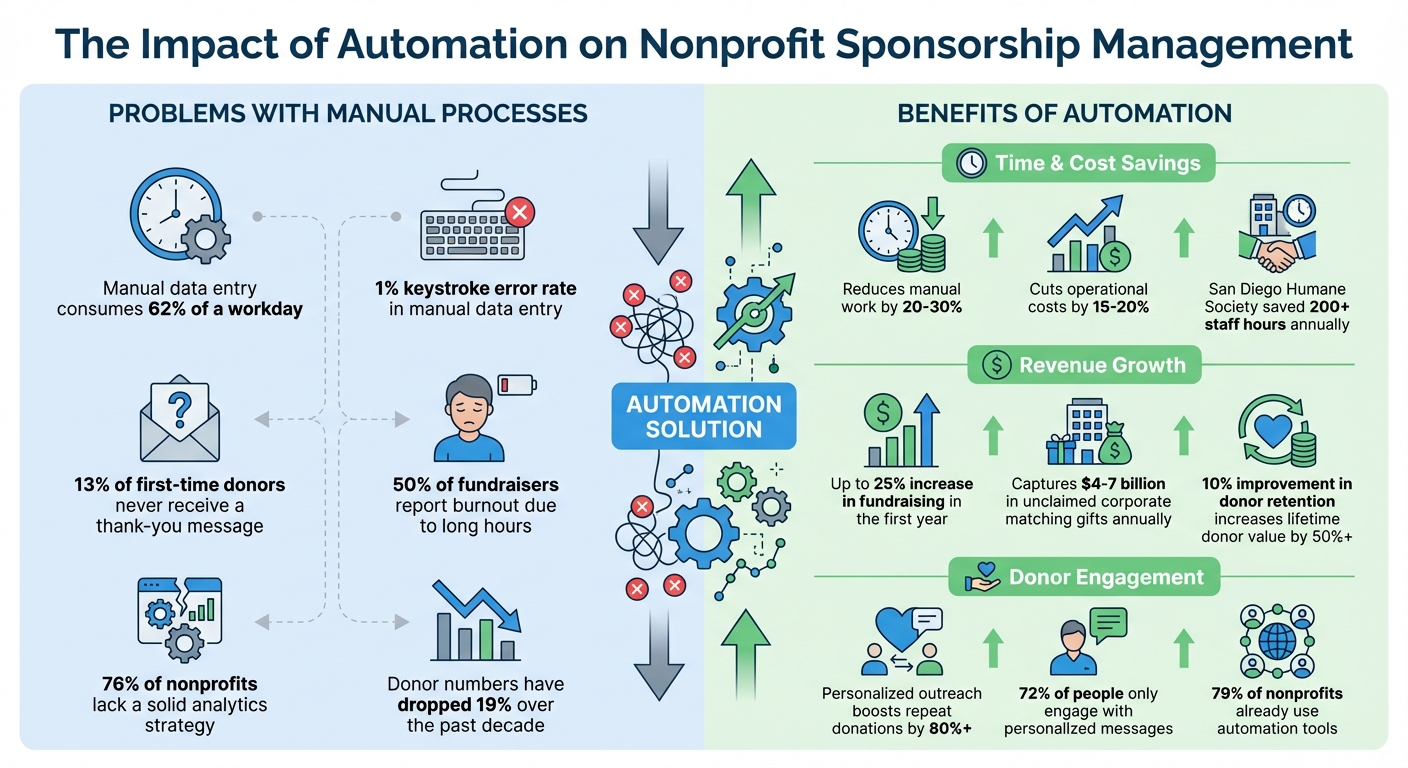
Nonprofits are increasingly turning to automation to handle sponsorships, saving time and reducing errors. Manual processes like data entry, donation tracking, and communications can consume 62% of a workday and come with a 1% keystroke error rate. Automation addresses these inefficiencies while improving donor retention and financial stability. Here's how:
- Time Savings: Automating recurring donations and communications saves hundreds of hours annually, as seen with the San Diego Humane Society, which saved 200+ staff hours by automating monthly charges.
- Error Reduction: Automated systems use validation rules and real-time syncing to minimize errors in data and records.
- Stronger Donor Relationships: Personalized, automated outreach boosts repeat donations by over 80% and builds trust through timely updates.
- Increased Revenue: Automation helps nonprofits capture unclaimed corporate matching gifts, potentially worth $4–$7 billion annually, and improves fundraising by up to 25% in the first year.
Automation tools also streamline payment processing, centralize data tracking, and integrate seamlessly with CRMs and payment gateways. Whether managing 50 or 5,000 sponsorships, nonprofits can cut operational costs by 15–20% and focus more on their mission by adopting the right platforms.
How Nonprofit Automation Reduces Costs and Increases Fundraising Revenue
What Is Sponsorship Automation?
Defining Sponsorship Automation
Sponsorship automation simplifies the ongoing relationship between sponsors and beneficiaries by handling repetitive tasks like managing recurring commitments, sending tailored updates, and keeping detailed records. While general fundraising automation focuses on broader tasks - such as issuing tax receipts or thank-you emails after one-time donations - sponsorship automation is specifically designed for long-term commitments.
Unlike one-time donors who contribute occasionally, sponsors provide consistent support, which requires systems that can handle recurring payments, maintain sponsor-beneficiary connections, and deliver personalized updates. As Justin Wheeler, CEO and Co-founder of Funraise, explains:
"As social interactions have gone digital, donations have moved into the digital realm as well, making it imperative that nonprofits evolve their ability to accept those digital donations".
These automated tools help address the manual errors and inefficiencies that are common in traditional sponsorship management.
Problems That Automation Solves
Managing sponsorships manually comes with a host of challenges. Staff often spend countless hours processing recurring payments, updating records, and ensuring communications are accurate. This time-intensive process is prone to errors - incorrect addresses can lead to undelivered updates, and mismatched records make it difficult to track the impact of contributions.
Data silos add another layer of complexity. When fundraising and finance teams use separate systems, discrepancies in recurring donation records can cause confusion and inefficiency. Automation eliminates these barriers by centralizing data, streamlining workflows, and allowing nonprofits to focus on building stronger relationships with sponsors. For example, missed payments can trigger automated, timely reminders, replacing inconsistent manual follow-ups. This is especially important when nearly 50% of fundraisers report burnout due to long hours and limited support, an issue automation helps alleviate by taking over routine tasks.
With sponsorship automation, all data is stored in one centralized system. Recurring donations are processed automatically, expired payment details are updated seamlessly, and staff are notified only when their involvement is essential. Built-in validation rules and standardized data fields reduce the chance of errors before they even happen. The outcome? Nonprofits can cut operational costs by 15–20% while delivering the personalized experience that sponsors expect.
How Automation Improves Sponsorship Management
Automated Donor Communication
Automation has completely reshaped how nonprofits communicate with their sponsors, saving time while strengthening relationships. By delivering personalized messages at scale, it eliminates the need for manually crafting individual emails. For example, when a new sponsor signs up, automated systems can immediately send receipts and heartfelt thank-you messages. This is a big deal, especially considering that 13% of first-time donors never receive a thank-you message.
Personalization is key to keeping sponsors engaged. Automation tools can use merge fields to include details like the sponsor's name, donation amount, and the specific child or project they’re supporting. These small touches make the messages feel personal, which is crucial since 72% of people say they only engage with personalized marketing messages. Nonprofits can also create automated "Welcome Series" workflows, guiding new sponsors through a series of emails over several weeks. These might start with a thank-you note, followed by stories about the impact of their contributions, and finish with an invitation to join a monthly newsletter.
Behavior-based triggers take things up a notch. For instance, follow-up emails can be sent when a sponsor clicks on a link, attends an event, or reaches a donation milestone. These timely, relevant messages make a big difference: personalized outreach can boost repeat donations by over 80%. Scheduled updates also ensure sponsors know exactly how their contributions are being used, building the trust that turns one-time donors into loyal, long-term supporters.
But automation doesn’t just stop at communication - it also simplifies payment processes.
Payment Processing and Recurring Donations
Recurring donations are the backbone of financial stability for nonprofits, allowing them to plan programs and staffing more effectively. Automation ensures these recurring payments are processed smoothly, handling tasks like monthly charges, issuing tax-compliant receipts instantly, and updating donor records in real time. This eliminates manual data entry, which often comes with a 1% error rate per keystroke, ensuring accurate financial tracking.
One standout feature is automated payment recovery (also known as dunning management). If a credit card expires or a payment fails, the system automatically retries the transaction at optimal times and sends notifications to sponsors, prompting them to update their payment details. This significantly reduces the number of donors lost due to technical issues.
Self-service portals further enhance the experience by allowing sponsors to update payment methods, adjust donation amounts, and access receipts on their own. This level of control improves donor retention while freeing up staff to focus on building relationships instead of dealing with administrative tasks. The financial benefits are clear: nonprofits using integrated payment automation can see up to a 25% increase in funds raised during their first year. The result? Fewer errors, smoother operations, and a more engaged donor base.
Data Tracking and Reporting
Automation doesn’t just streamline communication and payments - it also centralizes data tracking, creating a single hub where information from donation forms, payment systems like Stripe or PayPal, and email platforms is updated in real time. Dashboards provide instant access to metrics like donation volume, average gift size, and conversion rates. This allows nonprofits to spot trends and adjust strategies on the fly, without waiting for monthly reports cobbled together from spreadsheets.
Tracking contributions alongside expenses also helps demonstrate ROI and the impact of donations. Advanced systems even use predictive analytics to identify sponsors who might increase their contributions or are at risk of lapsing, enabling nonprofits to reach out proactively. This is especially important given that 76% of nonprofits currently lack a solid strategy for using analytics. Organizations that embrace automation gain a clear competitive edge.
Automated reporting also simplifies stakeholder communications. Instead of spending hours compiling data manually, nonprofits can generate progress reports for board meetings, grant applications, or donor updates in just a few clicks. This reduces manual work by 20–30% and cuts costs by 15–20%. More importantly, improving donor retention by just 10% can increase the lifetime value of a donor base by 50% or more, making data tracking one of the most impactful ways to use automation effectively.
Connecting Automation with Your Existing Systems
Website and CRM Integration
Integrating automation tools with your website and CRM helps eliminate duplicate work and ensures your data stays accurate. When done right, this integration allows sponsor details entered on your website to show up instantly in your CRM - no manual entry required.
Most nonprofits already juggle several tools, like a WordPress website, a donor database, and an email platform. In fact, research indicates that 79% of nonprofits already use automation tools. Many rely on no-code solutions like Zapier or Make to connect these systems. These tools act as bridges, enabling website forms to share information with your CRM. For instance, when a sponsor updates their payment details through a self-service portal, that update syncs automatically to your CRM and accounting software within minutes.
To ensure everything functions smoothly, create a data entry style guide. This guide should standardize how information is formatted across all your systems - whether you use "St." or "Street" in addresses, how dates are formatted (MM/DD/YYYY), and how currency is displayed (e.g., $1,500.00). The Nonprofit Leadership Alliance underscores the importance of this approach:
"Data standardization is essential for nonprofits to effectively manage their donor data and make data-driven decisions".
Assign team members to oversee specific data areas - someone for contact details, another for donation records - so there’s clear accountability if issues arise.
Once your website and CRM are connected, the next step is ensuring your payment systems integrate just as seamlessly.
Payment Gateway Compatibility
Your automation tools must work effortlessly with payment gateways like Stripe, PayPal, or Square to handle donations securely and efficiently. A strong integration extends the smooth data flow between your website and CRM to financial transactions. When set up correctly, details like transaction histories, billing addresses, and payment statuses sync automatically to your CRM, eliminating the need for manual data entry.
Before moving forward, confirm that your payment processor is PCI-compliant and uses encryption to safeguard donor information. Set up field mapping to connect fields from your payment gateway (like "Transaction Amount") to the corresponding fields in your sponsorship programs. Testing with 100–200 sample records - covering scenarios like major donors, recurring sponsors, and first-time givers - can help identify any issues, such as missing fields or truncated text, before you go live.
Adjust your sync frequency based on activity levels: during busy periods, syncing every 15–30 minutes works best, while hourly syncing is fine for quieter times. The benefits are hard to ignore: nonprofits can see up to a 25% increase in fundraising within the first year of using integrated systems, all while cutting time spent on administrative tasks by 20–30%.
How to Choose an Automation Platform
What to Look for in a Platform
When selecting an automation platform, ease of use should be at the top of your list. Look for tools with user-friendly dashboards that simplify your day-to-day tasks and reduce the effort spent on repetitive processes.
Data analytics capabilities are equally important. Advanced reporting tools can help you uncover giving patterns and identify major donors before they go unnoticed. Many modern platforms incorporate AI to analyze historical data, making it easier to predict which donors might increase their contributions. Security is another critical factor - ensure the platform is PCI compliant, uses encryption, and provides restricted access controls for payment handling.
Pricing models are another area to scrutinize. Some platforms charge per user, others per transaction, and some base costs on the size of your contact database. Think of this as an investment rather than just an expense. Additionally, if you're a nonprofit, inquire about discounts - many platforms offer reduced rates for 501(c)(3) organizations.
Ultimately, your choice should align with your organization's size and specific needs.
Matching Tools to Your Organization's Needs
For smaller nonprofits managing fewer than 100 sponsorships, simplicity and affordability should guide your decision. Focus on platforms offering essential features like donor tracking, automated thank-you emails, and basic reporting. A pricing model based on commitments - such as $0.80 per commitment - may be more budget-friendly than fixed monthly fees when you're just getting started.
If your organization is growing and handling between 100 and 500 sponsorships, prioritize scalability and integration. Choose a platform that integrates seamlessly with your existing CRM and email marketing tools. Look for features that automate recurring donations and generate actionable insights. Since improving donor retention by just 10% can increase lifetime donor value by over 50%, tools that enable personalized communication at scale are a must.
For larger nonprofits managing complex programs, customization and advanced analytics are key. Seek platforms with API access, custom workflows, and predictive analytics. The ability to segment donors by factors like engagement level, donation history, and communication preferences is crucial. Considering that 72% of people engage only with personalized messages, your platform should make sophisticated targeting easy without requiring excessive manual effort.
Child Sponsorship Program Tools
Conclusion
Automation takes the hassle out of sponsorship management by cutting down on manual tasks and reducing mistakes. With 79% of nonprofits already using automation tools, the impact is clear: it can shave off 20–30% of manual work and trim operational costs by 15–20%. This means less time spent on repetitive tasks - which can eat up 62% of a workday - and more time dedicated to building donor relationships and focusing on strategic goals.
Automated systems don't just save time; they also ensure accuracy. From maintaining precise donor records to sending reliable communications, automation helps organizations engage donors consistently. This, in turn, boosts donor retention. In fact, nonprofits using integrated automation platforms have seen fundraising increases of up to 25% within their first year.
These improvements aren't just about saving time - they're about staying ahead in a competitive fundraising environment.
"Automation isn't just about efficiency - it's a way to stay competitive in today's fundraising landscape." - HelpYouSponsor
To get started, identify the manual processes that slow down your sponsorship program. Begin by automating high-impact tasks like donation processing, thank-you emails, and data tracking. Once these are in place, you can expand further. Whether you're managing 50 or 5,000 sponsorships, the right automation platform should fit your organization's size, budget, and objectives while working seamlessly with your current systems.
With donor numbers having dropped by 19% over the past decade, choosing the right technology isn't just a smart move - it’s a necessary one. By adopting tools that align with your mission, you'll be better equipped to protect and grow your donor base while driving your goals forward.
FAQs
How does automation help nonprofits retain donors?
Automation plays a key role in helping nonprofits maintain strong donor relationships by simplifying communication, improving accuracy, and saving valuable time. Take this example: when someone makes a donation, automated workflows can immediately log the contribution, update the donor’s profile, and send out a personalized thank-you email or receipt. This not only ensures donors feel valued but also provides them with a clear, tax-deductible record in U.S. dollars.
Automated tools can also handle regular outreach, like sending segmented newsletters, reminders for donation anniversaries, or updates on how contributions are making an impact. These consistent touchpoints keep donors engaged without requiring staff to manually manage every interaction. Plus, automation helps eliminate errors in donor records, ensuring contact details and giving histories are always accurate. With fewer administrative tasks to juggle, nonprofit staff can dedicate more time to fostering deeper connections with supporters, creating a more rewarding experience that inspires long-term commitment.
What features should a nonprofit look for in a sponsorship automation platform?
When selecting a sponsorship automation platform, focus on features that streamline your workflows and strengthen connections with donors. Key tools to consider include donor tracking features to organize sponsorship details and histories, as well as automated communication tools like email workflows to keep donors updated without extra effort. Integration with a CRM system is also important to consolidate your data in one place.
Additionally, you'll want financial and reporting tools to monitor payments and gain valuable insights. Make sure the platform can scale with your organization, so it continues to meet your needs as you grow. And don’t overlook a user-friendly interface - it can save your team time and make adoption smoother for everyone.
How can automation help nonprofits save money on sponsorship management?
Automation offers nonprofits a way to cut costs by streamlining repetitive tasks. Think about processes like entering donor information, generating receipts, or sending personalized thank-you notes - automation can handle these efficiently, reducing manual work by 20-30% and trimming operational expenses by 15-20%. Plus, it helps avoid common errors, saving time spent on corrections and keeping records accurate.
When it comes to payment processing, automation can lower transaction fees and prevent problems like duplicate payments. Tools that provide real-time reporting also eliminate the need for manually creating reports, giving staff more time to focus on the organization's core mission. These improvements help nonprofits make the most of their budgets, achieving more with the resources they already have.