
How Nonprofits Achieve Steady Sponsorship Income in 2026
Practical tactics to build predictable sponsorship revenue: recurring giving, donor retention, digital payments, automation, and financial planning for nonprofits.


Nonprofits in 2026 face increasing financial challenges, but achieving steady sponsorship income is possible with the right strategies. Here's what you need to know:
- Focus on Recurring Donations: Monthly "sustainer" donors have nearly 90% retention rates, compared to 45% for one-time donors. This stability reduces fundraising costs and ensures predictable income.
- Assess Revenue Stability: Use metrics like Monthly Recurring Revenue (MRR) and churn rate to identify risks and opportunities. Avoid relying on a single funding source for more than 25% of your income.
- Engage Donors Effectively: Personalized communication, regular updates, and tools like HelpYouSponsor can improve retention while automating repetitive tasks. Retaining donors costs significantly less than acquiring new ones.
- Offer Flexible Sponsorship Models: Child-centered, community-based, and tiered sponsorships provide options for donors at different levels. Clear payment schedules and upgrade paths can encourage consistent contributions.
- Leverage Digital Tools: Accept digital wallets like PayPal and Apple Pay, and make monthly giving the default option to increase recurring donations.
Recurring Donations: How to Boost Donor Retention and Revenue | Ep 140
How Nonprofits Assess Their Current Sponsorship Revenue
To improve sponsorship stability, you first need a clear picture of where you currently stand. Focusing solely on annual revenue can be misleading, as it doesn’t reveal how predictable or sustainable your funding really is. A detailed assessment helps identify both strengths and vulnerabilities.
Take a closer look at your revenue sources. For instance, an organization that reports $120,000 in sponsorship income might seem financially stable - until you realize $80,000 of that comes from just two corporate sponsors whose contracts expire in March. Relying heavily on a small number of sponsors puts your programs at risk if those partnerships end. A helpful guideline is the 25% rule: no single funding source should contribute more than 25% of your total income. This kind of analysis sets the stage for more strategic revenue planning.
Metrics That Show Sponsorship Stability
Tracking certain metrics can give you a clearer picture of your revenue’s reliability. One key metric is Monthly Recurring Revenue (MRR). To calculate this, multiply the monthly contribution amount by the number of active sponsors. For example, if 150 sponsors each give $35 per month, your MRR would be $5,250. Keeping an eye on changes in MRR can help you identify trends or potential problems early.
Another important metric is the churn rate, which measures how many sponsors stop contributing over a given period. For example, if you start the month with 200 sponsors and lose 8, your churn rate is 4%. A high churn rate could signal deeper issues with sponsor engagement that need attention.
You should also look at average sponsorship duration - how long sponsors typically stay active. This metric offers insights into the long-term stability of your revenue. Breaking this data down by sponsor type (such as individual versus corporate) can uncover patterns that may help you refine your approach to engagement.
How to Find Weak Points in Your Revenue
Spotting gaps in your cash flow is critical for maintaining financial stability. Compare your monthly expenses to your incoming revenue. For example, if your program costs $8,000 per month but only generates $6,000, that $2,000 shortfall could quickly drain your financial reserves. This is especially concerning for programs like child sponsorships, which come with long-term commitments.
Diversifying payment options can also strengthen your revenue stream. Nonprofits that accept alternatives like stocks or securities have seen growth of 66% in recent years, compared to just 11% for those that rely solely on cash donations. Offering flexible payment methods can make a noticeable difference in your funding consistency.
Tools like HelpYouSponsor’s dashboards can simplify this process. They track MRR trends, flag at-risk sponsors, and highlight preferred payment methods, allowing you to address potential issues before they escalate.
Lastly, building a financial safety net is essential. Aim to save three to six months’ worth of operating expenses as a buffer against unexpected revenue drops. For example, if your monthly costs are $8,000, you should aim to set aside $24,000–$48,000 to safeguard your operations during challenging times.
How to Design Sponsorship Models for Consistent Revenue
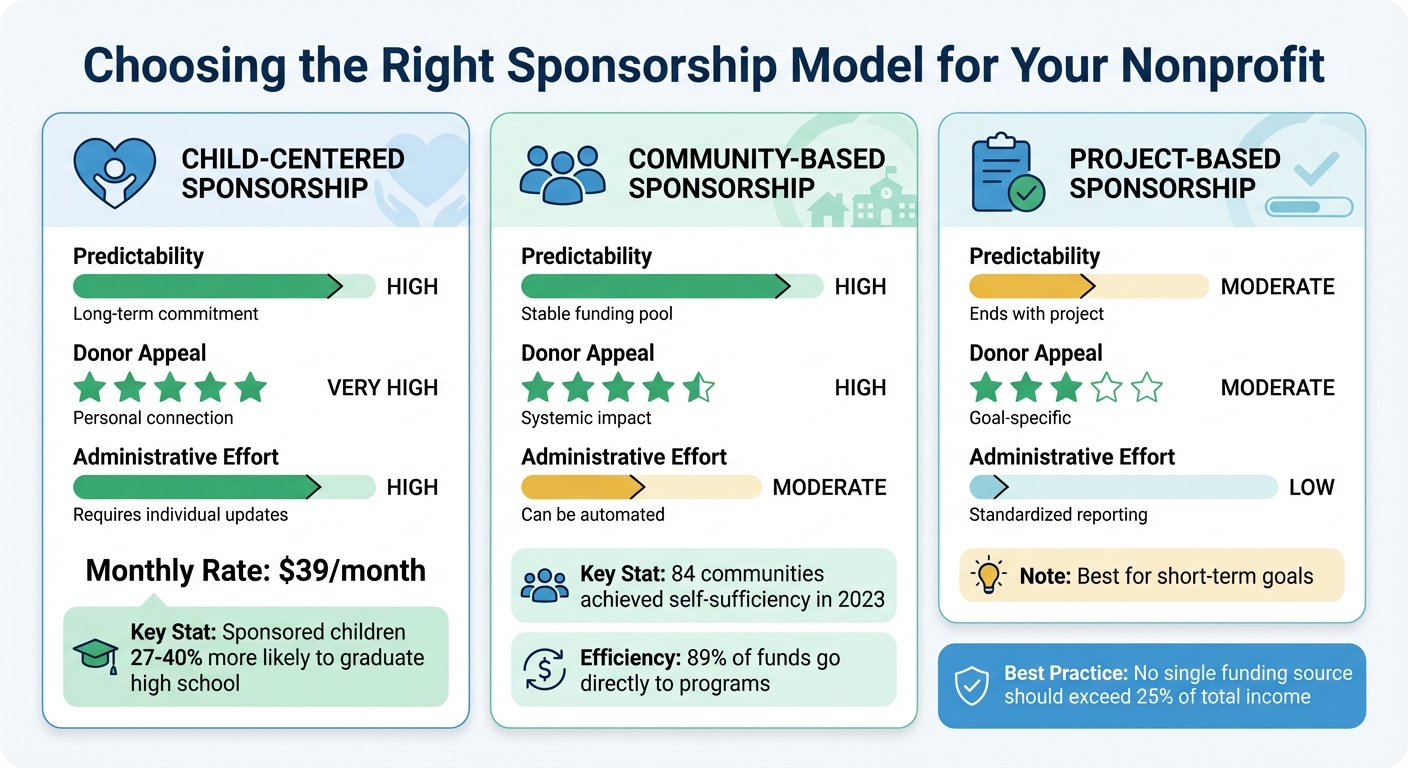
Nonprofit Sponsorship Models Comparison: Predictability, Appeal, and Administrative Effort
Creating a sponsorship program that delivers steady income starts with defining its key components clearly from the outset.
Sponsorship Types That Generate Recurring Income
Child-centered sponsorship establishes a personal bond between sponsors and individual children. This approach keeps donors engaged by providing regular updates about the child they are supporting. Organizations like World Vision and Children International typically set their starting contribution at $39 per month for this model. Research highlights the impact of such programs: sponsored children are 27% to 40% more likely to graduate high school and 14% to 17% more likely to secure salaried employment.
Community-based sponsorship pools contributions to fund larger initiatives, such as building clean water systems, healthcare facilities, or schools. For example, in 2023, World Vision reported that 84 communities achieved self-sufficiency through this method, with 89% of funds going directly to program services. This option appeals to donors who want to make a broader, systemic impact without the need for individualized updates.
Tiered sponsorship levels offer donors flexibility based on their financial capacity, with clear descriptions of what each tier accomplishes. For instance:
- $35 per month might cover basic supplies.
- $50 per month could provide daily meals or weekly family support.
- $100 per month might fund comprehensive aid.
By outlining these tiers, donors can easily see how their contributions translate into tangible outcomes. Once these models are in place, structured payment options and upgrade paths can further enhance revenue stability.
Setting Up Payment Schedules and Upgrade Options
Monthly payment plans are the backbone of consistent cash flow, helping cover ongoing operational costs. These regular contributions make budgeting more predictable and reliable.
Encouraging bank transfers (EFT) over credit cards can improve donor retention. Bank transfers eliminate issues like expired or canceled cards, which often interrupt recurring donations. While quarterly or annual payment options provide flexibility, monthly payments offer the most dependable income stream.
To increase contributions, establish clear upgrade paths for donors. For example, use CRM data to identify donors who give sporadically - say, $100 once a year - and suggest a smaller, recurring monthly donation like $10. Framing these upgrades around specific goals can be especially effective. For instance: "An additional $15 per month could provide school uniforms for three children." This approach feels more personal and impactful than generic requests for increased support.
Platforms like HelpYouSponsor simplify the process by automating recurring payments, receipting, and reminders. This automation can handle up to 90% of sponsorship-related tasks, reducing the risk of revenue gaps caused by missed follow-ups. With these operational tasks streamlined, your team can focus more on building meaningful donor relationships.
Sponsorship Model Comparison
To choose the best sponsorship model for your organization, consider the following comparison:
| Model | Predictability | Donor Appeal | Administrative Effort |
|---|---|---|---|
| Child-Centered | High (Long-term commitment) | Very High (Personal connection) | High (Requires individual updates) |
| Community-Based | High (Stable funding pool) | High (Systemic impact) | Moderate (Can be automated) |
| Project-Based | Moderate (Ends with project) | Moderate (Goal-specific) | Low (Standardized reporting) |
Child-centered sponsorships demand more administrative effort but foster strong donor loyalty. Community-based models strike a balance between predictable funding and manageable overhead, especially when paired with automation. Project-based campaigns, while impactful, are better suited for short-term goals and lack the stability of recurring income.
For example, One Acre Fund diversified its revenue streams between 2015 and 2022, shifting to earn 65% of its income through program activities rather than relying solely on donations. Similarly, your sponsorship model should aim to build resilience by focusing on recurring commitments instead of one-time contributions.
How to Reduce Churn Through Donor Engagement
Keeping donors engaged over time is just as crucial as bringing them on board in the first place. Boosting donor retention by just 10% can increase lifetime giving by 200% while significantly cutting costs - retaining a donor costs only $0.20 compared to $1.50 to acquire a new one. Despite this, nonprofits often struggle, with an average donor retention rate of just under 35% across the sector. Alarmingly, nearly 1 in 4 donors stop giving within six months of their first donation. This makes donor retention not just a good practice but an essential strategy for maintaining steady sponsorship income. Understanding the stages of a donor’s journey is key to tackling this challenge.
Understanding the Sponsor Lifecycle
Donors move through distinct stages, and your engagement tactics should evolve to match each phase. The donor journey typically includes five key stages: Awareness, Consideration, Engagement, Donation, and Loyalty. Each stage lays the groundwork for lasting support, but the real relationship starts after the first donation.
During the onboarding phase, send a personalized welcome message within 24 hours. Use this opportunity to explain how their contribution will make a difference and what they can expect moving forward. Research shows that 72% of consumers engage only with personalized outreach, so avoid generic templates.
In the active engagement phase, focus on maintaining regular communication without always asking for more money. Share impact stories, updates on programs, and behind-the-scenes content to keep your mission front and center. Follow the "Rule of Seven": thank a donor seven times before making another donation request. This approach fosters relationships built on gratitude rather than transactions.
For renewal and retention, pay close attention to engagement metrics to identify donors who may be at risk of lapsing. Interestingly, 11% of U.S. donors stop giving simply because they forget they supported the organization. Regular, meaningful communication can help prevent this.
When working to prevent lapses, segment your donors based on how often they give and how engaged they are. Create a tailored communication plan for at-risk donors that emphasizes gratitude and the impact of their contributions. Match your acknowledgment efforts to the size of the gift: small gifts might warrant automated emails, mid-sized gifts could receive handwritten notes, and major gifts may call for phone calls or public recognition.
Using Automation for Donor Communication
Managing donor communication manually can be time-consuming and error-prone. Missed thank-you notes or delayed updates can leave donors feeling undervalued. This is where automation becomes a game-changer.
Platforms like HelpYouSponsor handle repetitive tasks that often overwhelm nonprofit teams. For example, the system can automatically send donation receipts, deliver personalized thank-you messages at key milestones, and provide regular program updates - all on a schedule. This allows your team to focus on building deeper relationships with major donors and those at risk of disengaging.
HelpYouSponsor’s free plan supports up to 10 commitments per month, making it an excellent option for organizations just starting their sponsorship programs. As your program grows, the platform scales with you. One organization, for instance, expanded its sponsored children from 20 to 35 in just six months by combining automated updates with personalized interactions.
Automation doesn’t mean sacrificing a personal touch. Features like merge tags let you personalize messages at scale by addressing donors by name and referencing details about their specific sponsorship. You can also set up automated milestone emails for events like sponsorship anniversaries, birthdays of sponsored children, or project completion updates, keeping donors engaged without requiring constant manual effort.
Manual vs. Automated Lifecycle Management
Blending manual care with smart automation creates a more effective and sustainable donor engagement strategy. Here’s a comparison of the two approaches:
| Feature | Manual Management | Automated (HelpYouSponsor) |
|---|---|---|
| Time Required | High; staff must track dates and send emails individually. | Low; the system automates key communications. |
| Accuracy | Prone to human error; milestones can be missed. | High; automated triggers ensure consistency. |
| Consistency | Variable; depends on staff availability. | Steady; ensures regular communication. |
| Personalization | High, but hard to scale. | High; uses automation to personalize at scale. |
Automated systems ensure consistent communication, even during staff transitions or busy periods. Donors receive timely receipts, updates, and milestone recognitions, transforming one-time contributors into long-term supporters.
For example, in June 2025, BWF partnered with a leading children’s hospital to revamp its donor engagement strategy. By introducing donor personas, targeted digital marketing, and compelling storytelling, the hospital achieved a 51% increase in year-end revenue, a 22% rise in total gifts, and a 25% boost in first-time donors. Personalized communication at scale proved to be the key to reducing donor churn and building enduring relationships.
Improving Operations and Financial Planning
Strong operational systems and careful financial planning set nonprofits with steady sponsorship income apart from those dealing with unpredictable revenue. Without clear processes in place, organizations often spend too much time on administrative tasks, make costly mistakes, and miss chances to plan effectively for the future. Establishing solid workflows and maintaining accurate financial records are key to building this stability. Just like with donor engagement, consistent processes are the foundation of sustainable sponsorship income. Let’s explore how standardized systems and precise data management can drive better strategic planning.
Creating Standard Sponsorship Management Processes
Having consistent processes for sponsor onboarding, matching, and reporting can significantly reduce redundant work and ease the administrative load on nonprofit teams.
Centralizing sponsorship data on a single platform boosts efficiency across the board. For example, HelpYouSponsor consolidates all sponsorship information into one accessible location, automating 90% of sponsorship tasks. It handles routine activities like issuing donation receipts, tracking payment schedules, and sending program updates automatically. This means staff can quickly access details like sponsor information, payment history, and communication records without sifting through spreadsheets or physical files. Such streamlined processes are especially helpful during staff transitions or busy periods when manual systems often falter. In 2023, Hope Children's Home adopted HelpYouSponsor to manage their first 20 sponsored children. Within just six months, consistent monthly donations allowed them to grow their program to support 35 children.
Maintaining Accurate Data and Financial Records
Efficient operations go hand in hand with accurate financial records, which are vital for reliable forecasting. Keeping detailed sponsor records ensures nonprofits can budget effectively and adjust strategies based on real data.
HelpYouSponsor’s tracking and reporting tools make this easier by keeping sponsorship commitments and donations up to date. The platform follows the accrual accounting method, recording revenue when it’s earned rather than when cash is received, ensuring financial records are both clear and compliant. With its reporting features, organizations can monitor current sponsorship levels, upcoming renewals, and revenue trends - critical insights for deciding on program expansions or reallocating resources.
To safeguard against financial uncertainty, nonprofits should maintain reserves covering 3–6 months of operating expenses. It’s also wise to avoid relying on a single funding source for more than 25% of total income. As Fourthwall emphasizes:
"Diversifying revenue streams is not merely a strategic choice; it's necessary to ensure your nonprofit's longevity and effectiveness".
Regular budget reviews - at least twice a year - allow organizations to adjust spending plans in response to changes in funding or community needs.
Diversified giving options also lead to tangible growth. Nonprofits that accept stocks and securities in addition to cash donations saw income grow by 66%, compared to just 11% growth for those accepting only cash. From 2015 to 2022, One Acre Fund transitioned from relying heavily on donations to generating 65% of its income through its own programs, achieving financial stability despite shifts in global giving patterns. These examples highlight how strong operations and thoughtful financial planning work together to build sustainable sponsorship income.
Responding to 2026 Fundraising Trends
Keeping up with 2026 fundraising trends can mean the difference between a nonprofit with steady income and one constantly scrambling to stay afloat. The fundraising landscape is evolving quickly - monthly giving revenue grew by 5% in 2024, while one-time donations stayed flat. Adapting to these shifts is essential for maintaining reliable sponsorship income in the years ahead. These changes highlight the importance of strategies that ensure consistent donor support.
Expanding Digital Giving and Recurring Donations
Modern donors want donation processes to be quick and easy. Offering digital wallet options like Apple Pay, Google Pay, and PayPal reduces barriers and increases the likelihood of completed donations. In fact, 76% of nonprofits now offer PayPal, 47% offer Apple Pay, and 40% offer Google Pay, making these tools a standard feature for organizations.
Another key strategy is converting one-time donors into monthly supporters. While 90% of nonprofits now provide a monthly giving option, only 35% pre-select this option on their donation forms. By simply making monthly giving the default choice, organizations can significantly grow recurring revenue. Another effective tactic is using an upsell lightbox - a pop-up that appears after a one-time donation, encouraging donors to commit to a smaller monthly gift instead. Matt Monberg, Senior Vice President at TrueSense Marketing, explains:
"In 2026, commit to a renewed focus on recruiting and retaining more monthly sustainers. Regular monthly givers provide steady support, but they also require intentional stewardship for retention".
Platforms like HelpYouSponsor make it easier to manage recurring donations. They support multiple digital wallets and even offer a free plan for organizations handling up to 10 sponsorships per month, allowing nonprofits to grow recurring revenue without upfront costs.
But providing a seamless donation experience is only part of the equation - building trust with donors is just as critical.
Meeting Donor Expectations for Transparency
Donors today want to know exactly how their contributions are making an impact. Sharing clear and measurable results fosters trust and improves retention. Mithra Irani Ramaley, Chief Development Officer at City Year, sums it up:
"Every story needs a stat, and every stat needs a story".
This means pairing data - like the number of children helped or projects completed - with real stories about the lives impacted by those contributions.
HelpYouSponsor simplifies this process with tools that track sponsorship commitments and generate detailed reports. These reports show how funds are used and what outcomes they achieve. The platform can even send automated updates to donors, keeping them informed without adding to your administrative workload. When donors see tangible results - whether it’s a child’s improved school performance, a completed building project, or life-saving medical care - they’re much more likely to continue their support.
Transparency not only builds trust but also lays the groundwork for refining your overall strategy.
Regular Reviews to Adjust Your Strategy
To stay relevant and effective, nonprofits need to regularly evaluate their strategies. Reviewing sponsorship data and adjusting plans based on real performance - not assumptions - helps ensure long-term success. Just as consistent donor engagement and automation drive stability, regular strategy reviews allow organizations to remain agile.
HelpYouSponsor offers analytics tools that provide real-time insights into sponsorship trends, renewal rates, and revenue patterns. These insights make it easier to identify problems early and spot new opportunities. At a minimum, schedule formal reviews twice a year to evaluate which sponsorship models are most stable, which communication methods resonate best with donors, and where you may be losing support. Diversifying revenue streams and refining strategies based on these reviews can lead to meaningful growth tailored to your nonprofit’s specific needs.
Conclusion
Securing consistent sponsorship income in 2026 means nonprofits need to rethink their strategies for long-term, reliable funding. Start by evaluating your current revenue streams. Metrics like donor retention rates and monthly recurring revenue can help pinpoint areas for improvement. From there, focus on creating sponsorship models that emphasize recurring donations - such as sustainer programs - which have been shown to significantly improve donor retention.
Engaging donors strategically plays a big role in reducing churn. Automating communication and tracking the sponsor lifecycle can keep supporters connected to your mission without overloading your team. For instance, revenue from monthly giving grew by 5% in 2024, while one-time donations stayed flat. These steps - evaluating revenue, building recurring giving programs, and leveraging automation - work together to create a solid foundation for financial stability in 2026.
To stay ahead, take advantage of digital giving options and ensure clear, transparent reporting. Regularly revisit your strategy using real data to make adjustments as needed. Diversifying revenue streams is also critical - no single funding source should account for more than 25% of your total income.
Platforms like HelpYouSponsor can simplify this process by automating 90% of sponsorship tasks, including recurring billing, donor updates, and tracking impact. Its free plan even supports smaller organizations. With built-in analytics, you can access real-time insights to guide your decisions and drive growth. By combining well-tested strategies with the right tools, nonprofits can transform steady sponsorship income from a goal into a reality.
FAQs
What are the best ways for nonprofits to diversify sponsorship income in 2026?
Nonprofits can create a reliable and varied sponsorship income by diversifying their funding sources. Start by identifying potential sponsors that share your mission, such as large corporations, local businesses, foundations, or community organizations. Develop tiered sponsorship packages with clear benefits, like increased brand exposure, opportunities for employee involvement, or partnerships in cause-related marketing. To maintain financial stability, ensure no single sponsor contributes more than 25% of your total sponsorship income.
Incorporating both traditional event sponsorships and recurring programs - like child sponsorships - can help generate consistent monthly revenue while offering sponsors compelling stories to share. Use donor-management tools to monitor engagement, track renewal dates, and measure impact. This will allow you to respond quickly if a sponsor decides to move on.
To strengthen your funding base even further, diversify with other revenue streams, such as individual donations, grants, and in-kind contributions. Regularly showcase sponsor contributions through newsletters, social media, and impact reports to nurture long-term relationships. These approaches will help build a dependable and diverse funding pipeline for 2026 and the years ahead.
What metrics should nonprofits track to maintain steady sponsorship income?
To maintain consistent sponsorship income, nonprofits should prioritize tracking key metrics that highlight growth, loyalty, and efficiency. Here are some important ones to keep an eye on:
- Sponsor Acquisition Rate: This shows how many new sponsors you’ve brought on board during a specific timeframe. It’s a solid indicator of your organization’s ability to grow.
- Sponsorship Retention Rate: This measures the percentage of sponsors who continue supporting your cause over time. A high retention rate signals strong relationships and program reliability.
- Return on Investment (ROI): By comparing the revenue generated from sponsorships to the costs of acquiring and managing them, this metric reveals how efficiently your strategy is working.
Other useful insights come from tracking sponsor engagement levels - like participation in events or responsiveness to emails - and lifetime sponsor value, which estimates the total contributions a sponsor is likely to make throughout their relationship with your organization. Regularly analyzing these metrics allows nonprofits to spot patterns, refine their approaches, and secure dependable funding for their mission.
How can automation help nonprofits improve donor engagement and retention?
Automation is transforming how nonprofits connect with and retain donors by taking over repetitive tasks and enabling personalized interactions on a large scale. Imagine this: instead of manually crafting thank-you emails or remembering to send birthday greetings, automated tools handle it all. These tools can deliver tailored messages - like impact updates or special occasion notes - making donors feel valued without adding to staff workloads. This kind of consistent, heartfelt communication builds stronger bonds and keeps donors engaged.
But it doesn't stop there. Automation also offers real-time insights into donor behavior, such as tracking donation trends or spotting when someone might stop giving. Armed with this information, nonprofits can send timely, targeted appeals to reengage donors, improving retention and saving money that would otherwise go toward finding new supporters. Plus, by automating tasks like payment processing and generating reports, staff gain more time to focus on what truly matters: nurturing relationships and ensuring the organization runs smoothly. The result? Stronger connections, efficient operations, and a more dependable funding stream.