
Mission Trips: Building Bridges Between Donors and Communities
Mission trips convert casual donors into committed partners by combining community-led projects, clear goals, ethical storytelling, and tech-enabled follow-up.

Mission trips connect donors directly with the projects and communities they support, creating personal, emotional bonds that financial updates alone can't achieve. By immersing participants in hands-on experiences, these trips often inspire greater long-term commitment and advocacy. Key takeaways:
- Purpose: Strengthen donor relationships through firsthand experiences.
- Planning: Set clear goals and select participants aligned with your mission.
- Activities: Focus on meaningful, community-led interactions.
- Technology: Use tools to engage donors before, during, and after trips.
- Impact: Measure results and maintain connections to ensure lasting support.
Mission trips can transform one-time donors into lifelong supporters by fostering deeper connections and showing the tangible results of their contributions.
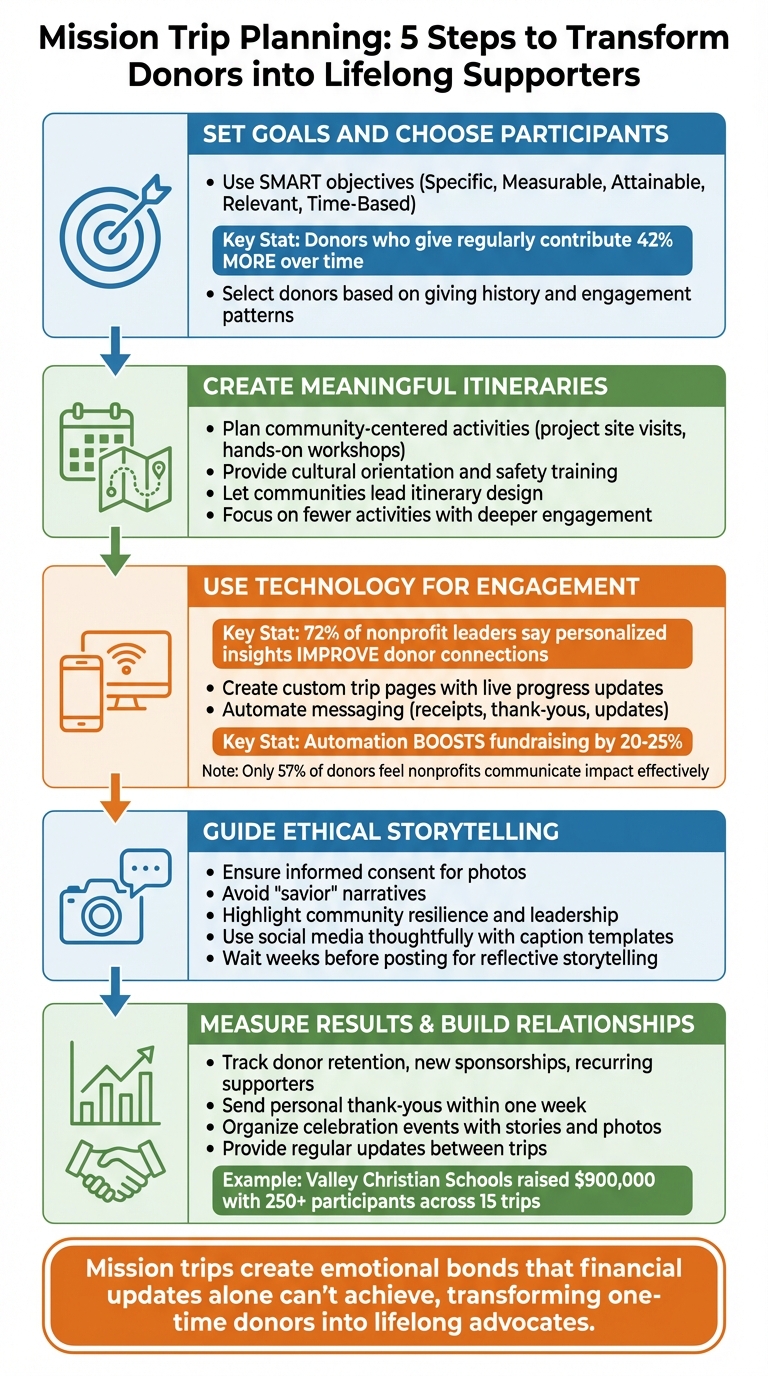
5-Step Mission Trip Planning Process for Nonprofits
Step 1: Set Goals and Choose Participants
Set Clear Goals for the Trip
The foundation of any successful mission trip lies in setting clear and measurable objectives. Without well-defined goals, the trip risks becoming a fleeting experience rather than a meaningful effort that fosters long-term donor relationships. Use SMART objectives - Specific, Measurable, Attainable, Relevant, and Time-Based - to guide your planning. For example, you might aim to enroll a specific number of students in an educational program, secure new child sponsorships, or complete an infrastructure project like installing clean water systems. Tracking both numerical outcomes and donor feedback ensures the trip delivers lasting results .
Focus on creating goals that go beyond offering temporary aid. Instead of short-term charity, aim for outcomes that support long-term community development. For instance, instead of a general objective like "help the community", set actionable targets such as increasing school enrollment by a certain percentage or completing a sustainable infrastructure project. These kinds of goals not only provide immediate benefits but also pave the way for communities to achieve self-sufficiency.
Here’s an important point to keep in mind: donors who give regularly contribute 42% more over time compared to one-time contributors. This makes it crucial to establish objectives that encourage ongoing relationships rather than one-off transactions. Once your goals are in place, the next step is to select participants who can help bring these objectives to life.
Choose the Right Donors
With your objectives defined, the focus shifts to selecting the right participants - donors who can both benefit from and contribute to the trip. Start by analyzing your donor base. Look for supporters who have previously funded similar projects or shown interest in the communities you’re working with. Tools like HelpYouSponsor’s child sponsorship software can help segment your supporters based on their giving history, interests, and engagement patterns. Once you have identified these donors, setting up your sponsorship program correctly is the next step to ensuring long-term success.
Prioritize donors who have a history of recurring contributions, as they are more likely to deepen their involvement over time. To better understand potential participants, use surveys or interest forms to gauge their motivations. Ask them what excites them most about the trip and what concerns they might have. For trips focused on fundraising, select donors based on their capacity, enthusiasm, and willingness to build a stronger connection with the community.
The ultimate goal is to invite donors who are ready to move from simply giving to forming a deeper, transformational partnership with the communities they support. By aligning the right participants with your mission, you set the stage for meaningful impact and enduring relationships.
Step 2: Create Meaningful Itineraries
Plan Community-Centered Activities
Mission trips that resonate deeply connect donors to the tangible outcomes of their contributions. To achieve this, design itineraries that include visits to project sites like schools, clean water wells, healthcare clinics, or agricultural initiatives funded by donors. These firsthand experiences allow donors to see the real-world impact of their support.
Incorporate hands-on activities such as vocational training, entrepreneurial workshops, or community meetings with local leaders. These interactions encourage mutual learning and foster genuine collaboration. As Katherine Redington, Vice President of Social Impact Journeys at Elevate Destinations, explains:
"We don't need to craft a version of the journey that is not reflective of the actual lived experience of a place. This does not mean we can't ensure donors' safety... but our bias should lean towards what is authentic."
Focus on fewer activities with longer visits, allowing for deeper engagement. Include daily debrief sessions to help donors process their experiences and connect them to your organization's mission.
Crucially, let the community take the lead in shaping the itinerary. Work closely with local partners who have an ongoing presence in the area. This ensures that activities reflect genuine community needs rather than donor assumptions. As the BuildFaith Editors emphasize:
"The project design allows for those who are visited to define their own needs."
With a thoughtfully crafted itinerary, you can ensure donors are ready to approach these experiences with respect and understanding.
Prepare for Safety and Cultural Sensitivity
Once the itinerary is set, equip donors with the tools they need to engage respectfully and safely. Provide a mandatory cultural orientation that covers local history, socioeconomic contexts, and key customs. For instance, in places like Kenya, using your left hand for greetings or eating is considered disrespectful.
Collaborate with local organizations that have welcomed your involvement. This partnership helps avoid an intrusive presence or fostering a "savior mentality." Training should also address issues of power and privilege, ensuring donors understand they are there to learn alongside the community, not to "fix" it.
Step 3: Use Technology for Engagement and Follow-Up
Engage Donors Before the Trip
Technology makes it easier than ever to connect with donors right from their first interaction. Platforms like HelpYouSponsor allow you to create custom trip pages that showcase your project’s story, outline donation goals, and even display live progress updates. These features not only inform but also inspire action.
Automated messaging tools take care of essential communication, such as sending personalized updates, receipts, and thank-you emails. This consistent outreach builds trust and keeps donors engaged. According to HelpYouSponsor, 72% of nonprofit leaders say that personalized donor insights significantly improve their ability to connect with supporters.
To maximize engagement, ensure your trip pages are mobile-friendly and offer integrated payment options, including recurring donation setups. This approach can turn one-time contributors into long-term supporters by mastering donor retention, creating a foundation for ongoing impact.
Track Impact and Report Results After the Trip
Once the trip is complete, follow-up technology plays a vital role in maintaining donor relationships. HelpYouSponsor simplifies this process by automatically sending thank-you emails, receipts, and tracking donor behavior - such as increased contributions or new sponsorships - so you can measure the outcomes of your efforts.
AI-powered analytics can help you create impactful reports by combining data with visual storytelling, testimonials, and clear metrics. This matters because only 57% of online donors feel nonprofits effectively communicate how their gifts make a difference.
Another helpful tool is the household visibility feature, which consolidates family data to identify potential high-capacity donors and prevents duplicate communications that could annoy supporters. Automating donor management tasks like these has been shown to boost fundraising results by 20–25%.
Planning A Missions Trip
Step 4: Help Donors Share Their Experiences
After engaging with communities in a meaningful way, encouraging donors to share their experiences can strengthen the bond between contributors and the people they’ve supported.
Guide Ethical Storytelling and Content Creation
When donors return from mission trips, they’re often eager to share what they’ve seen and learned. Provide them with clear guidelines to ensure their storytelling respects the dignity of the communities they visited while remaining genuine and impactful.
A key part of this process is ensuring informed consent. Donors should always ask permission before taking or posting photos, explaining where and how the images will be shared. For photos of minors, it’s essential to get consent from a parent or guardian. Avoid sharing identifiable details like full names, addresses, or other private information. In sensitive environments, such as orphanages or health clinics, faces should be blurred, and names changed - even if consent has been granted. Encourage donors to only photograph individuals they’ve built a personal connection with and who have explicitly agreed to be featured.
The tone of the narrative is equally important. Donors should avoid framing their stories as "hero" narratives that position them as saviors. Instead, they should focus on highlighting the resilience and leadership of local communities. Language matters - stories should uplift and celebrate community-driven initiatives. Before posting, donors can reflect on questions like: Am I representing these individuals respectfully? Does this post center the community's efforts rather than my own?
To avoid overwhelming the experience with cameras, designate one or two team photographers. This approach ensures a more respectful atmosphere and allows others to stay fully present. Sharing photos with the subjects immediately - rather than treating it as a one-way transaction - can also help build mutual respect. Once the trip is over, social media and testimonials can be powerful tools to amplify these experiences thoughtfully.
Share Stories Through Social Media and Testimonials
When used carefully, social media can extend the reach of a mission trip’s impact. However, donors should remember that their posts may be seen by the very communities they’re featuring. This awareness calls for extra care and thoughtfulness.
Encourage donors to take their time before sharing. Waiting a few weeks after the trip allows for more reflective and meaningful storytelling, rather than impulsive reactions. Providing caption templates can help donors naturally use language that credits local partners and explains the broader context of the work.
Before posting, donors can use a simple checklist: Do the photos portray individuals in a respectful and positive light? Was informed consent obtained? Does the post focus on the mission and the community, rather than just the donor’s personal experience? Avoid sharing images from sensitive settings, like hospitals or clinics, as these can unintentionally compromise privacy or dignity.
When writing testimonials, specifics matter. Including names, locations, and context helps highlight the leadership and voices of the community itself. Avoid sweeping generalizations about entire cultures or countries. Donors should position themselves as supporters, amplifying the stories of local leaders and community members. This approach acknowledges that the real work belongs to the community - work that started long before the donor arrived and will continue long after they leave. By acting as a "microphone" for these voices, donors can share stories that are both respectful and empowering.
Step 5: Measure Results and Build Long-Term Relationships
Once the mission trip ends, the work is far from over. Measuring the impact and nurturing relationships are essential for ensuring the trip's efforts lead to meaningful, lasting change. A mission trip is not just an event - it’s part of an ongoing journey.
Track Key Metrics
Success measurement begins before the trip even starts. Collaborate with local partners to set clear, measurable goals that align with the community's real needs. Whether it’s the number of wells constructed or the gospel shared, these goals should reflect priorities that matter locally - not just numbers that look impressive in a report.
After the trip, dive into the results. Conduct group debriefs, gather anonymous surveys, and hold follow-up discussions three to six months later. This longer timeline helps uncover whether the efforts made a lasting difference or just a short-term impact.
It’s also vital to track donor engagement. Look at metrics like donor retention, new sponsorships, and how many one-time donors became regular supporters. For instance, Valley Christian Schools showed how centralized tracking could amplify results. They organized over 250 students and staff for 15 simultaneous trips and raised more than $900,000 in just one season by streamlining their communication and fundraising on a unified platform.
Don’t stop there - measure the personal growth of participants months after the trip. Use follow-up surveys to see if donors have increased their local volunteering, maintained financial support, or deepened their spiritual engagement. These insights reveal whether the trip sparked genuine, lasting transformation.
Keep Donors Connected After the Trip
The energy and connections built during a mission trip can fade quickly without thoughtful follow-up. Within a week, reach out to every donor with a personal thank-you - whether through handwritten notes, emails, or phone calls. Be specific and highlight the impact their support made.
Organize a celebration event soon after the trip. Share stories, photos, and videos that showcase the successes. As Katherine Redington, Vice President of Social Impact Journeys at Elevate Destinations, puts it:
"Donor trips should be a part of a robust strategy where the donor trip is but one piece in a longer journey of building a movement and connecting people across cultures with more accountability and purpose".
Use this post-trip momentum to strengthen relationships. Work with donors individually to align their passions - discovered during the trip - with new opportunities, whether through funding projects or advocacy roles. Encourage them to commit to the next trip early. Building long-term connections with the same community transforms fleeting moments into deep, genuine relationships.
Keep donors engaged between trips with regular updates, virtual donor walls, and progress reports. This ongoing communication builds trust and credibility, ensuring supporters stay invested in the mission.
Comparison: Mission Trips vs. Virtual Updates
Mission trips and virtual updates each bring unique strengths to donor engagement. Knowing when to use one - or how to blend both - can help your organization build deeper, more meaningful connections with supporters.
Mission trips offer something digital tools can't fully replicate: a profound emotional connection. These immersive experiences allow donors to engage their senses and witness the direct impact of their contributions. This level of engagement often transforms participants into long-term advocates. This shift reflects broader fundraising trends reshaping donor relationships toward deeper, more personal connections. For example, in 2023, two midlevel donors who visited the Galápagos Islands became significantly more involved - one joined the organization's board, while the other took on the role of chairing the Zoo Ball.
On the other hand, virtual updates excel in scalability and accessibility. They can reach thousands of supporters at once without the logistical hurdles of organizing travel. Tools like social media, email newsletters, and even virtual reality (VR) experiences allow organizations to share updates frequently. A study by the International Committee of the Red Cross showed that VR modules customized for donors led to higher contributions compared to traditional on-screen videos with the same content.
Cost is another key difference. Mission trips can range from $3,000 for volunteer-focused experiences to over $20,000 for high-level donor expeditions. Virtual updates, by contrast, are cost-effective donor stewardship strategies that require far fewer resources, leveraging existing digital platforms and staff time. However, the return on investment can vary significantly. For instance, a single experiential trip to Samoa for the Greater Good Diaper Project raised $1.5 million in 2023, while virtual updates help maintain steady donor engagement over time.
Comparison Table: Mission Trips vs. Virtual Updates
| Aspect | Mission Trips | Virtual Updates |
|---|---|---|
| Emotional Connection | High, thanks to face-to-face interaction and sensory immersion | Moderate, relying on digital storytelling and visuals |
| Retention Rate | Higher, often leading to roles like board membership or major gifts | Lower, but keeps donors engaged consistently |
| Cost | Higher, between $3,000–$20,000 per person with significant planning | Lower, using digital platforms and staff resources |
| Reach | Limited, based on trip capacity and donor availability | Broad, reaching thousands simultaneously |
| Community Impact Visibility | Direct and firsthand - donors see the work in real-time | Indirect, through videos, reports, and testimonials |
Conclusion
Mission trips have a unique way of building lasting connections, turning occasional donors into devoted supporters. When donors experience your work firsthand, they form an emotional bond that goes far beyond what email updates or annual reports can offer. These immersive experiences inspire the kind of empathy that turns supporters into enthusiastic advocates for your mission.
The success stories from organizations like the Houston Zoo and AtlasDaughters highlight the measurable benefits of well-planned mission trips. These examples prove how hands-on experiences can deliver meaningful results for your organization and the communities you aim to uplift.
With tools like HelpYouSponsor, managing donor relationships becomes simpler. From tracking engagement to setting up fundraising pages and automating updates, it allows you to focus on what matters most - building stronger connections and creating greater impact.
FAQs
How do we choose the right donors for a mission trip?
To make the most of your efforts, choose donors who genuinely care about your cause and share a meaningful bond with your organization. Look for individuals who have shown a consistent interest in your mission and align with the trip’s goals, whether that’s raising funds or spreading awareness. Focusing on dedicated participants not only boosts the trip’s success but also helps build deeper, long-term connections with your supporters.
How can we avoid a “savior mentality” on trips?
To steer clear of a “savior mentality,” it’s crucial to focus on empowering communities rather than positioning yourself as the solution to their challenges. Start by recognizing and appreciating the strengths and resources that already exist within the community instead of highlighting what you can bring to the table. Approach every interaction with humility, ensuring your efforts are aligned with the community’s real needs and priorities.
Building long-term relationships is key. Collaborating with trusted local organizations and supporting initiatives led by the community itself encourages mutual respect. This approach helps ensure that mission trips uplift and empower rather than unintentionally coming across as patronizing or overly paternalistic.
What metrics show a mission trip improved donor retention?
Metrics that help showcase how mission trips can improve donor retention include donor retention rate, donation retention rate, and lifetime donor value. For instance, increasing donor retention by just 10% can lead to a noticeable rise in a donor’s lifetime value. Monitoring these metrics provides a clear way to gauge how mission trips enhance donor engagement and encourage lasting support.