
Improving Nonprofit Sustainability with Data-Driven Decision Making
Use donor data and predictive analytics to boost retention, cut fundraising costs, and strengthen long-term nonprofit sustainability.


Nonprofits face an ongoing challenge: achieving their mission while dealing with limited funding. The solution? Using data to guide decisions. By analyzing key metrics like donor retention, campaign efficiency, and donor lifetime value, organizations can make smarter choices that lead to measurable outcomes. For example, nonprofits that focus on retaining donors see retention rates jump from 18.6% after the first gift to 38.1% after the second. Tools like HelpYouSponsor simplify this process by centralizing donor data, offering predictive insights, and automating donor communication. The result? Better resource allocation, stronger donor relationships, and long-term impact. Here’s how nonprofits can use data to their advantage.
How Nonprofits Can Use Predictive Analytics for Data Driven Decisions
Key Metrics for Tracking Nonprofit Performance
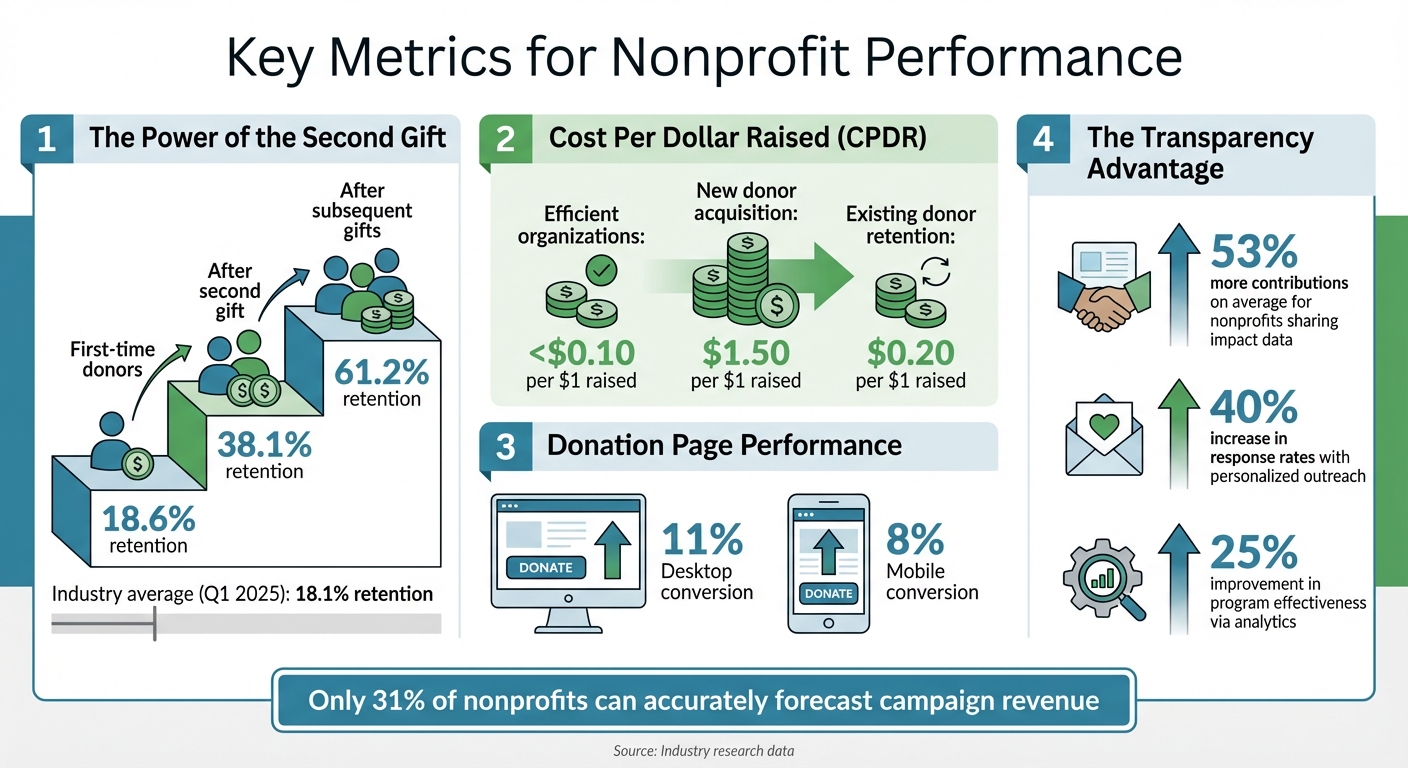
Key Nonprofit Fundraising Metrics and Donor Retention Statistics
Keeping tabs on the right metrics can turn educated guesses into actionable strategies. For nonprofits, the goal is to pinpoint indicators that reveal what's effective, what needs improvement, and where to channel resources. One of the most critical metrics to monitor? Donor retention.
Donor retention tells the real story. This metric reflects the percentage of donors who continue to give year after year, offering a clear picture of how well your organization is maintaining relationships. The calculation is straightforward: divide the number of returning donors in year two by the total donors from year one, then multiply by 100. Industry averages show retention rates as low as 18.1% in Q1 2025. However, retention jumps from 18.6% for one-time donors to 38.1% after a second gift, and it climbs to 61.2% with subsequent contributions. That second donation is crucial - it’s often the first step toward donor loyalty.
Another essential focus is campaign performance metrics, which measure fundraising efficiency. Cost per dollar raised (CPDR) is a key indicator, showing how much it costs to generate every dollar. Efficient organizations keep this below $0.10 per dollar raised. Comparatively, acquiring new donors costs around $1.50 per dollar raised, while retaining existing donors costs just $0.20. Donation page conversion rates also provide insight, with desktop pages converting at 11% and mobile pages at 8%. These figures help identify which channels are worth the investment and which might be draining resources without yielding results.
Predictive metrics are the backbone of long-term planning. Donor lifetime value (LTV) is calculated by multiplying the average donor lifespan by the average donation amount and donation frequency. While only 31% of nonprofits can accurately forecast revenue from campaigns, those who embrace cohort analysis - tracking donor groups over time - can project revenue 3–5 years into the future. Historical data also powers predictive models, helping organizations anticipate repeat or upgraded gifts.
"The best fundraising leaders are experts on their performance metrics and prove how one dollar invested turns into more than that dollar. The deep understanding of ROI, in particular, makes it much easier to pitch for more investment." - Paul Matthews-Brokenshire, Industry Solutions, Salesforce.org
Finally, engagement metrics - like email open rates, click-through rates, and social media interactions - offer insight into how well your messaging resonates. These non-monetary indicators often hint at future giving patterns. For example, nonprofits that share impact data report receiving 53% more contributions on average. Personalized outreach, crafted using donor data, can increase response rates by up to 40%. To get the full picture, balance these numbers with qualitative feedback from surveys to understand not just what donors do, but why they do it.
How HelpYouSponsor Supports Data-Driven Strategies
HelpYouSponsor offers nonprofits tools designed to streamline operations and make data-driven decisions, ensuring every effort is informed by clear insights.
1. Centralized Donor Data Management
HelpYouSponsor brings all donor information into one platform - whether it’s online donations, recurring contributions, one-time gifts, or even offline donations. This creates a comprehensive view that not only tracks financial transactions but also highlights engagement metrics like event participation, volunteer activities, and communication preferences. With everything in one place, identifying patterns and trends becomes second nature.
The platform’s segmentation tools allow nonprofits to group donors based on factors like demographics, giving history, personal interests, or even wealth indicators. This means you can go beyond surface-level data. For example, instead of viewing someone as just a one-time donor, you might identify them as a "monthly supporter passionate about educational initiatives." On top of that, automated tools handle tedious tasks like merging duplicate records and updating addresses, ensuring your database stays clean and accurate.
2. Reporting and Analytics Features
HelpYouSponsor’s reporting tools take the guesswork out of decision-making. They track key metrics like monthly donation totals and campaign performance, providing actionable insights. You can quickly see which fundraising appeals are most effective, which donor groups are the most engaged, and how efficiently your resources are being used. These insights can lead to a 25% boost in program performance.
The platform also supports predictive analytics, monitoring donor behavior over time to forecast revenue and flag potential lapses. This is especially important given that roughly 80% of first-time donors only give once. Early warning signs, such as declining email engagement or missed recurring payments, can be addressed proactively to improve retention. All of these analytics integrate seamlessly with payment and communication tools, creating a unified system.
3. Integrated Payment and Communication Tools
HelpYouSponsor makes payment processing and donor communication effortless. The platform connects with various payment gateways, giving donors the option to contribute via credit card, bank transfer, or digital wallet. Mobile-friendly forms further simplify the donation process, reducing barriers to giving. Donors can even choose to cover processing fees, ensuring more funds go directly to your cause.
Automation plays a big role in donor outreach. Tax receipts, thank-you messages, and welcome emails are sent automatically, eliminating manual follow-ups. This matters because securing a second gift significantly improves donor retention rates - from 18.6% after the first gift to 38.1%. Real-time syncing between payment data and donor records minimizes errors, while automated retries for failed payments help maintain consistent cash flow - an essential factor for long-term stability.
Steps to Improve Fundraising Efficiency with Data
1. Set Clear Goals and Define Key Metrics
Before diving into data collection, focus on what truly matters - your mission-critical metrics. Ask yourself: What information will help drive your mission forward? This could include donor demographics, giving history, or engagement levels. To stay on track, use SMART goals (Specific, Measurable, Achievable, Relevant, Time-bound). For instance, instead of vaguely aiming to "improve donor retention", set a goal like "increase donor retention by 20% within 12 months".
Next, evaluate your current data sources and address any gaps with standardized data governance practices. This includes ensuring consistent data entry, regular validation, and strict privacy standards. Why is this important? 76% of nonprofits lack a comprehensive analytics strategy, which can hinder their progress. Moreover, nonprofits that share their impact data with supporters see an average of 53% more contributions. Clean, reliable data isn't just about organization - it directly influences your fundraising success.
Once your goals and governance policies are in place, you’re ready to centralize data collection.
2. Use Tools for Data Collection and Analysis
With your goals set, streamline your data collection process using tools like HelpYouSponsor. This platform consolidates all donation types into one system, reducing the need for manual data entry. It also allows you to segment donors by demographics, giving history, or personal interests. To make the most of your data, follow the DeCAL methodology: Define your objectives, Collect and clean your data, Analyze it, and Leverage insights to take action.
Dive into the four types of analytics to fully understand your data:
- Descriptive analytics: Understand past trends, like identifying peak giving seasons.
- Diagnostic analytics: Pinpoint reasons behind past performance, such as why a campaign fell short.
- Predictive analytics: Forecast future outcomes, like which donors are most likely to give again.
- Prescriptive analytics: Get actionable recommendations, like the best donation amount to request from each donor.
Using analytics effectively can boost program effectiveness by 25%, making it a game-changer for your fundraising efforts.
With these insights in hand, you’re ready to refine and personalize your strategies.
3. Refine Strategies Based on Data Insights
Once you’ve gathered and analyzed your data, put those insights to work. Personalize your donor outreach by tailoring communications to match past giving patterns, contact preferences, and event participation. This level of personalization can increase response rates by up to 40%. For example, use predictive scoring to identify major gift prospects or invite frequent donors to join recurring giving programs.
"Analytics gives us the insight to know whether we need to go wider or tighter in our donor communication. Every dollar we raise means more money channeled to fighting childhood cancers." - Owen Finegan, CEO, The Kids' Cancer Project
Keep your strategies dynamic by reviewing analytics quarterly. Adjust your goals as new data emerges and monitor key performance indicators like Donor Lifetime Value, Cost Per Dollar Raised (aim for less than $0.10 per $1.00 raised), and donor retention rates to evaluate your progress. These metrics will show whether your refinements are delivering results.
Conclusion
Data-driven decision-making is at the heart of nonprofits that achieve measurable results. Organizations leveraging analytics report 25% improvements in program effectiveness, raise 53% more from donors when they share impact data, and see 40% higher response rates through personalized outreach. These outcomes directly strengthen their ability to fulfill their mission, highlighting the importance of moving from intuition-based choices to precision-driven strategies.
To adopt evidence-based approaches, nonprofits should focus on defining clear metrics tied to their mission and building strong data governance practices. Tools like HelpYouSponsor make this transition easier by centralizing donor information and simplifying reporting processes. Many nonprofits are now embracing digital tools to enhance their operations, recognizing that long-term success relies on understanding donor behavior, allocating resources effectively, and maintaining transparency with supporters.
This focus on analytics is particularly crucial for child sponsorship programs, where sustaining recurring revenue depends on fostering long-term donor relationships and ensuring consistent program outcomes.
"Nonprofit data analytics moves organizations beyond good intentions toward demonstrable, evidence-based results." - Cait Abernethy, Director of Marketing at UpMetrics
Yet, 76% of nonprofits still lack a comprehensive analytics strategy. The tools and methods are already available, and the benefits are clear. By auditing your data, setting actionable goals, and monitoring key insights, your organization can drive growth and create lasting impact.
FAQs
How does using data help nonprofits retain donors more effectively?
Using data gives nonprofits a clearer picture of donor behavior, preferences, and giving patterns, making it easier to build stronger, lasting connections. By digging into this information, organizations can pinpoint their most loyal supporters and craft personalized communication strategies that resonate on a deeper level. For instance, segmenting donors based on their past contributions and tailoring messages to match their interests can significantly boost the chances of repeat donations.
Data tools also help track how donors engage across various channels, revealing what drives them to stay involved. This allows nonprofits to send well-timed updates, heartfelt thank-you notes, and impact reports that strengthen trust and loyalty. By focusing on meaningful interactions and avoiding donor fatigue, organizations can not only improve retention rates but also create a more dependable foundation for their fundraising efforts.
What are the most important metrics nonprofits should track to improve fundraising efforts?
To boost fundraising efforts, nonprofits should prioritize tracking key metrics that shed light on financial performance, donor involvement, and the impact of their programs. Some of the most important metrics to monitor include total annual fundraising revenue, average donation size, and donor retention rates. These figures offer a snapshot of the organization's financial health and the loyalty of its supporters.
Beyond that, keeping tabs on new donor acquisition, gift frequency, and campaign performance - measured by engagement rates, website traffic, and conversion rates - can reveal how well outreach strategies are working. It's also crucial to evaluate financial ratios, such as program expenses compared to fundraising costs, to ensure resources are being used wisely and in line with the nonprofit's mission. By regularly analyzing these data points, organizations can make smarter decisions, deepen connections with donors, and set the stage for long-term success.
How does HelpYouSponsor help nonprofits manage and use their data effectively?
HelpYouSponsor equips nonprofits with tools and strategies to make sense of their data. By simplifying the processes of data collection, organization, and analysis, it helps organizations turn messy or incomplete information into practical insights that drive smarter decisions and smoother operations.
Using data analytics, nonprofits can uncover trends, assess their impact, and fine-tune critical programs like donor engagement and fundraising. HelpYouSponsor also works with organizations to create customized data strategies aimed at achieving specific goals, ensuring high-quality data, and keeping it secure. These resources empower nonprofits to enhance their efficiency, build trust through transparency, and amplify their overall effectiveness.