
How Nonprofits Can Achieve Sustainability with Data-Driven Fundraising
Centralize donor data, track RFM and engagement, use predictive analytics, and personalize outreach to boost retention and build sustainable nonprofit funding.


Nonprofits often face financial uncertainty, but using donor data effectively can create stability. By analyzing giving trends, consolidating donor information, and leveraging tools like HelpYouSponsor, organizations can improve fundraising outcomes, increase donor engagement, and plan for long-term growth. Here’s the key takeaway:
- Centralized donor data: Organize all donor information into one system to reduce errors and personalize communication.
- Key metrics to track: Focus on Recency, Frequency, Monetary value (RFM), engagement rates, and donor retention to predict giving patterns.
- Personalized outreach: Tailor campaigns to donor preferences to boost contributions and loyalty.
- Predictive analytics: Identify at-risk donors and high-potential prospects to maximize retention and revenue.
- Measure results: Use metrics like ROI, retention rates, and average gift size to refine strategies.
Tools like HelpYouSponsor simplify these processes, ensuring nonprofits can focus on building stronger donor relationships and achieving financial stability.
Data-Driven Fundraising: Strategies for Non-Profit Success
Collecting and Organizing Your Donor Data
Getting donor data right is critical. Yet, only 40% of nonprofit professionals use their data to shape fundraising strategies, and just 5% rely on data for every decision. That’s a huge missed opportunity, especially since 59% of donors say they’d give up to 10% more if their experience felt personalized.
The problem? Many nonprofits scatter their donor data across spreadsheets, email tools, payment systems, and volunteer platforms. This disorganized approach often leads to duplicate records and outdated details. The result? Donors receive appeals with incorrect information, which can make an organization seem out of touch.
Natalie Paskoski, Manager of Communications at the Association of Fundraising Professionals, explains the impact:
"Often the biggest barrier to personalized stewardship is the quality of your donor data, or in some cases, your complete lack of data. There's nothing worse than appearing tone deaf and unappreciative because you've sent a donor an appeal that has incorrect information."
Take Mercy Ships UK as an example. By consolidating and analyzing their donor data, they uncovered 300 high-capacity prospects already in their system. One surprising discovery? A donor contributing just $5 per month turned out to have an estimated net worth of $85 million. This insight completely transformed their cultivation strategy. Stories like this underscore why having a unified data system is essential - and why HelpYouSponsor can make all the difference.
How HelpYouSponsor Simplifies Data Management
HelpYouSponsor brings all your donor data together in one place. The platform tracks donations automatically, integrates with payment gateways to capture transaction details, and offers real-time insights into donor behavior. Everything funnels into a single dashboard, giving you a complete view of each supporter’s history and engagement.
With centralized data, you can move from guesswork to decisions backed by evidence. Patterns become easier to spot, new strategies can be tested, and results are measurable - all vital when resources are tight.
Steps to Centralize Donor Information
To fully harness the power of centralized data, follow these steps to create a reliable, unified system for donor information:
- Use a CRM as your main hub. All donor details - contact info, donation history, volunteer activities, event participation, and communication preferences - should live in one system. APIs can automate the transfer of data from payment processors, email tools, and other platforms, reducing manual errors.
- Set clear data entry standards. Decide on consistent rules for entering data. For instance, determine whether you’ll use "St." or "Street" in addresses and stick to it. Consistency ensures accurate segmentation and reporting.
- Schedule regular data clean-ups. Plan quarterly audits to remove duplicates, update contact details, and fill in missing information. Jessica Roberts, Vice President of Data Analytics at CCS Fundraising, highlights why this matters:
"Strong data isn't just a backend function. It's what allows fundraisers to focus on building real relationships. When the information is reliable and easy to access, we can spend less time digging and more time performing the work that drives results."
Clean, organized data isn’t just about keeping things tidy - it’s the foundation for effective, data-driven fundraising strategies. With a unified system, your organization can focus on what matters most: building meaningful connections with donors and driving impactful results.
Understanding Donor Trends and Predicting Behavior
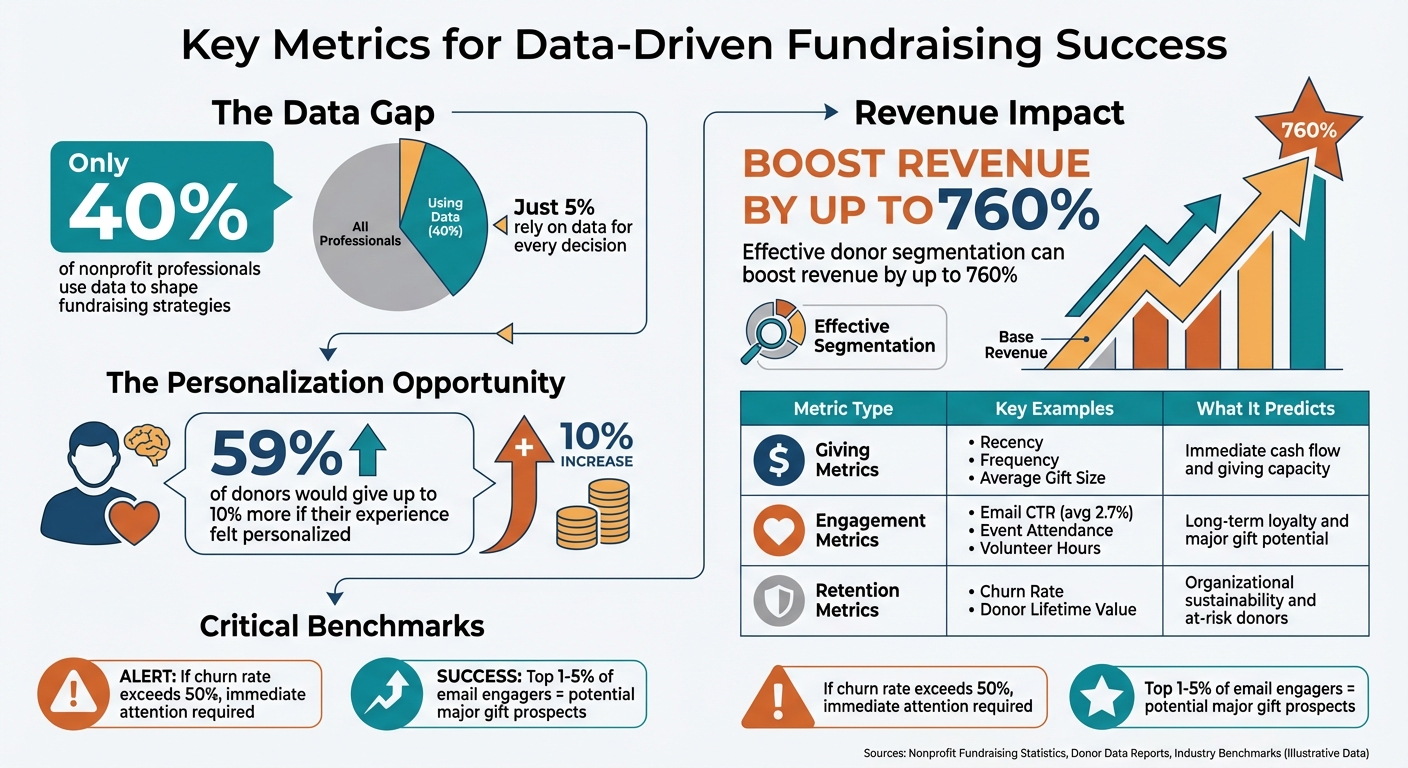
Data-Driven Fundraising Statistics: Impact on Nonprofit Revenue and Donor Retention
Once you've centralized your donor data, the next step is to dig into it and uncover giving patterns. Why does this matter? Recognizing these patterns can help you predict key behaviors: who’s likely to donate again, who might stop, and who could step up as a major donor. This kind of proactive donor analysis is often what separates successful nonprofits from those that struggle.
Unfortunately, many nonprofits don’t fully tap into their data for fundraising. But the potential payoff is massive: effective donor segmentation can boost revenue by up to 760%. By understanding these trends, you’re not just predicting donation potential - you’re also building a stronger, more sustainable strategy. The trick lies in knowing which patterns to focus on and how to act on them.
Nathan Chappell, Senior Vice President at DonorSearch, offers a thought-provoking perspective on donor analysis:
"Wealth does not equal philanthropy. We actually take all wealth data out because wealth does not determine whether someone gives."
In other words, a donor’s connection to your cause and their level of engagement often matter more than their financial capacity. This insight underscores the importance of tracking the right metrics to forecast donor behavior effectively.
Key Metrics for Tracking Donor Behavior
To make sense of donor behavior, focus on a few core metrics that guide effective segmentation. One widely used approach is RFM analysis, which stands for:
- Recency: How recently someone gave
- Frequency: How often they give
- Monetary value: How much they give
RFM analysis uncovers patterns that can help predict future actions.
But it doesn’t stop there. Engagement metrics - like email clicks, event attendance, or volunteer hours - can reveal hidden opportunities. For instance, non-financial actions often signal potential for major gifts down the road. Consider this: in 2021, the average email click-through rate for nonprofits was 2.7%. By identifying the top 1-5% of supporters who consistently click links or open emails, you might find untapped major gift prospects.
Here’s a quick breakdown of the types of metrics to track and what they reveal:
| Metric Type | Key Examples | What It Predicts |
|---|---|---|
| Giving Metrics | Recency, Frequency, Average Gift Size | Immediate cash flow and giving capacity |
| Engagement Metrics | Email CTR, Event Attendance, Volunteer Hours | Long-term loyalty and major gift potential |
| Retention Metrics | Churn Rate, Donor Lifetime Value | Organizational sustainability and identifying "at-risk" donors |
One particularly important metric is your churn rate - the percentage of donors who gave last year but haven’t yet this year. If this rate exceeds 50%, it’s a red flag that demands immediate attention. By identifying donors who gave in the past 12 months but haven’t contributed this year, you can re-engage them before they’re lost for good.
Using HelpYouSponsor's Reporting Features
Once you’ve identified the metrics that matter, tools like HelpYouSponsor make it easier to analyze and act on them. HelpYouSponsor’s dashboard automates tracking, calculating donor lifetime value by summing up all contributions from each supporter. This helps you spot high-value donors - like those who give smaller amounts frequently but contribute significantly over time.
The platform also segments donors based on their giving habits and highlights behaviors that need attention. For example, it flags donors who haven’t given in six months or monthly contributors who haven’t increased their gift in a year. These insights trigger targeted re-engagement workflows, eliminating the need for manual tracking.
Additionally, HelpYouSponsor’s real-time dashboards show which donation amounts ($20, $50, $100) perform best on your forms. This data allows you to fine-tune your ask strategies and quickly adjust to maintain momentum and long-term stability.
Personalizing Campaigns to Increase Engagement
Using donor trends to guide personalized outreach can significantly boost engagement. Generic campaigns often fall flat, but when you customize messages for specific donor groups, you create stronger connections that lead to increased involvement and lasting support.
The statistics are compelling: 74% of donors are more likely to give more or donate outside their usual schedule when presented with a clear and specific need. Additionally, 88% of donors respond positively to a combination of powerful imagery and compelling storytelling. By aligning your appeals with donors' values and interests, you can show them the tangible impact of their contributions.
Segmenting donors based on their interests, communication preferences, and past engagement is key to delivering relevant messages. For instance, if a donor has supported a water project in the past, send them updates or sponsorship opportunities highlighting children benefiting from newly installed wells. This approach ensures your messaging feels meaningful rather than random. Below, we’ll explore actionable ways to align your campaigns with donor preferences.
Practical Strategies for Campaign Personalization
Start by crafting impact-focused stories that connect donation amounts to specific outcomes. For example, explain that a $25 donation covers a student's registration fee, while $50 provides essential school supplies. Pair these amounts with real images of the beneficiaries to create a deeper emotional connection.
Adjust your ask amounts based on donor history. If a donor typically gives $30, suggesting $25 might feel too low, while $100 could seem unrealistic. Use their past giving patterns to suggest amounts that feel achievable. This method has been shown to increase fundraising revenue by an average of 11%.
Personalize your messaging by sending appeals from a real person - like a program director, field worker, or volunteer - rather than a generic "team" or organization name. Research shows 58.5% of donors prefer communications from an individual rather than a brand voice.
Since 42% of donors prefer email for appeals, focus on email while monitoring engagement across other channels. Track donor preferences to deliver messages through their preferred platforms.
Experiment with A/B testing for subject lines, imagery, and storytelling styles tailored to different donor segments. This approach helps you discover what resonates most and improves conversion rates.
Creating Custom Campaigns with HelpYouSponsor
To make personalization scalable, tools like HelpYouSponsor can take your campaigns to the next level. This platform allows you to design custom campaigns for specific donor groups, whether you're engaging first-time donors, reconnecting with lapsed supporters, or encouraging monthly sponsors to increase their contributions.
HelpYouSponsor enables you to create unique donation pages for each audience, complete with customized ask amounts based on their giving history. The platform tracks which amounts - $20, $50, $100 - yield the best results for each segment, letting you refine your strategy in real time. This data-driven approach ensures you can adapt mid-campaign to sustain momentum.
With 44% of donations now happening on mobile devices, mobile optimization is critical. HelpYouSponsor’s donation pages automatically adjust to smartphones and tablets, making the process seamless and boosting conversion rates.
For nonprofits focused on child sponsorship, the platform offers tools to connect donors with individual children's stories. By matching stories to donors based on their interests and past engagement, you can make every appeal feel personal and meaningful. This approach not only strengthens donor relationships but also encourages long-term support.
Improving Donor Retention with Predictive Analytics
Keeping donors engaged is essential for maintaining financial stability. Predictive analytics transforms donor retention into a measurable process by identifying early warning signs. Instead of waiting for donors to stop contributing, this approach allows organizations to pinpoint at-risk supporters and take action to maintain their connection.
The results speak volumes: organizations using predictive analytics have seen their "Top Prioritized Prospects" donate seven times more than other donors. Take UNICEF Australia, for example. By leveraging predictive analytics, they increased net revenue by 26%, improved campaign ROI by 35%, and saved $30,000 by sending 15,000 fewer mailers through more targeted outreach. These numbers highlight how data-driven strategies can significantly boost revenue.
Predictive models can also uncover patterns, like donors who attend virtual events being three times more likely to make year-end contributions. Unlike traditional segmentation methods, these models update in real time, adjusting donor categories based on their latest interactions. This ensures your outreach is always based on the most current data - not outdated assumptions.
"The art of nonprofit fundraising is quickly becoming a science."
- Mahir Iskender, CEO, KNDR.digital
Beyond increasing revenue, strong retention rates serve as a signal to grantmakers. High retention demonstrates community support and a stable donor base - key factors funders assess when evaluating an organization’s long-term potential. These insights also help shape strategies to reconnect with donors who have drifted away.
Re-engaging Lapsed Donors
Statistics show that 70% of donors make a single gift and then stop giving. The silver lining? Reconnecting with lapsed donors costs far less than acquiring brand-new supporters, as you already have insights into their previous connection to your cause.
By identifying which lapsed donors are most likely to return, you can focus resources where they’ll have the biggest impact. Start by analyzing data to find "look-alikes" of donors you’ve successfully re-engaged in the past. If a specific program has worked before, look for similar patterns among other lapsed donors. Then, tailor your outreach to their preferred communication methods - whether that’s email, phone, or in-person meetings.
Massachusetts General Hospital has been applying this approach since 2010. By partnering with BWF, they’ve used predictive modeling and donor scoring to focus on high-potential prospects and critical projects. This data-driven strategy has maximized their fundraising impact.
To implement similar strategies, begin by cleaning up your donor database - removing duplicates and standardizing formats ensures more accurate predictions. Refresh your predictive models every three to six months or whenever your donor data grows by 20% or more. Regular updates keep your predictions aligned with current donor behavior.
Calculating Donor Lifetime Value
Understanding donor lifetime value (LTV) takes retention insights a step further. LTV estimates how much a donor will contribute over their entire relationship with your organization. The formula is simple:
LTV = Average Donation Amount × Donation Frequency × Donor Lifespan.
Knowing a donor’s LTV helps you allocate resources wisely. For example, if a donor’s LTV is $1,000, spending $50–$100 to acquire them makes sense. This approach shifts the focus from short-term contributions to long-term value.
Organizations using analytics for LTV and cohort analysis have seen donor retention rates increase by 20%, and nonprofits leveraging LTV modeling have boosted revenue from returning donors by up to 30%. These improvements come from identifying which donor groups deserve more attention and which acquisition channels bring in loyal supporters.
At the Children’s Hospital of Philadelphia, predictive algorithms helped identify high-LTV donors, reducing the time from first contact to contribution by 17%. These donors also gave 22% more on average. This success was achieved by analyzing 800 data points per donor to prioritize high-value prospects.
To calculate LTV for your organization, segment donors into cohorts - such as by the year they were acquired or the channel through which they gave. Tools like Excel pivot tables or CRM reporting features can help you pinpoint which groups have the highest LTV and retention rates. Don’t stop at financial metrics; include factors like event attendance, email engagement, and social media activity. These additional insights provide a fuller picture of donor behavior.
"Every nonprofit that wants to be here tomorrow needs to be able to leverage data to some extent."
- Nathan Chappell, Senior Vice President, DonorSearch
Once you’ve calculated LTV for different donor segments, use these insights to project multi-year revenue. This approach allows your organization to move from short-term fundraising efforts to long-term financial planning, giving you the stability to pursue ambitious goals with confidence.
Measuring Campaign Results and Improving Over Time
Once you’ve centralized your donor data, the next step is evaluating your campaign performance. This is crucial for maintaining growth. Yet, surprisingly, only 31% of nonprofits can accurately predict their campaign revenue. Without clear metrics, organizations often rely on guesswork, which can make resource allocation and planning inefficient.
The most effective fundraising leaders don’t leave performance to chance. As Paul Matthews-Brokenshire from Salesforce.org puts it:
"The best fundraising leaders are experts on their performance metrics and prove how one dollar invested turns into more than that dollar. The deep understanding of ROI, in particular, makes it much easier to pitch for more investment".
This kind of insight shifts fundraising from a reactive process to a strategic tool for long-term growth.
How to Measure Campaign Success
Start with three core metrics: Donor Retention Rate, Average Gift Size, and Campaign ROI. These metrics help you understand donor engagement, assess whether your ask amounts align with donor capacity, and measure whether your campaigns are generating positive returns.
- Fundraising ROI: This metric shows how much revenue you generate for every dollar spent. It’s calculated by dividing total revenue by total expenses. High-performing teams often achieve a 5:1 ROI - for example, spending $10,000 to raise $50,000.
- Donor Retention Rate: This measures how many donors continue to give year over year. Calculate it by dividing the number of repeat donors by your total donor base, then multiplying by 100. Retaining donors is typically less expensive than acquiring new ones. Keep an eye on your Churn Rate - the percentage of donors who gave last year but not this year.
- Average Gift Size: Divide your total revenue by the number of donations to find this figure. It helps you understand donor capacity and set future ask amounts. Using this data, you can segment donors and tailor your appeals, ensuring you don’t under-ask major donors or over-ask smaller ones.
Additional metrics like Donor Acquisition Cost (DAC) - calculated by dividing campaign expenses by the number of new donors acquired - help you gauge the cost-effectiveness of your acquisition channels. Similarly, tracking the Conversion Rate, or the percentage of people who take action when asked, can reveal how effective your appeals are.
Platforms like HelpYouSponsor make tracking these metrics easier. Their tools centralize donation data, automatically calculate ROI, and monitor retention rates across donor segments. Real-time dashboards provide actionable insights, allowing you to adjust strategies as needed.
For instance, in March 2024, Cassie Chilcutt, Prospect Research Manager at Grand Canyon Conservancy, used embedded data analysis to refine her major gift strategy. By focusing on high-likelihood prospects, she reduced major gift officer portfolios by over a third, boosting efficiency in donor stewardship.
These metrics provide a solid foundation for refining your strategies.
Using Data to Improve Your Fundraising
Tracking metrics is only part of the equation - what truly matters is how you use that data to improve. The most successful organizations follow a test and measure cycle: try new strategies, evaluate the results, and adjust accordingly.
Conduct regular SWOT analyses (Strengths, Weaknesses, Opportunities, and Threats) to understand not just what happened but why. For example, if an email has a high open rate but low click-through rate, you might discover that while the subject line was effective, the content didn’t resonate.
Use historical data for bottom-up forecasting. By reviewing past gifts, you can identify patterns and predict donor behavior, creating realistic revenue goals. Similarly, refine your ask amounts by analyzing previous donations and wealth indicators to align with donor capacity. Organizations that effectively segment donors and personalize asks have seen revenue increases of up to 760%.
Maintaining clean data is critical. Regularly audit your database to remove duplicates, fix errors, and standardize entries. Inaccurate data can lead to flawed predictions and wasted resources.
To avoid bias, involve multiple team members in reviewing campaign results. This ensures decisions are based on data, not assumptions. As Jane Trenaman from Salesforce.org explains:
"Nonprofits need a deep understanding of metrics and what they mean to inform all decisions: from which acquisition channels to focus investment on, which segments teams should prioritise, where to unblock the pain points in the supporter journeys, to what timeframe to forecast future growth".
Promote a data-driven culture across your organization by making analytics accessible to all teams. When everyone - from leadership to frontline staff - bases decisions on evidence, your organization becomes more agile and effective. Jessica Ainsley, Insights Manager at Fred Hollows Foundation NZ, highlights this shift:
"Fundraising Intelligence is changing the way I manage and plan my campaigns. I jump in to the app every day to answer quick questions I have along the way".
HelpYouSponsor supports this approach with tools that provide a unified view of donor engagement across fundraising, marketing, and events. These reporting features help you identify which channels drive the most donations and allocate resources effectively. By tracking trends over time, you can refine your strategies to ensure financial stability and growth.
Conclusion
Achieving financial sustainability starts with making informed decisions that are in sync with your donor base. As Nathan Chappell from DonorSearch explains:
"Every nonprofit that wants to be here tomorrow needs to be able to leverage data to some extent".
Shifting from instinct-driven choices to data-focused strategies transforms fundraising from uncertain guesswork into a structured approach for long-term success.
The key is to move from insights to action. Start by centralizing donor data, analyzing behavior patterns through key metrics, personalizing outreach efforts, and consistently tracking outcomes. Organizations that adopt this method often see real results, showcasing how data can drive meaningful progress.
HelpYouSponsor offers the tools to make this process seamless. With features like donation tracking, automated retention analysis, and real-time dashboards, the platform removes the obstacles to implementing data-driven strategies. You don’t need a specialized analytics team to begin - just a willingness to understand your donors better. This ongoing insight leads to smarter strategies and deeper impact.
Emily Courville from the Humane Society highlights the potential within your database:
"Your database is a gold mine. There is so much you can learn about what your donors are doing if you just start to look".
The data you need is already there; the challenge lies in using it effectively to strengthen relationships, optimize resources, and secure a sustainable future for your mission. Strategic use of data bridges the gap between operational efficiency and long-term growth.
Start with small, measurable changes, evaluate consistently, and adapt based on what the data reveals. Financial stability thrives on continuous improvement and letting data guide your decisions.
FAQs
What’s the best way for nonprofits to organize and manage donor data effectively?
Nonprofits can streamline their donor data management by bringing everything together in one organized system. This involves consolidating essential details like donation history, contact information, and engagement preferences into a single database. Having all this data in one place makes it easier to spot trends, customize outreach, and keep records accurate.
To maintain data accuracy, it’s important to routinely update and review records, removing duplicates or outdated entries. Focusing on data hygiene ensures nonprofits have a reliable foundation for building meaningful donor relationships and making informed decisions. These steps not only simplify daily operations but also strengthen fundraising efforts over time.
What key metrics should nonprofits track to boost donor engagement?
Nonprofits aiming to strengthen donor connections should pay attention to a few key metrics that shed light on donor behavior and preferences. Start with the donor retention rate, which reflects how well you’re keeping your current supporters. Another critical measure is donor lifetime value, which calculates the total amount a donor contributes over their entire relationship with your organization. Together, these metrics provide insight into the strength of your donor relationships.
Equally important is tracking donor acquisition costs, which helps gauge the efficiency of your fundraising efforts and pinpoint the most effective outreach channels. Keeping an eye on donation frequency and recency can also identify donors who might need a gentle nudge to stay engaged. Additionally, reviewing participation in events or campaign responses can guide you in tailoring your outreach strategies to be more meaningful and personalized.
By honing in on these metrics, nonprofits can foster deeper relationships with donors and lay the groundwork for sustainable growth.
How can predictive analytics help nonprofits retain donors?
Predictive analytics enables nonprofits to hold onto donors by examining past behaviors to predict future actions. By spotting patterns that suggest a donor might lose interest, organizations can step in early and address potential concerns.
Armed with this data, nonprofits can craft customized outreach strategies that align with each donor's unique preferences. This personalized touch not only builds stronger connections but also boosts engagement and encourages long-term commitment, helping secure consistent support for the organization.