
How Future-Ready Nonprofits Design Smarter Donor Systems
How nonprofits centralize donor data, fix quality issues, integrate tools, and use automation and AI to boost retention and streamline fundraising.


Nonprofits struggle with outdated donor management tools, leading to inefficiencies and donor loss.
Key issues include:
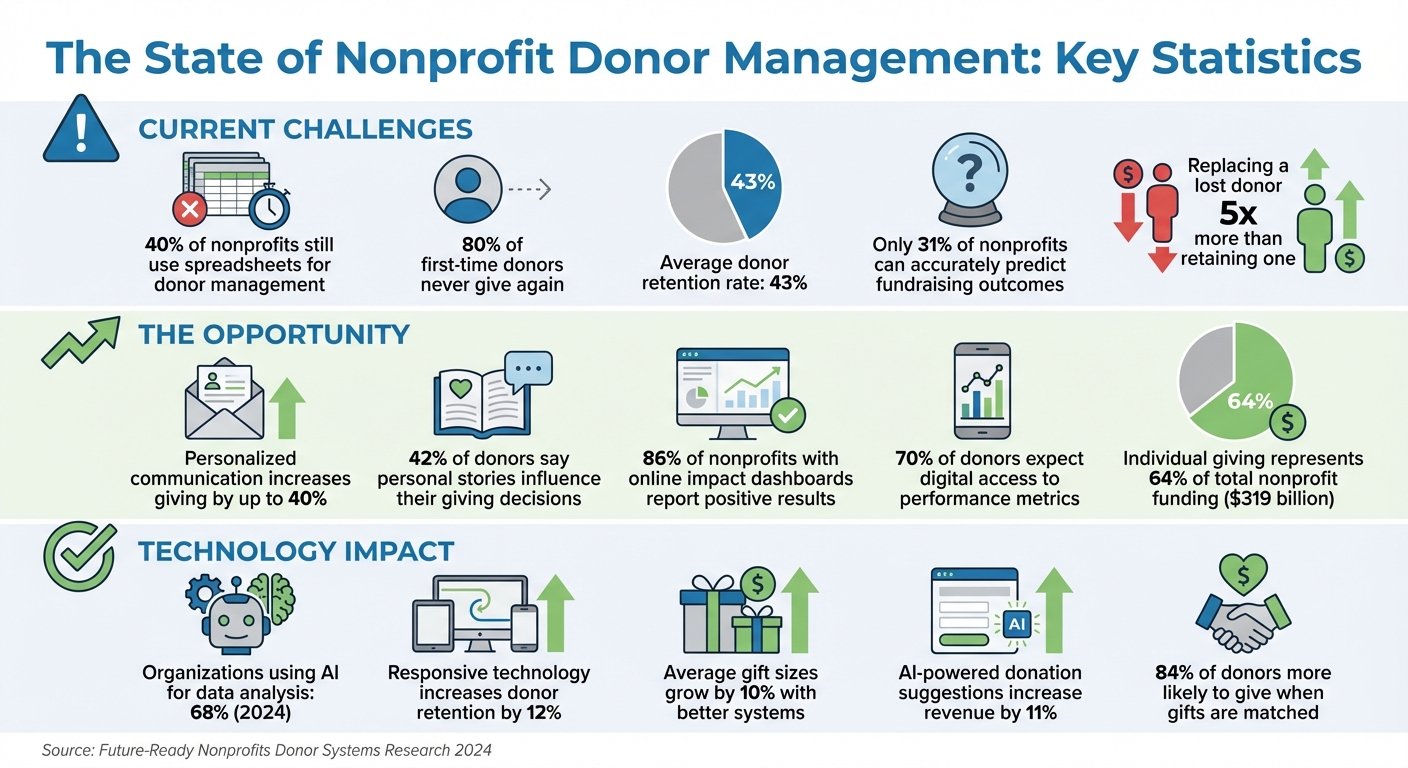
- 40% of nonprofits still use spreadsheets, causing data silos and manual errors.
- 80% of first-time donors never give again, while donor retention averages just 43%.
- Disconnected systems make it hard to forecast revenue, with only 31% of nonprofits able to predict fundraising outcomes accurately.
Smarter donor systems solve these problems by:
- Centralizing data for a 360-degree view of donor engagement.
- Automating tasks like donation processing, thank-you emails, and reporting.
- Leveraging data insights to improve retention, personalize outreach, and increase giving.
Steps to improve donor systems:
- Audit your current tools: Measure donor retention, acquisition costs, and manual inefficiencies.
- Fix data quality issues: Remove duplicates, update contact info, and use segmentation tools like RFM scoring.
- Integrate systems: Connect CRMs, donation platforms, and email tools to eliminate silos.
- Choose scalable platforms: Look for mobile access, real-time analytics, and features like matching gift integrations.
- Adopt AI and automation: Predict donor behavior, personalize campaigns, and reduce churn.
Example: EduBridge Foundation unified their systems, boosting recurring donor retention by 8% and reducing churn by 30% in six months. Tools like HelpYouSponsor offer cost-effective solutions tailored for nonprofits, ensuring growth without overspending.
Modernize your donor management system to reduce donor loss, improve efficiency, and build stronger relationships.
Nonprofit Donor Management Statistics and Impact
How Nonprofits Can Scale Donations with CRM: Ditch Spreadsheets for Smarter Donor Management
Evaluate Your Current Donor Management System
Take a closer look at your current donor management system to uncover gaps and understand how well it’s performing. Did you know that only 31% of nonprofits can accurately predict revenue from their fundraising campaigns? A major reason for this challenge is that many systems aren’t built to handle the complexities of today’s donor relationships.
Start by tracking key metrics like Revenue per Donor, Donor Acquisition Cost (DAC), and retention rates to evaluate the effectiveness of your technology. Across the nonprofit sector, the average donor retention rate is just 43%. Even more striking, replacing a lost donor costs five times more than retaining one. If your system struggles to provide these numbers quickly, that’s a serious warning sign.
"The best fundraising leaders are experts on their performance metrics and prove how one dollar invested turns into more than that dollar." – Paul Matthews-Brokenshire, Industry Solutions, Salesforce.org
Don’t forget to calculate the hours spent on manual data entry and reconciliation. This can reveal hidden inefficiencies. For instance, if it takes more than 24 hours to process donations, you likely have an integration issue. Consider the example of the EduBridge Foundation, which saw donor retention drop from 62% to 55% in a year. By unifying their CRM, survey tools, and email platforms, they boosted new recurring donor retention by 8 percentage points and reduced churn among donors with missed payments by 30% - all within six months.
Review Data Quality and Segmentation
Your donor data is only as useful as it is accurate and actionable. Start with a baseline audit to identify gaps, like missing volunteer emails, phone numbers, employer details for matching gifts, or incomplete giving histories. Watch for rising email bounce rates, which often indicate outdated contact information, and check for duplicate records that could fragment a donor’s profile. When donor communication is personalized using accurate data, giving can increase by up to 40%. But this level of personalization is impossible if your database is full of errors.
To improve segmentation, try RFM scoring - a method that evaluates Recency (when the donor last gave), Frequency (how often they donate), and Monetary value (their total contributions). This helps group supporters into meaningful categories. Your system should also flag early warning signs of donor disengagement, like declining email open rates, missed payments, or delays in outreach. If you’re still manually sorting donors in spreadsheets or can’t easily see which supporters attended your last event, it’s time to upgrade your segmentation tools. Standardize how names, dates, and addresses are entered, and assign someone to oversee data quality on an ongoing basis.
Identifying data issues is just the first step. To truly improve donor engagement, you’ll need to address integration challenges as well.
Find Integration and Workflow Problems
Poor integrations can block access to real-time donor insights. For example, if your online donation forms don’t automatically sync with your CRM, or if your email marketing and accounting software function as separate silos, you’re likely wasting time and increasing the risk of errors. Shockingly, 40% of nonprofit communications and marketing teams still rely on spreadsheets to manage data. This often means staff are manually copying information instead of focusing on building connections with donors.
Map out your workflows to identify where manual steps are slowing you down. For instance, do donations automatically trigger thank-you emails and accounting updates? Can your team access donor information on their phones during events, or are they tied to desktop systems? When you generate campaign performance reports, does the process pull real-time data from all systems, or do you have to spend hours consolidating data from multiple sources? These kinds of integration gaps make it nearly impossible to make informed, strategic decisions. By documenting where your current system falls short, you can prioritize the integrations that will have the biggest impact.
Choose Scalable Tools for Donor Management
Once you've pinpointed the gaps in your current system, the next step is to choose tools that not only address those issues but also grow alongside your nonprofit. In other words, you need a solution that can handle increasing numbers of donors, transactions, and more complex data without requiring a complete overhaul every few years. Considering that 80% of first-time donors don’t return, having a system that helps retain them is crucial.
A scalable donor management system should act as the central hub for your operations, connecting essential tools like payment processors, accounting software (e.g., QuickBooks or Sage), and marketing platforms (e.g., Constant Contact). This integration eliminates isolated data silos and ensures real-time access to critical information.
Make sure the platform you choose offers mobile access and an easy-to-use interface. Mobile access allows your team to quickly retrieve donor information during events. Additionally, evaluate the vendor’s customer support and onboarding resources to ensure your staff can learn and use the system effectively. Remember, organizations that leverage data effectively are three times more likely to see major improvements in decision-making.
Key Features of Future-Ready Platforms
The right donor management platform should simplify your daily operations while opening doors to new revenue streams. Start by ensuring it provides centralized data and seamless integration. For example, your system should automatically update donor records as soon as a gift is made and sync with your accounting software, so both your development and finance teams are always aligned.
If your nonprofit tracks unique relationships - like sponsorships - you’ll need custom fields and objects. For instance, managing a sponsorship program might require recording connections between a sponsor, a child, and a corporate partner. Without this flexibility, you could end up forcing your data into rigid templates that don’t reflect your actual needs.
Matching gift integrations are another must-have feature. Studies show that 84% of donors are more likely to give if their gift is matched, and one in three might even increase their donation when matching is available. Automating matching gift processes can increase revenue from these programs by up to 61%. Make sure your CRM can integrate with tools that capture this often-overlooked source of funding.
Finally, prioritize real-time reporting and analytics. A platform that automatically consolidates data from all connected systems can help you spot trends, evaluate campaign performance, and make informed decisions without wasting hours on manual data crunching. These capabilities are essential for choosing a system that meets your needs - and one example is HelpYouSponsor.
Why HelpYouSponsor Works for Nonprofits
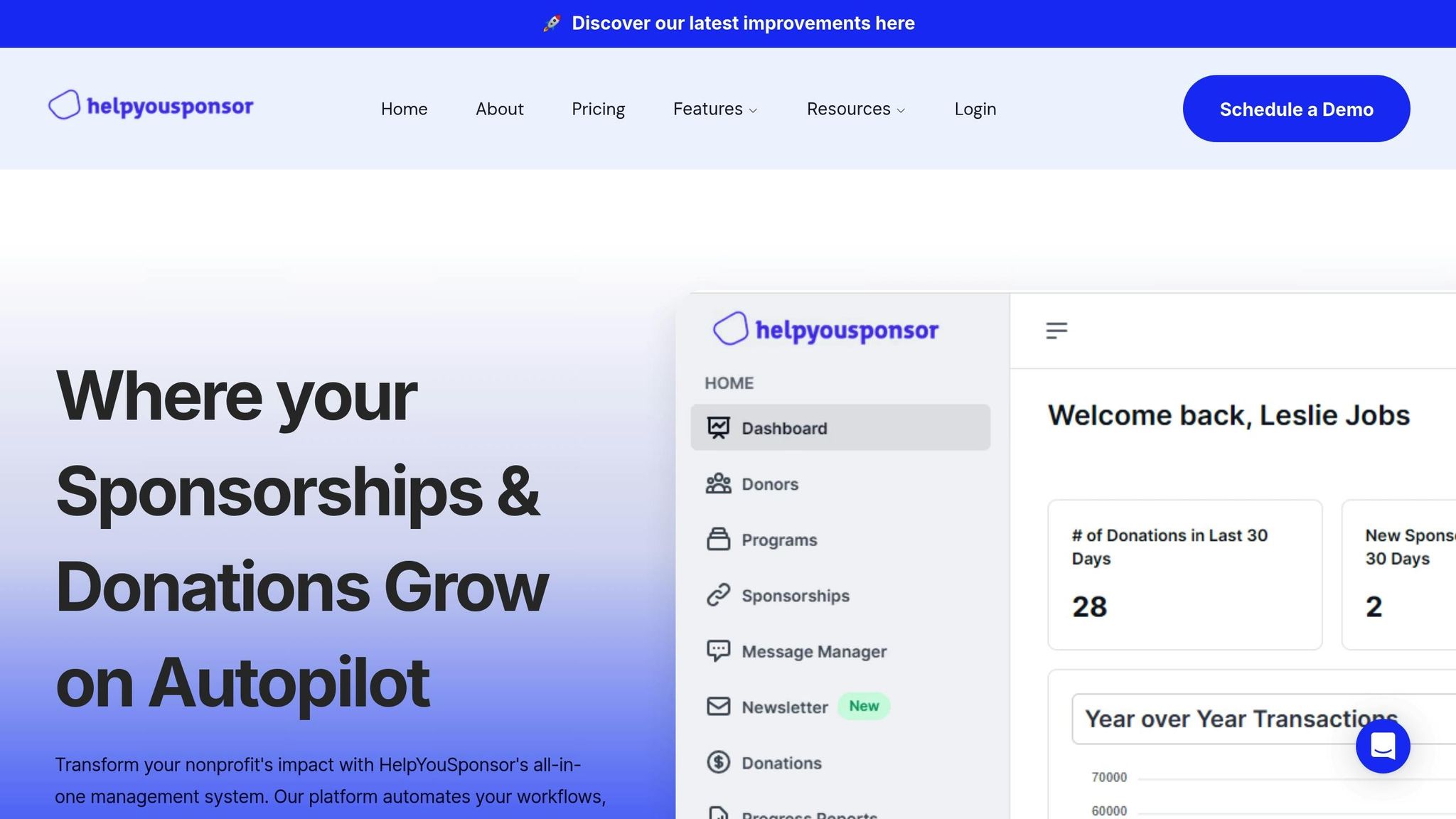
HelpYouSponsor is specifically designed for nonprofits managing sponsorship programs, donor relationships, and fundraising campaigns. Created by experts with firsthand experience in nonprofit sponsorships, the platform tackles the real challenges organizations face.
One of its standout features is its usage-based pricing model. HelpYouSponsor charges only when the software actively benefits your organization, basing costs on the number of commitments (sponsorships or donations) you track each month. For example, there’s a Free Plan for up to 10 commitments, a Pro Plan at $50/month for up to 63 commitments, and a Max Plan at $0.80 per commitment for larger programs. This approach ensures your costs scale with your organization’s growth, whether you’re managing 10 sponsors or 1,000.
The platform also offers an intuitive, user-friendly interface that minimizes the learning curve for your team. It allows you to manage sponsorships for a variety of projects - whether it’s supporting children, pastors, medical surgeries, or building campaigns - all from one centralized location. With integrated payment gateways, automated receipts and thank-you messages, and tools to showcase sponsorship opportunities directly on your website, HelpYouSponsor eliminates the hassle of juggling multiple disconnected tools. This streamlined approach lets your team focus on cultivating meaningful donor relationships instead of wrestling with spreadsheets or outdated systems.
Apply Advanced Strategies for Donor Engagement
Once your donor management system is set up, it’s time to put it to work by creating stronger, more meaningful connections with your donors. The key? Personal, timely communication. Studies show that personalized outreach can increase giving by up to 40%. And with 87% of businesses recognizing that customers expect tailored content, it’s no surprise that donors expect the same level of personalization.
To truly engage your donors, it’s crucial to understand who they are and what drives their generosity. Start by segmenting your database so you can deliver the right message to the right person at the right time. Automation can take care of repetitive tasks - like sending receipts or scheduling updates - so your team can focus on building authentic relationships. As Rob Burke, CMO of DonorDock, wisely notes:
"Tools don't build relationships...you do. But the right tools, used wisely, can give you back the time and focus you need to connect meaningfully with your donors."
With this approach, you’re not just keeping up with donor expectations - you’re setting the stage for a more effective and future-focused donor management strategy.
Use Data Segmentation for Personalized Campaigns
Segmentation is all about dividing your donor base into smaller groups based on shared traits, allowing you to craft messages that truly resonate. A great starting point is RFM analysis, which focuses on donors’ Recency, Frequency, and Monetary value to refine targeting. By understanding giving patterns, you can tailor your campaigns to match donor behavior.
But don’t stop there. Go deeper by segmenting donors based on their interests, demographics, or where they are in their relationship with your organization. For example, if your nonprofit supports both education and healthcare, share stories that align with each donor’s preferred cause. You can also reconnect with "LYBUNT" (Last Year But Unfortunately Not This Year) and "SYBUNT" (Some Year But Unfortunately Not This Year) donors by sending thoughtful “we missed you” messages. Research backs this up: 42% of donors say personal stories from beneficiaries influence their decision to give. Matching your content to what matters most to your donors can make a noticeable impact.
Here’s a real-world example: In July 2024, Classy (GoFundMe Pro) introduced an "Intelligent Ask Amounts" feature powered by machine learning. During A/B testing, this tool suggested donation amounts based on each donor’s giving history, leading to an 11% average increase in revenue for participating nonprofits. It’s proof that even small, data-driven adjustments - like recommending a donation amount that suits a donor’s capacity - can deliver big results.
Once you’ve segmented your audience, automation can help you stay connected without adding extra work for your team.
Automate Communications and Impact Updates
Automation makes it easier to keep donors engaged while lightening the load on your staff. A great place to start is with a gratitude cadence: send a personalized thank-you message within three days of a gift, an impact report within 30 days, and regular updates every three months. These touchpoints reinforce your donors’ contributions and keep your organization top of mind.
You can also set up workflows to handle routine communications, like instant gift acknowledgments, birthday or anniversary greetings, and syncing emails with your CRM. For instance, configure your system to send a receipt and thank-you email immediately after a donation is made, and follow it up with a personal phone call within 48 hours for major gifts. This combination of automation and personal outreach not only reduces donor drop-off but also adds a thoughtful, human element.
The numbers speak for themselves: while 38% of online donors typically give again the following year, the retention rate for first-time online donors is just 25%. Automated updates can help bridge this gap by turning data into meaningful donor interactions. For example, 86% of nonprofits that provided donors with online access to impact dashboards reported positive results, and 70% of donors now expect digital access to performance metrics. Use automation to consistently deliver these updates through email newsletters, SMS messages, or donor portals on your website. It’s a simple way to keep your donors informed, engaged, and inspired to give again.
Prepare Your System for Future Trends
To build on the scalable tools mentioned earlier, it's crucial to get your system ready for upcoming trends. A forward-thinking donor system adapts to changes in technology, donor expectations, and fundraising practices. With 58% of 501(c)(3) organizations already using AI in digital communications as of April 2024, adopting new tools wisely can position your nonprofit for success. This preparation sets the stage for incorporating advanced analytics.
Maintain Data Hygiene and Keep Systems Updated
Your donor management system is only as good as the data it holds. Before diving into AI or predictive analytics, make sure your database is clean, accurate, and up-to-date. Regular audits are essential to remove duplicate records and outdated information. Neglecting this step can undermine automation and segmentation efforts.
Set up a data governance framework with clear standards for quality, access, and ongoing maintenance. This framework should include consistent guidelines for how staff enter and manage donor information, ensuring everyone follows the same process. Syncing your CRM with tools like email platforms and event management software can also help eliminate repetitive data entry and reduce errors. One mid-sized nonprofit that streamlined its data management saw a 15% increase in revenue within a year.
Review your technology roadmap annually to align with new trends, goals, and lessons learned. A 2-3 year planning window is ideal, as longer-term plans may become outdated due to rapid tech advancements. Prioritizing data quality pays off - organizations that focus on this are 3 times more likely to see significant improvements in decision-making.
Once your data is in top shape, you can confidently use AI to predict donor behaviors and improve engagement strategies.
Use AI and Predictive Analytics
AI isn't a futuristic concept anymore - it's a practical tool that nonprofits are using today to predict donor behavior, personalize outreach, and reduce donor churn. By 2024, 68% of 501(c)(3) organizations are leveraging AI to analyze constituent data, and the results are impressive. AI can comb through historical data to find "statistical look-alikes" in your database, helping you identify new prospects similar to your best donors. It can also predict actions like whether a donor will renew their gift, how much they might donate next, or their potential to become a major or planned giver.
Here are some real-world examples:
- In 2022, the American Cancer Society, under the leadership of Ben Devore, used machine learning to pinpoint effective digital ad campaigns. This led to a donor engagement rate of nearly 70% and revenue exceeding benchmarks by 117%.
- In 2019, Animal Haven, a New York nonprofit, used Fundraise Up to analyze website visitor behavior and tailor donation suggestions in real-time, resulting in a 264% boost in recurring donors.
- In May 2020, the Rainforest Action Network tested software from Accessible Intelligence Limited to refine writing styles and communication timing for fundraising appeals. The result? An 866% increase in converting one-time donors into monthly supporters.
The best approach is to start small and ensure human oversight. Begin with focused use cases and pre-built models to test how AI fits into your organization. Use AI for tasks like decision-making and content drafting, but have humans review outputs for tone, accuracy, and ethics. As Ashutosh Nandeshwar, SVP of Data Science and Analytics at CCS Fundraising, puts it:
"Especially with generative AI, not only can it be a lever for becoming more efficient, but [nonprofits] can also free up time to do the things they do best, which is being donor-centric, stewarding and cultivating those donors."
AI can also help identify donors at risk of disengaging, enabling you to send targeted follow-ups like impact reports or thank-you messages before they stop giving. Considering that first-time donor retention rates are typically between 20% and 30%, and acquiring a new donor often costs 50% more than their initial gift, these insights can have a big impact. However, keep in mind that AI can't fix poor fundraising practices. It's a tool to enhance your strategy, not a replacement for the personal connections that drive successful fundraising. Pairing AI with these human-centered efforts can refine your donor engagement approach even further.
Conclusion
Create a donor system that grows alongside your nonprofit’s mission. Successful organizations today view their donor management systems as essential partners in achieving their goals. By centralizing donor data, automating repetitive tasks, and leveraging tools like HelpYouSponsor to handle sponsorships and individual giving, your team can focus on what truly matters: building genuine connections with supporters.
The numbers speak for themselves: Individual giving makes up 64% of total nonprofit funding, amounting to approximately $319 billion. Yet, many nonprofits still face challenges like a 50% annual donor retention rate. With responsive technology, donor retention has increased by 12%, and average gift sizes have grown by 10%.
These gains come from deliberate actions: keeping your data clean, segmenting donors effectively, and using AI to anticipate donor needs. Start by auditing your data, mapping out the donor journey, and identifying one or two areas where automation can save time. These steps align with earlier advice on improving data quality and streamlining tasks. Whether you’re managing child sponsorships, running targeted campaigns, or overseeing general fundraising, platforms like HelpYouSponsor adapt to your needs - from free plans for new organizations to scalable, usage-based pricing as you grow. This foundation positions you to stay ahead of emerging trends.
Your donors expect transparency, personalization, and clear impact reporting. Build your system today to meet their expectations tomorrow.
FAQs
How can nonprofits centralize donor data to boost engagement and fundraising success?
To streamline donor data management, nonprofits should establish a centralized data hub that seamlessly integrates all systems - like online donation forms, email marketing tools, and event platforms. At the same time, individual programs or chapters can retain control over their specific records. This setup eliminates the need for manual data transfers, reduces duplicate entries, and ensures every interaction is recorded in real time.
Keeping data clean and accurate is essential. Regular tasks such as deduplication, verifying contact details, and standardizing key metrics - like donor lifetime value, retention rates, and average donation size - help maintain data integrity. This accuracy allows for better decision-making and supports personalized donor communication at scale.
Incorporating data stewardship into daily workflows is equally important. Assign dedicated data managers, set up alerts for unusual trends, and use dashboards to monitor donor engagement metrics. With access to current donor histories and segmented lists, teams can send personalized thank-you notes, suggest appropriate donation levels, and design targeted campaigns. This approach strengthens donor relationships and leads to more successful fundraising efforts.
How does AI help nonprofits predict donor behavior and improve retention?
AI is transforming the way nonprofits understand and retain their donors. By analyzing past donation patterns, demographic details, and engagement habits, AI can predict how likely someone is to donate again, the best donation amount to suggest, and even the most effective ways to communicate. This shifts nonprofits from simply reacting to past behavior to actively planning for future success.
With these predictions, AI can pinpoint donors who might be at risk of losing interest and recommend tailored strategies to re-engage them. It can also handle tasks like follow-up emails and donor segmentation automatically, giving staff more time to focus on building meaningful connections. The outcome? Smarter resource management, more satisfied donors, and improved retention rates.
How can nonprofits use scalable donor systems to drive growth?
Scalable donor management systems play a key role in helping nonprofits grow by keeping all donor information - like donation history, communication preferences, and engagement metrics - in one central hub. This streamlined approach makes it easier for organizations to segment their supporters, create personalized outreach, and automate routine tasks such as sending receipts or thank-you notes. The result? Staff can spend less time on administrative work and more time building meaningful relationships with donors.
What’s more, these systems grow alongside the nonprofit, accommodating additional users, campaigns, and integrations (like email marketing or event management tools) without the need for costly upgrades. Features such as real-time analytics, predictive giving models, and automated recurring gift processing provide valuable insights, enabling nonprofits to make smarter decisions and boost donor retention.
By simplifying operations, cutting administrative costs, and improving donor engagement, scalable donor management systems equip nonprofits to grow sustainably and work toward achieving their long-term missions.