
FATF Compliance: Reducing Harm to Nonprofits
How risk-based assessments, internal controls, and technology can stop banks from de‑risking nonprofits under FATF rules.


Nonprofits face growing challenges due to compliance with FATF's Recommendation 8 (R.8), aimed at preventing misuse for terrorist financing. While intended to focus on high-risk organizations, many nonprofits are unfairly labeled as high-risk, leading to financial exclusion. Banks often "de-risk" by severing ties with nonprofits, fearing regulatory penalties. This disrupts critical operations, especially for those providing international aid.
Key takeaways:
- De-risking by banks: Nonprofits lose access to banking services, delaying transfers and closing accounts.
- FATF updates: Simplified measures for low-risk nonprofits (October 2023, February 2025) stress proportionate compliance.
- Solutions: Evidence-based risk assessments, stronger internal controls, collaboration with regulators, and leveraging centralized platforms for transparency.
Nonprofits can address these challenges by improving transparency, automating compliance processes, and partnering with regulators to ensure fair implementation of FATF standards.
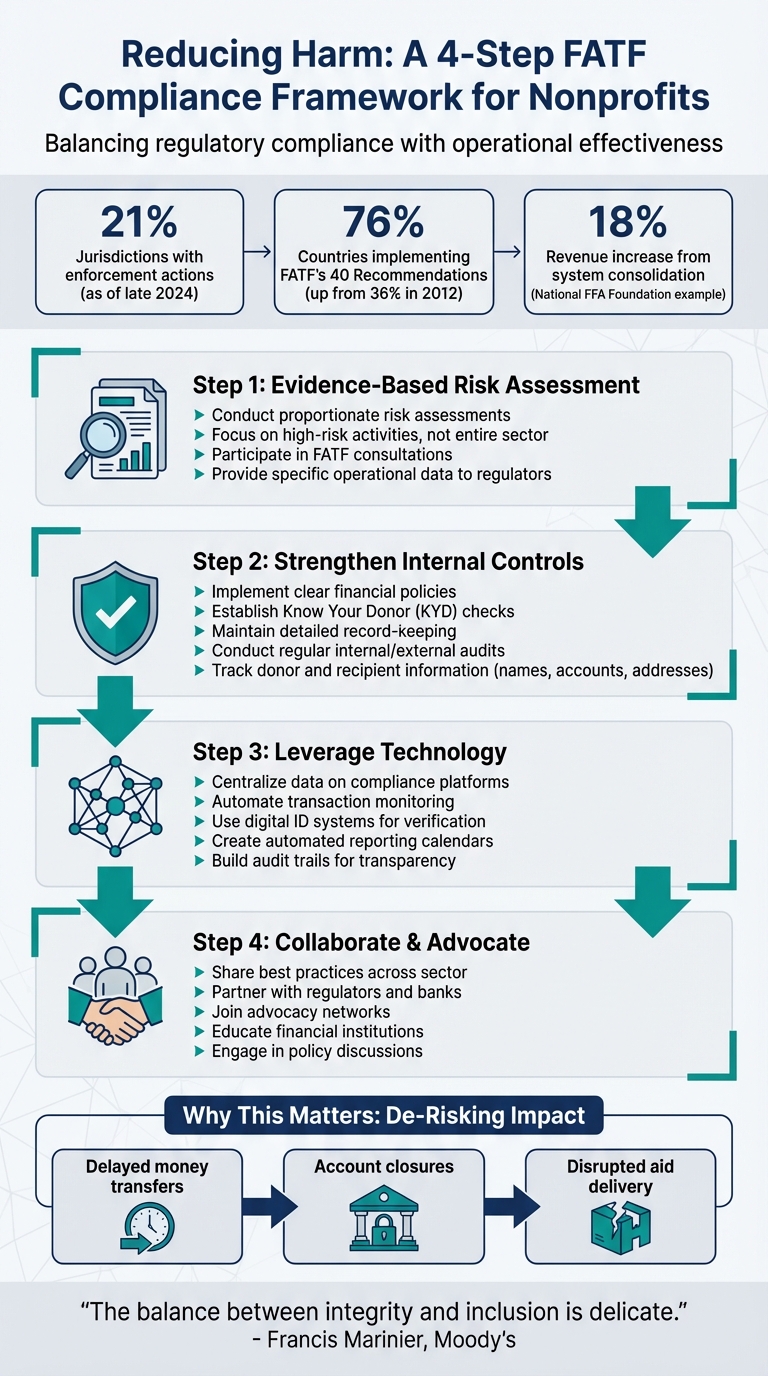
4-Step Framework for FATF Compliance in Nonprofits
The Main Challenges: De-Risking and Financial Exclusion
Why Banks Avoid Nonprofits
Banks often choose to cut ties with nonprofits rather than deal with the complexities of managing risks, largely due to pressure from the Financial Action Task Force (FATF). This practice, known as de-risking, has become a significant hurdle for nonprofit organizations. As the European Center for Not-for-Profit Law puts it:
"De-risking is the phenomenon of financial institutions terminating or restricting business relationships with clients or categories of clients to avoid, rather than manage, risk."
The fear of regulatory penalties makes the cost of due diligence too high for many banks. Even though nonprofits rarely present genuine financial risks, they are frequently labeled as high-risk entities without sufficient evidence to back up such claims. This creates a challenging "guilty until proven innocent" scenario, where nonprofits must prove their credibility before gaining access to banking services. The result? A cascade of difficulties that disrupt their operations, often requiring more robust child sponsorship software features to maintain transparency and compliance.
The Ripple Effects of Financial Exclusion
The impact of de-risking goes far beyond regulatory compliance headaches. According to the Charity & Security Network:
"With this report, the question as to whether financial access is a problem for NPOs has now been answered: it definitively is."
Financial exclusion takes many forms - delayed money transfers, rejected account applications, and sudden account closures. These obstacles directly undermine the ability of nonprofits to carry out their missions. The Charity & Security Network further highlights the issue:
"Banks under pressure to comply with AML/CFT regulatory expectations and sanctions have delayed or denied financial transfers and closed accounts, complicating efforts by charities and humanitarian groups trying to deliver aid."
For nonprofits working internationally, these financial roadblocks can be the difference between providing critical aid and leaving communities in need without support. While FATF’s risk-based approach is intended to safeguard legitimate nonprofits, gaps in its implementation continue to create unintended harm, impacting the very groups it seeks to protect.
sbb-itb-a630d3d
NPOWG Webinar | De-risking & Financial Inclusion
How to Reduce Harm: Risk-Based and Proportionate Approaches
Reducing financial exclusion and de-risking requires a shift toward evidence-based risk assessments and proportionate monitoring. The Financial Action Task Force (FATF) made this clear in its updated standards from February 2025, which emphasize the need for a measured approach. Specifically, countries are encouraged to:
"allow and encourage simplified measures in lower risk areas."
This focus on proportionality is essential. Not all nonprofits carry the same level of risk. FATF Recommendation 8 was never meant to target the entire nonprofit sector but rather a small subset of organizations that are genuinely at risk of being exploited for terrorist financing. Unfortunately, many banks and regulators still apply blanket compliance measures, creating unnecessary obstacles for legitimate organizations. These updated standards open the door for better collaboration between nonprofits and regulators.
Conducting Evidence-Based Risk Assessments
Accurate, evidence-based risk assessments are crucial for aligning with FATF standards and addressing financial exclusion. Nonprofits should actively collaborate with regulators to ensure these assessments are grounded in real-world operations rather than assumptions. A good example of this approach comes from the Wolfsberg Group, a collective of 12 major global banks. During FATF's consultation on revisions to Recommendation 16, the group highlighted operational challenges and data privacy concerns.
Nonprofits can take a similar approach by participating in FATF consultations. A FATF report revealed that as of late 2024, only 21% of jurisdictions (13 out of 62 respondents) had issued supervisory findings or enforcement actions on compliance. This indicates many countries are still figuring out how to implement these standards, offering nonprofits a timely opportunity to share their perspectives.
When engaging with regulators, nonprofits should focus on providing specific, actionable data. For instance, compliance costs and monitoring systems often disrupt operations. One example is the unbundling of payments, which can increase costs and cause delays. Alan Ketley of the Wolfsberg Group explains:
"As PSPs work towards compliance, there must be consideration of potential unintended consequences on users – for example, if intermediaries have to unbundle payments, then there will be cost implications for users along with potential delays."
Providing such detailed insights helps regulators develop proportionate monitoring systems that address risks without creating unnecessary burdens.
Proportionate Monitoring and Outreach
The February 2025 FATF updates stress that compliance efforts must be "focused, targeted, and risk-based" rather than applying broad, one-size-fits-all measures. Monitoring should prioritize activities, partners, or geographic areas identified as higher risk through evidence-based assessments, rather than scrutinizing every transaction equally.
For nonprofits operating in lower-risk contexts, simplified due diligence can reduce administrative burdens while maintaining compliance. Leveraging flexible technology solutions - like hybrid data formats that handle both structured and unstructured data - can also help organizations adapt to evolving regulatory requirements.
When working with banks, nonprofits should refer to the Interpretive Note to Recommendation 8 (INR.8), which emphasizes that compliance measures should be proportionate. As Francis Marinier from Moody's points out:
"The balance between integrity and inclusion is delicate."
Strengthening Internal Controls
Strong internal controls are essential for maintaining a nonprofit's credibility and operational strength. While collaborating with regulators is crucial, nonprofits must also focus on building their own internal frameworks. These controls show a commitment to compliance, safeguard relationships with banks, and protect both reputation and day-to-day operations.
Setting Up Internal Fund Management Controls
To establish effective internal controls, nonprofits need effective nonprofit sponsorship programs, detailed record-keeping, and appropriate "Know Your Donor" (KYD) checks to confirm the legitimacy of donations. The level of due diligence should match the value and potential risk of each contribution.
Systems must collect complete information about both donors and recipients, including names, account numbers, and physical addresses. This helps align with FATF Recommendation 16 (the "Travel Rule") and assures banks and regulators of the organization's transparency. Regular audits - both internal and external - add another layer of protection against illicit financial activity.
It's also important to design systems that handle both structured and unstructured data. This flexibility ensures that your organization can adapt as compliance requirements evolve across different regions.
Beyond internal measures, working with others in the sector can amplify these efforts.
Sector-Wide Collaboration on Best Practices
Collaboration across the nonprofit sector can bolster collective resilience. Many organizations, especially smaller ones, face challenges in developing comprehensive compliance systems due to limited resources. By sharing knowledge and practices, nonprofits can overcome these hurdles together.
Create open communication channels to stay updated on regulatory changes and new risks affecting nonprofit operations. Partnering with regulators, governments, and financial institutions can help clarify the generally low-risk nature of nonprofit activities, addressing issues like de-risking.
Joint training programs are another way to help smaller organizations gain access to essential tools for risk assessment, due diligence, and monitoring. Additionally, engaging in discussions with banks and policymakers allows nonprofits to educate financial institutions about their operations, reducing the stigma that can lead to account closures.
A great example of this collaborative approach is the Wolfsberg Group’s model, which shows how unified standards can improve internal processes and strengthen sector-wide compliance efforts.
Using Technology to Improve Compliance and Operations
Technology has become a game-changer for meeting FATF compliance requirements. It simplifies processes by centralizing data, automating reporting, and maintaining transparent records that meet the needs of both regulators and financial institutions. These tools not only address regulatory demands but also improve operational efficiency, creating a seamless connection between compliance and day-to-day activities.
Using Platforms Like HelpYouSponsor for Transparency
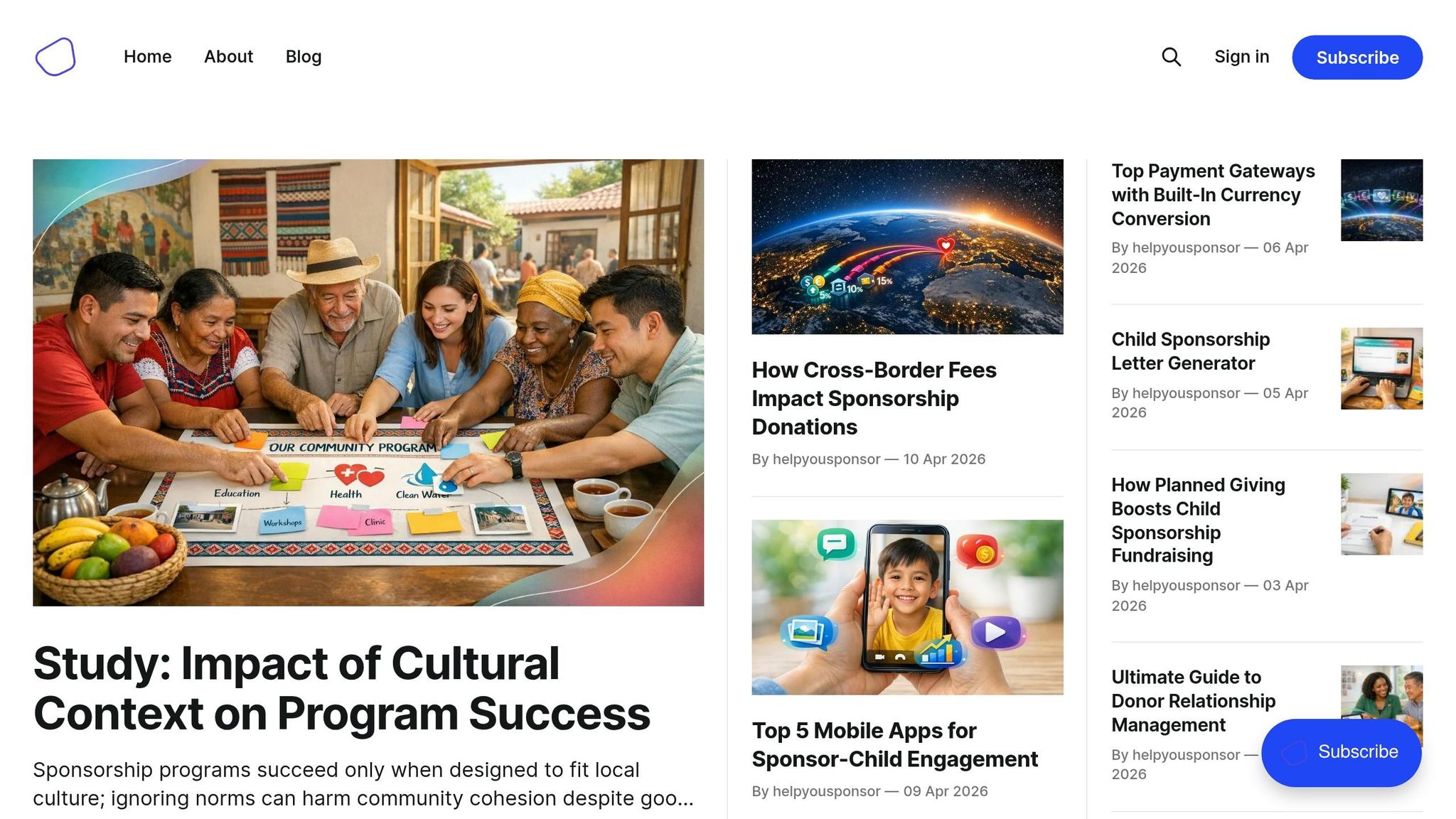
Centralized platforms are transforming how nonprofits meet transparency expectations. Take HelpYouSponsor, for example. This platform offers tools tailored for nonprofits, enabling them to meet the stringent transparency standards required by banks and regulators. It consolidates key information - such as donor details, donation programs, payment methods, and transaction dates - into a single, accessible location. This makes it easy for nonprofits to demonstrate clear record-keeping and provide a complete picture of where funds originate and how they’re used.
For organizations operating across multiple regions, jurisdiction-based access controls ensure compliance with varying local data regulations. Additionally, the platform’s custom report builders allow nonprofits to pre-load regulator-specific data fields, turning complex annual reporting tasks into a quick and painless process. Audit trails further enhance accountability by creating permanent records of communications between sponsors and recipients.
The platform also helps nonprofits track trends, which can be critical in demonstrating program effectiveness and financial stability. For instance, if a bank raises concerns about your organization's risk profile, you can present detailed analytics that highlight consistent donor behavior, successful program outcomes, and transparent fund flows. These insights can directly challenge assumptions that often lead to de-risking practices.
While centralization improves transparency, automation takes compliance to the next level by reducing manual workloads.
Automating Compliance and Reporting
Automation builds upon centralized transparency to make compliance even easier. For smaller nonprofits, which often struggle with limited resources, automation can significantly reduce the administrative load. As the Financial Action Task Force points out:
"Reliable digital ID can make it easier, cheaper, and more secure to identify individuals in the financial sector and help with transaction monitoring requirements and minimize weaknesses in human control measures".
Digital identity systems streamline donor verification, making the process faster and more accurate compared to manual methods.
Automated systems also monitor transactions for suspicious activities, flagging potential issues without requiring constant manual oversight. By integrating data into a centralized system, nonprofits eliminate the inefficiencies of juggling multiple disconnected tools, which helps close compliance gaps. A great example is the National FFA Foundation, which consolidated 14 separate systems into one centralized platform in April 2026. This move not only streamlined their operations but also resulted in an 18% revenue increase.
Another way automation simplifies compliance is through automated reporting calendars. These calendars send reminders for filing deadlines, ensuring your organization stays on top of regulatory requirements. As KLR compliance experts emphasize:
"Regulatory bodies and funding sources often require these forms, and failure to complete could result in loss of funding or penalties. It is wise to outline all required reporting deadlines on a reporting calendar".
Automation can also handle complex calculations, such as the IRS public support test (the 33% rule). By automatically tracking donor types and revenue sources over a rolling five-year period, nonprofits can maintain their public charity status without the hassle of managing spreadsheets.
When compliance is seamlessly integrated into your daily workflow, it stops being a burden. This allows nonprofits to focus their energy on advancing their mission rather than getting bogged down by administrative tasks.
Conclusion
FATF compliance doesn’t just meet regulatory demands - it also protects your mission. The secret lies in balancing three key strategies: using risk-based approaches, reinforcing internal controls, and embracing technology. Focus on high-risk areas while streamlining oversight for low-risk activities to maintain compliance without disrupting your operations.
Proportionality is critical. FATF standards now support simplified measures for lower-risk areas, recognizing that not all nonprofits carry the same level of risk. Keeping transparent records and conducting evidence-based risk assessments (like ensuring program spending exceeds 75%) helps establish trust with regulators and financial institutions.
Collaboration also plays a vital role in shaping fair policies. The Global NPO Coalition on FATF highlights the importance of partnerships between nonprofits, governments, and regulators to prevent financial exclusion. They stress:
"The aim is to mitigate the unintended consequences of countering the financing of terrorism (CFT) policies on civil society in order that legitimate charitable activity is not disrupted".
Being part of advocacy networks and engaging in sector-wide discussions can influence policies and protect charitable work.
Technology, meanwhile, transforms compliance into an operational strength. Digital tools simplify data management, automate reporting, and create the audit trails that regulators and banks expect. When compliance integrates seamlessly into everyday workflows, nonprofits can save time and resources, allowing them to focus on their core mission.
With 76% of countries now implementing FATF's 40 Recommendations - up from just 36% in 2012 - the global regulatory landscape is evolving. Nonprofits that adopt transparent, risk-based practices can not only comply but thrive, ensuring they continue to serve their communities effectively while meeting regulatory expectations.
FAQs
How can my nonprofit prove it’s low-risk to our bank?
To reassure your bank that your nonprofit poses minimal risk, take a risk-based approach in line with FATF (Financial Action Task Force) recommendations. Show proof of compliance with AML/CFT (Anti-Money Laundering/Countering the Financing of Terrorism) measures. This includes maintaining clear and transparent financial records, implementing strong internal policies, and demonstrating active risk management practices. By aligning with FATF standards and maintaining consistent compliance, you can help ease concerns and minimize the chance of financial exclusion.
What internal controls are essential for FATF compliance?
To meet FATF compliance standards, organizations need to put in place strong internal controls that protect their funds, ensure accurate financial records, and minimize the risk of misuse. Here’s where the focus should be:
- Donation Acceptance: Establish clear policies to verify the legitimacy of donations. This includes identifying donors, documenting contributions, and ensuring funds come from lawful sources.
- Spending Oversight: Implement strict oversight mechanisms to monitor how funds are allocated and spent. Require approvals for expenditures and maintain transparency in financial transactions.
- Financial Record Management: Keep detailed and accurate records of all financial activities. This not only ensures compliance but also helps build trust with stakeholders by showing accountability.
By concentrating on these areas, organizations can better align with FATF requirements while protecting their resources effectively.
How can HelpYouSponsor reduce compliance workload and de-risking?
HelpYouSponsor simplifies compliance and lowers risks by automating donor management. It centralizes data to cut down on errors and includes built-in reporting tools to make tracking easier. These features take the hassle out of manual processes, allowing nonprofits to work more efficiently and focus on their mission.