
Effective Donor Management: Building Trust and Fostering Engagement


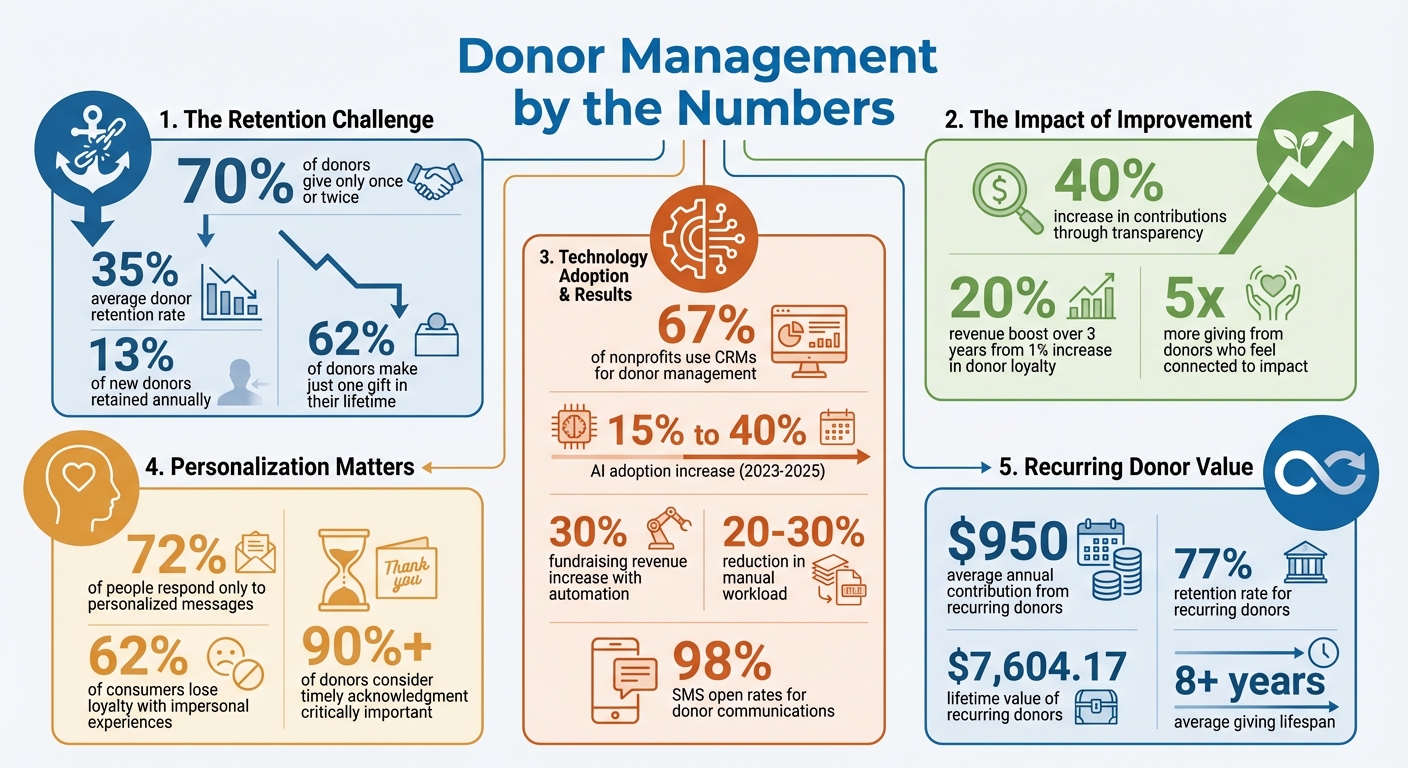
To strengthen donor relationships and improve retention, nonprofits need a clear donor management strategy. Here's the core takeaway: Most organizations struggle with retaining donors, as 70% of them give only once or twice, and retention rates hover around 35%. However, prioritizing transparency, personalization, and technology can significantly improve outcomes.
Key insights:
- Transparency boosts contributions by up to 40%.
- A 1% increase in donor loyalty can lead to a 20% income boost over three years.
- Technology like CRMs and AI tools can automate tasks, such as using ChatGPT for nonprofits, improve segmentation, and predict donor behavior, saving time and increasing revenue.
Actionable steps:
- Create a framework: Map the donor journey (Awareness, Research, Decision, Retention) and set SMART goals.
- Segment donors: Use data like Recency, Frequency, and Monetary value (RFM) to tailor outreach.
- Personalize communication: Address donors by name, reference specific contributions, and celebrate milestones.
- Leverage multiple channels: Use email, social media, direct mail, and SMS based on donor preferences.
- Adopt technology: Use CRMs and AI-driven tools to automate tasks, track engagement, and analyze data.
- Show impact: Provide clear updates on how donations are used with visuals and detailed reports.
Building Strong Relationships: Donor Retention Strategies that Work
Creating a Donor Management Framework
To build lasting relationships with donors, you need more than good intentions - you need a structured plan. A solid framework ensures that every interaction is purposeful and prevents you from simply reacting to situations. Instead, you’ll be proactively nurturing your relationships.
Think of donor engagement as a journey with distinct stages: Awareness, Research, Decision, and Retention. Each stage requires a tailored approach. For instance, a first-time donor might appreciate a warm welcome and clear updates on how their contribution is making an impact. On the other hand, a long-time supporter might value exclusive insider updates or invitations to special events.
A centralized data system is the backbone of this framework. Whether you use a CRM or a dedicated donor management platform, having all your donor interactions - like email opens, event attendance, volunteer hours, and giving history - in one place is essential. This data helps you make informed decisions about your next steps. With your framework in place, it’s time to set clear, actionable goals to guide your donor interactions.
Setting Clear Goals for Donor Management
Vague goals like "improve retention" won’t cut it. Instead, aim for SMART goals - specific, measurable, achievable, relevant, and time-bound. For example, instead of saying, "We want better retention", you could set a goal to increase donor retention from 35% to 45% by December 2026. Or, commit to acquiring 200 new donors through social media campaigns in the first quarter.
Tracking the right metrics is just as important as setting goals. Indicators like donor retention rates, acquisition costs, and donor lifetime value provide insights into the long-term benefits of your efforts. For example, in June 2025, BWF partnered with a leading children’s hospital to refine its donor engagement strategy by using donor personas and a digital marketing plan. The results? A 51% increase in year-end giving revenue, a 22% boost in the number of gifts, and a 25% rise in first-time donors.
It’s also crucial to align your goals with your mission, not just your budget. For example, an environmental nonprofit might aim to convert 15% of one-time donors into monthly supporters within six months. This approach creates a reliable funding base for ongoing conservation efforts. As Tobi Nifesi from TechSoup aptly put it:
"Your donor management strategy is vital to keeping your nonprofit organized and donors happy."
Segmenting Your Donor Base
Once your framework is established, the next step is segmentation. Treating all donors the same is a missed opportunity. Segmentation allows you to tailor your messages and strategies to specific groups, making your efforts more effective.
Start with RFM analysis - Recency, Frequency, and Monetary value. For example, a major donor who gave $10,000 three years ago (high monetary value, low recency and frequency) requires a different approach than someone who donates $25 monthly (high recency and frequency, moderate monetary value). A lapsed major donor might appreciate a personal phone call, while a monthly donor would benefit from regular impact updates.
But don’t stop at financial data. Segment donors based on engagement signals like volunteer activity, email open rates, and event attendance. For instance, researchers once analyzed email data to identify 20 highly engaged individuals. After conducting wealth screenings, five were flagged as potential major donors capable of giving $25,000 or more annually. Within a year, one of these prospects became a major donor through targeted outreach.
You can also segment based on communication preferences and interests. If a donor who usually gives $100 annually suddenly donates $500, that’s a signal to reach out with a personalized message. Some donors may prefer email updates, while others respond better to direct mail or text messages. If your organization runs multiple programs, such as youth education and senior services, donors interested in one area should receive tailored updates and appeals specific to that program.
The more detailed your segments, the more personalized your outreach can be. For example, instead of lumping all high-income donors together, you could create a group like "high-income, environmentally conscious donors aged 45–60 who prefer email communication." This level of specificity allows you to craft messages that resonate with their values and motivations. It’s worth noting that 62% of consumers say they would lose loyalty to a brand if the experience feels impersonal. This principle applies to nonprofits, too - personalization matters.
Building Strong Donor Relationships
Once you’ve organized your donor segments, the next step is creating meaningful connections with each group. Strong donor relationships thrive on consistent, personalized interactions that make supporters feel valued and tied to your mission. In fact, donors who feel connected are five times more likely to increase their contributions over time.
At the heart of these relationships lies personalization. And no, it’s not just about adding a first name to an email. It’s about recognizing their specific gift amount, referencing the campaign they supported, and celebrating milestones like the anniversary of their first donation or lifetime giving achievements.
"The stronger your donor relationships, the more donors you'll have who return month after month, year after year."
But personalization is just one part of the equation. You also need to meet donors where they are - on their preferred communication channels - and provide clear, transparent updates on how their contributions are making an impact. When you combine these elements, you’re not just retaining donors - you’re turning them into advocates for your cause.
Personalizing Communications and Recognition
Personalization starts with the details. Use the donor’s preferred name (ditch “Dear Valued Donor”), reference their specific donation amount and the campaign they supported, and send a personalized thank-you note within 72 hours of receiving their gift. Importantly, don’t mix thank-you notes with solicitations - this can make your gratitude feel insincere.
"Saying thank you isn't enough if it feels automated."
Tailor ongoing communication to fit each donor segment. For instance:
- New donors might appreciate a welcome email series introducing your mission and ways to get involved beyond donations.
- Recurring donors could be recognized with perks like special volunteer opportunities or membership benefits.
- Major donors may prefer personalized updates from leadership, behind-the-scenes tours, or detailed impact reports.
Automate personalization using your CRM to ensure accuracy at scale. Celebrate milestones like birthdays or lifetime giving achievements, and recognize volunteer hours. These small gestures go a long way in creating emotional connections.
Another powerful tool is impact-driven storytelling. Instead of broad statistics like “We helped 500 families this year,” tell a $50 donor exactly how many food bags their gift provided, paired with the story of a family who benefited. And not every interaction needs to be about money - invite donors to volunteer, sign petitions, or share impact stories on social media. Even small non-financial asks, like completing a survey, can strengthen their bond with your organization.
Using Multiple Communication Channels
Donors have different preferences when it comes to how they’re contacted. Some favor email, others prefer direct mail, and many enjoy text messages or social media updates. The key is to match your outreach to each donor’s preferences and giving level.
Multichannel campaigns are especially effective. Combining direct mail with digital tools can boost response rates by 118%, and donors engaged across multiple channels often give three times more than those who are reached through a single channel.
"A key tactic to help drive donor engagement is to personalize correspondence to show your constituents you know them."
Use your CRM to identify each donor’s preferred communication method. For example, younger donors might respond better to texts or social media, while major donors might appreciate phone calls or in-person meetings. With SMS marketing achieving open rates as high as 98%, it’s a great option for time-sensitive messages like matching gift challenges or urgent appeals.
Here’s a quick look at how different channels can be used effectively:
Channel | Strength | Best Use |
|---|---|---|
Cost-effective & measurable | Personalized appeals and newsletters | |
Social Media | Broad reach & awareness | Sharing impact stories and mobilizing supporters |
Direct Mail | Tangible & personal | Detailed storytelling and emotional connection |
SMS | High open rates (98%) | Urgent appeals and event reminders |
Phone | Direct & personal | Major donor outreach and stewardship |
Keep your branding, graphics, and messaging consistent across all channels to build trust [20][21]. Tailor your content to fit the medium - use long-form stories in direct mail, concise updates in email, and visuals on social media. Ensure every communication links back to a single, easy-to-use giving page with a prominent “give” button. And test your materials to make sure personalization fields and links work correctly.
Finally, create feedback loops by sending surveys to learn about donor interests and communication preferences. This two-way dialogue shows that their opinions matter and helps you fine-tune your approach.
Showing Transparency and Accountability
Trust is the foundation of donor relationships, and transparency is key to earning it. Transparent organizations not only retain more donors but also see up to 40% higher contributions. On the flip side, about half of all donors report feeling discouraged when they don’t know how their money is being used.
Modern donors expect clear, detailed financial reporting. Break down expenses - program costs, administrative fees, and growth investments - so donors see exactly where their money goes. Use visuals like percentage charts, interactive dashboards, and infographics to make financial data more engaging.
Avoid vague statements like “helping children.” Instead, specify the number of students served through verified programs. Include verifiable documents like receipts or third-party assessments to back up your claims.
"Trust isn't just important for new charities and community efforts - it's everything."
When challenges arise, address them head-on with honest explanations and realistic timelines for resolution. Donors value honesty over perfection.
Customize impact reports based on donation levels. For instance, tell a $50 donor exactly how many food bags their gift provided, supplemented with photos and testimonials. Consider adding expenditure alerts through your donor management system, allowing donors to receive updates when their funds are allocated to specific areas like program delivery or administrative costs.
Finally, regularly survey donors to gauge their satisfaction with your transparency efforts. Showing that their feedback influences your approach reinforces trust and strengthens the relationship.
Using Technology for Donor Management
Technology has become a game-changer in donor management, transforming how nonprofits engage with supporters. Automation tools now handle repetitive tasks, leading to impressive results: fundraising revenue can increase by up to 30% within a year, while manual workloads drop by 20–30% and costs decrease by 15–20%.
The rise of AI-driven platforms has been even more striking. Between 2023 and 2025, AI adoption in the nonprofit sector surged from 15% to over 40%. These tools go beyond basic data storage, offering predictive insights into donor behavior and automating personalized outreach. This shift allows teams to focus on what matters most - building meaningful donor relationships instead of wrestling with spreadsheets.
"Especially with generative AI, not only can it be a lever for becoming more efficient, but [nonprofits] can also free up time to do the things they do best, which is being donor-centric, stewarding and cultivating those donors." - Ashutosh Nandeshwar, SVP of Data Science and Analytics, CCS Fundraising
Selecting the right technology is critical. When used effectively, even small improvements - like increasing donor retention by just 10% - can raise the lifetime value of your donor base by over 50%. The key lies in choosing tools that align with your organization’s size and needs, and leveraging the data they gather to make smarter engagement decisions.
Choosing the Right Donor Management System
A good donor management system should simplify operations and provide deeper insights into your supporters. Look for platforms that automate at least 90% of routine tasks, such as processing donations, generating receipts, and sending personalized thank-you messages. Automation clears the way for your team to focus on high-impact, relationship-building activities.
Advanced analytics are another must-have. Your system should include real-time dashboards that track giving trends, measure impact, and use predictive analytics to identify donors at risk of lapsing or those with potential for major gifts. Currently, 67% of nonprofits rely on CRMs to manage donations and nurture supporter relationships. The most effective systems allow for detailed segmentation based on demographics, giving history, and interests, using methods like Recency, Frequency, and Monetary value (RFM) analysis.
Payment gateway integration is equally important. Platforms that connect with processors like Stripe, PayPal, or Square automatically log transaction details, reducing errors from manual entry. Don’t overlook mobile optimization - many donations now come through mobile devices.
HelpYouSponsor is one platform offering these features with flexible pricing. The Free Plan supports up to 10 commitments per month, making it a low-risk option for smaller nonprofits. The Pro Plan ($50/month for up to 63 commitments) caters to growing organizations, while the Max Plan ($0.80 per commitment) provides scalable, usage-based pricing. This system combines donation tracking, automated receipts, messaging, and website integration in one place.
Real-world success stories highlight the impact of these systems. In 2019, Animal Haven, a New York-based animal rescue, used AI to suggest personalized donation amounts on its website, resulting in a 264% increase in recurring donors [24]. Similarly, Rainforest Action Network optimized the timing and content of its fundraising appeals with AI in 2020, achieving an 866% boost in converting one-time donors to monthly supporters.
Before implementing any system, standardize your data entry process. Develop a style guide to ensure consistency (e.g., "Street" vs. "ST") and set up validation rules to avoid duplicate or incorrect records. Laying this groundwork ensures your technology investment pays off with accurate, actionable insights.
Using Donor Data for Better Decisions
Once technology is in place, the next step is turning donor data into smarter strategies. However, 54% of organizations cite incomplete or inaccurate data as a major hurdle. Establishing a data hygiene plan is essential: conduct quarterly audits, use deduplication tools, and assign team members to oversee specific data categories, like contact information or giving history.
Clean data enables effective segmentation. Use RFM analysis to group donors by how recently, frequently, and generously they give. Assign engagement scores like "Cold", "Warm", or "Hot" based on interaction patterns, then tailor your outreach accordingly. Since 72% of people respond only to personalized messages, include details like nicknames, recent gift amounts, and preferred communication methods in your automated outreach.
Predictive analytics can take this even further. AI tools analyze past giving patterns to recommend donation amounts, flag donors likely to lapse, and identify those ready to increase their contributions. For example, Parkinson's UK tested an AI-generated mailing list against a traditional one, achieving a 14% response rate compared to 9% with the traditional list and uncovering 411 additional gifts.
Tracking donor employment data can also reveal matching gift opportunities. Since 1 in 3 donors say they would give more if a match were applied, this information is invaluable for maximizing contributions. It also helps identify donors with the capacity for larger gifts.
The American Cancer Society offers a compelling case study. By applying machine learning to optimize digital ad spending, the organization exceeded its donation revenue benchmark by 117% and achieved a donor engagement rate nearing 70%
To get started, automate one high-impact task, like sending thank-you emails, and gradually scale up to more advanced predictive models. Use your CRM to document every interaction with major donors through a "Moves Management" system, which tracks their journey toward deeper involvement.
Finally, foster two-way communication by surveying donors about their interests and preferences. This not only improves the quality of your data but also demonstrates that you value their input, building the trust and transparency needed for long-term engagement.
Retaining Donors and Encouraging Long-Term Support
Once you've set up effective donor management practices, the next step is keeping your donors engaged for the long haul. Here's why this matters: nonprofits typically retain only about 13% of new donors each year, and 62% of donors make just one gift in their lifetime. Even more concerning, donor retention has dropped by 4.6% year-over-year. But there's hope - boosting donor loyalty by just 1% can increase revenue by 20% over three years.
Creating a Donor Onboarding Process
The first 48 hours after a donation are critical. New donors need to feel seen and appreciated right away. Research shows that over 90% of donors consider timely acknowledgment "critically important" in deciding whether to give again [27]. On the flip side, 13% of donors who stop giving say it's because they never felt acknowledged [5]. A simple, personalized thank-you message within two days - naming the donor, specifying the gift amount, and linking it to an impact - can make all the difference.
"We need to rethink what we consider 'good donors'... Somewhere in your database is the next million-dollar donor; she is waiting for you to notice her."Lynne Wester, Principal and Founder, Donor Relations Group
To build on that initial connection, create a 90-day welcome journey. Start by sharing an impact story that shows how their contribution is making a difference. Invite them to join your online community or explore volunteer opportunities. In the second month, send a behind-the-scenes update, and by the third month, deliver an impact report. Add personal touches along the way - a welcome call from a board member or a handwritten note from your founder can make them feel valued. This step-by-step approach sets the stage for a lasting relationship.
Implementing Stewardship Activities
Good stewardship revolves around four key elements: Acknowledgment (thanking donors), Recognition (celebrating their contributions), Reporting (showing the impact of their gifts), and Ongoing Engagement (connecting without always asking for more). Tailor your efforts to match the donor's level of involvement.
Stay in touch with monthly updates that don't include donation requests. This consistent communication helps build trust and encourages loyalty. Recurring donors, who already have a retention rate of 77% and an average giving lifespan of over eight years, especially appreciate updates that focus on impact rather than solicitation. To go the extra mile, surprise them with small gestures of gratitude - think personalized video messages, anniversary cards marking their first donation, or a quick survey to learn more about their interests. These thoughtful touches can transform a simple donor relationship into a meaningful partnership.
"Effective stewardship turns transactional donor relations into transformational partnerships."Kindsight
Once donors feel connected, offering flexible giving options can deepen their commitment even further.
Offering Multiple Giving Options
Donors have different capacities and preferences when it comes to giving. Recurring giving programs, for instance, provide a steady revenue stream - recurring donors contribute an average of $950 annually, with a lifetime value of $7,604.17. For those ready to make a bigger impact, consider introducing planned giving options like bequests or stock gifts. Legacy giving is another great option to discuss with major donors who are emotionally invested in your mission.
Employer matching gift programs can also amplify individual donations, sometimes doubling or tripling their value. Additionally, creating tiered giving societies with perks like access to special events can encourage higher contributions. By offering a range of giving options that align with donor preferences, you build trust and encourage long-term support.
Platforms like HelpYouSponsor make it easier to manage these options. Their Free Plan supports up to 10 commitments per month, perfect for organizations just starting out. As your program grows, the Pro Plan ($50/month for up to 63 commitments) and Max Plan ($0.80 per commitment) can handle larger volumes. HelpYouSponsor automates receipts and thank-you messages within 24–48 hours, consolidates all donation types in one place, and integrates with multiple payment gateways. This simplifies the process and keeps donors engaged by offering them seamless, adaptable ways to contribute.
Conclusion
Building trust through effective donor management creates stronger, more lasting relationships. Research shows that organizations emphasizing transparency can see up to 40% more in donations, while donors who feel connected to an organization's impact give five times more over time. These approaches don't just help organizations survive - they lay the groundwork for consistent and reliable funding.
"Trust isn't just important for new charities and community efforts - it's everything."
This underscores the importance of moving away from generic communication. Instead, nonprofits should focus on personalized messages that highlight specific contributions and clearly show the impact of every donation. With nearly 70% of donors stating trust is a key factor before donating, fostering this trust is essential - and it opens the door to using technology to deepen donor relationships.
Technology can make donor management easier and more effective. A strong donor management system helps track engagement, automate tasks like receipts and thank-you notes, and segment donors for targeted communication. For example, HelpYouSponsor offers tools to simplify these processes, with options ranging from a Free Plan (up to 10 commitments per month) to scalable plans that grow with your organization. By combining clear goals, tailored outreach, and the right tech tools, nonprofits can transform one-time contributions into long-term support.
When trust, personalized outreach, and smart technology come together, they form a foundation for sustainable growth. The numbers back this up: a 1% increase in donor loyalty can lead to a 20% revenue boost over three years. Plus, recurring donors - who have an average lifetime value of $7,604.17 - provide the steady support needed for long-term success. By adopting these strategies, you're not just improving your fundraising; you're cultivating a community of dedicated supporters who genuinely believe in your mission.
FAQs
What’s the first donor-retention change I should make?
Building real, heartfelt relationships with donors goes beyond simply monitoring transactions or making repeated donation requests. It’s about connecting on a personal level. Tailor your communication to each individual, show consistent appreciation, and take the time to understand what drives their generosity. Acknowledge their contributions, keep them informed about how their gifts are making a difference, and involve them in meaningful ways. When you focus on these genuine connections, you build trust, deepen loyalty, and inspire a lasting commitment to your cause.
How do I segment donors if my data is messy?
To make sense of messy donor data, the first step is to clean and organize it. This process helps uncover patterns and groupings that might otherwise be hidden. Start by focusing on reliable data points such as donation history, engagement levels, demographics, or specific interests. These are often the most telling indicators of donor behavior.
Next, tackle duplicates and missing information. Consolidate repeated entries and fill in gaps where possible. Using tools designed for data cleaning and segmentation can save time and improve accuracy. Once the data is in better shape, create broad donor segments based on the cleaned information. Over time, as the quality of your data improves, you can refine these groups for more tailored communication. This approach not only streamlines your outreach but also helps build stronger, more meaningful relationships with your donors.
Which CRM features matter most for small nonprofits?
For small nonprofits, the right CRM can make a world of difference. Some of the most important features to look for include:
- Donor Data Centralization: Keep all donor information in one easily accessible place, reducing the need for scattered spreadsheets or manual tracking.
- Segmentation: Organize donors into specific groups based on factors like donation history, interests, or engagement levels. This allows for more tailored communication.
- Automation: Save time by automating repetitive tasks like sending thank-you emails, scheduling follow-ups, or managing recurring donations.
- Analytics: Gain insights into fundraising performance, donor behavior, and campaign success with built-in reporting tools.
- API Integrations: Connect your CRM with other tools like email marketing platforms or accounting software to keep your operations running smoothly.
These features work together to help nonprofits strengthen donor relationships, streamline their efforts, and boost fundraising effectiveness.