
Best Practices for Donor Workflow Personalization
Scale personalized donor engagement with centralized data, automation, and AI-driven workflows for accurate, timely communication.


Personalized donor engagement is crucial for strengthening relationships and ensuring long-term support through personalized donor journeys. However, managing donor workflows manually can quickly become unmanageable as your donor base grows. Platforms like HelpYouSponsor simplify this process by automating tasks, centralizing data, and improving communication accuracy.
Key Takeaways:
- Manual Methods: Scattered data, high error risks, and limited scalability make manual donor management inefficient for growing nonprofits focused on donor acquisition.
- HelpYouSponsor: Automates 90% of tasks, integrates donor data into one dashboard, and delivers tailored updates linked to specific projects or programs.
- Scalability: Handles thousands of donors with minimal admin effort, ensuring consistent and personalized engagement.
Quick Comparison:
| Feature | HelpYouSponsor | Manual Methods |
|---|---|---|
| Data Management | Centralized dashboard | Scattered files, prone to errors |
| Automation | Automates routine tasks | Manual tracking and updates |
| Personalization | AI-powered, detailed donor updates | High risk of mistakes and mismatches |
| Scalability | Handles thousands with ease | Limited by admin capacity |
Switching to a platform like HelpYouSponsor ensures you can scale donor engagement while maintaining a personal touch.
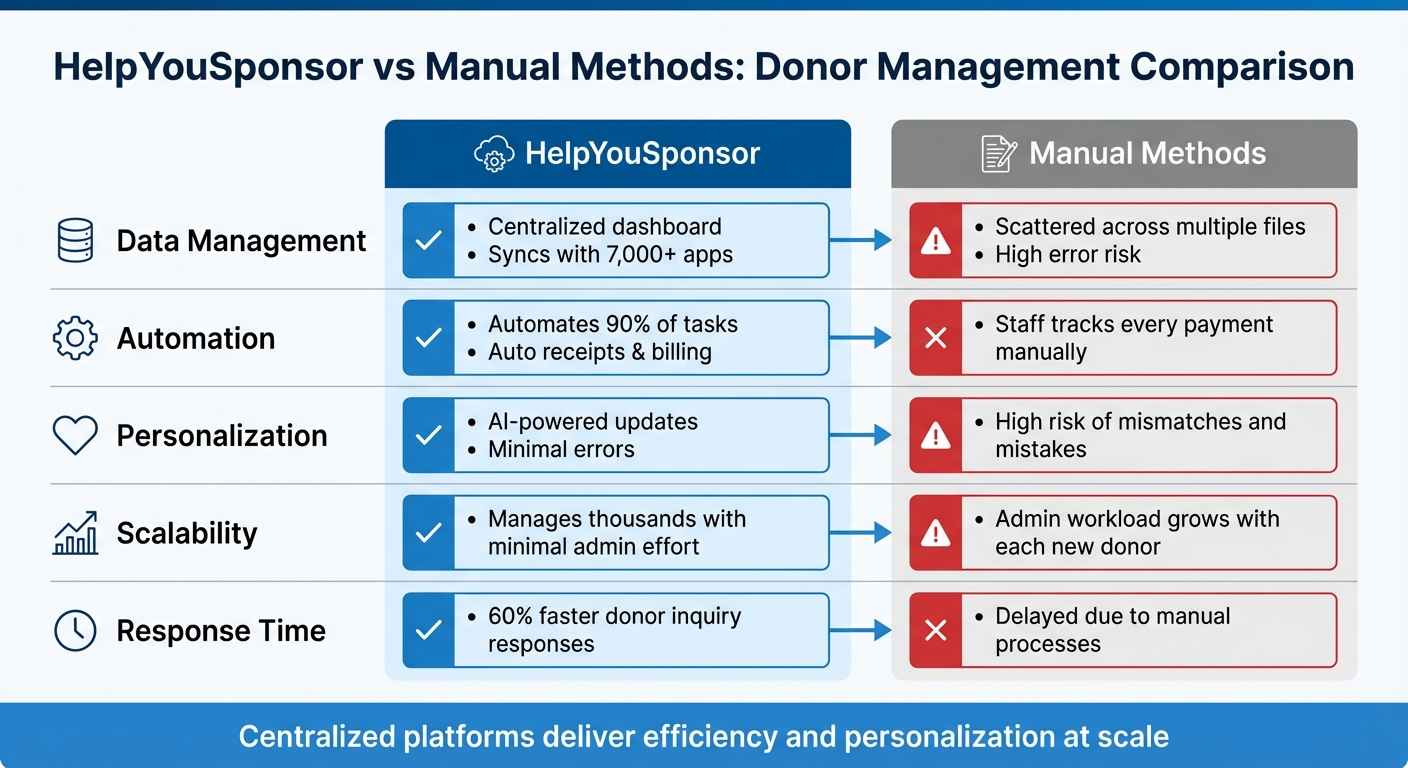
HelpYouSponsor vs Manual Donor Management: Feature Comparison
1. HelpYouSponsor
Data Integration
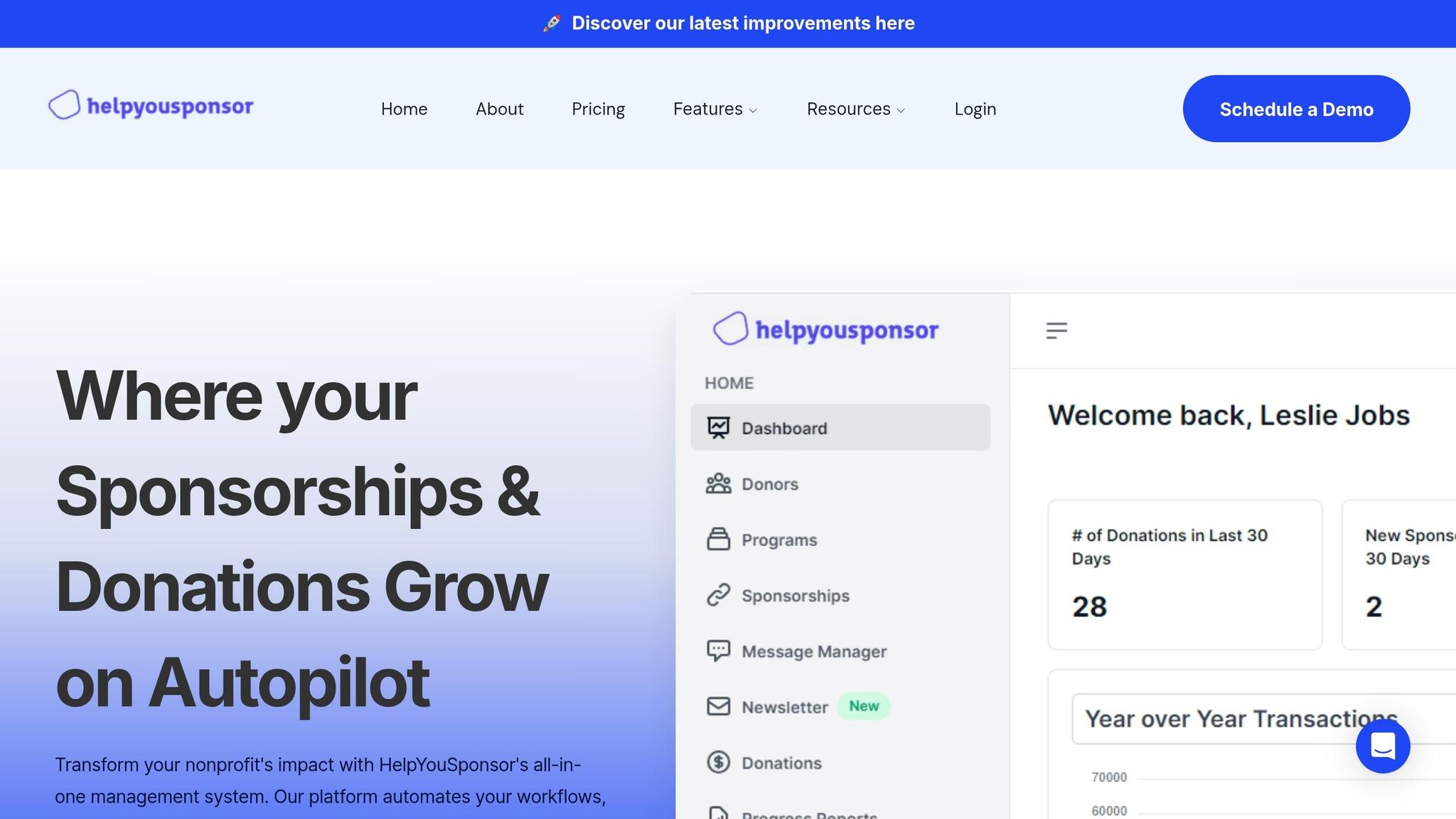
HelpYouSponsor simplifies donor management by consolidating all donor information into a single dashboard. Each donor profile automatically gathers personal details, sponsorship history, payment records, activity logs, and donation history. This eliminates the hassle of switching between multiple tools to get a full picture of your donors.
The platform also tracks relationships between donors through its Household Members and Related Contacts features. For example, if a couple donates separately or one donor inspires another to contribute, HelpYouSponsor maps these connections. It also categorizes contributions into Hard Credits (direct donations), Soft Credits (like matching gifts), and Influenced Totals (donations a donor helped generate). This layered approach not only shows who is giving but also highlights those actively expanding your mission, making your thank-you messages more thoughtful and impactful.
By centralizing and structuring this data, the platform sets the stage for seamless automation.
Automation Capabilities
HelpYouSponsor's Custom Auto Emails feature takes care of routine communications. Whether it’s sending donation confirmations, quarterly updates about sponsored children, or celebrating milestones, these automated messages free up your team to focus on bigger-picture strategies.
The system also identifies and removes duplicate donor records automatically, avoiding the embarrassment of sending duplicate messages to the same donor.
Personalization Accuracy
Every donor profile is directly linked to the specific children, projects, or programs they support. Updates sent to donors include personalized details about their sponsored child's academic progress, health achievements, or personal milestones.
The platform’s Activity Log keeps a record of every interaction, from messages sent to recent donation updates. Before reaching out to a donor, you can review this log to ensure your communication is timely and relevant. This real-time insight strengthens donor stewardship and keeps your messaging on point.
Scalability
HelpYouSponsor’s Program Management module is designed to handle sponsorship programs of any size. Whether you’re managing 50 sponsors or 5,000, the system maintains a personal touch in donor communication. Its API and external integrations allow seamless connections with accounting software, CRMs, and other essential tools.
For pricing, the platform offers a free plan for up to 10 commitments per month. The Pro plan costs $50/month and supports up to 63 commitments, while larger programs are priced at $0.80 per commitment on a usage-based model.
2. Manual Donor Management Methods
Data Integration
Managing donor data manually often scatters crucial information - like donation history, preferences, and engagement details - across spreadsheets, emails, and paper files. This fragmented approach increases the risk of errors, which can seriously impact even basic personalization efforts. Mistakes in names, contact details, or giving records can do more harm than good when trying to connect with donors on a personal level.
"Unifying your data in one place lets you see the full scope of your fundraising program - and it provides the most complete picture of your donors. The more first-party data you have, the more personalization you can do." - Jenn Thompson, SVP of Go to Market, RKD Group
Automation Capabilities
Without automation, nonprofits often resort to generic outreach because manually sifting through thousands of data points is simply unmanageable. Tracking qualitative data, like how often a donor promotes your cause or their irregular but repeated giving patterns, becomes nearly impossible. For example, a donor who gives three out of five years might be wrongly flagged as "lapsed" just because they skipped one year.
"There's very little reason in this day and age to send an email to everyone." - Cherian Koshy, Transformative Leader in Social Impact
These gaps in automation make it harder to deliver personalized and meaningful donor interactions.
Personalization Accuracy
Manual personalization quickly becomes overwhelming, creating what some describe as a "spider web of actions". Trying to account for every possible donor preference - like communication methods or specific interests - can paralyze teams, especially when managing a large number of donors.
"We all try and go at it and figuring out like, how do we be the most authentic relationship builder for every single donor? And it creates a spider web of different actions and then it is too much for anybody to manage, no matter how large the team." - Cherian Koshy, Transformative Leader in Social Impact
Even with thorough training, capturing and maintaining detailed preferences like titles, nicknames, or family connections becomes a daunting task as the donor base grows.
Scalability
The inefficiencies in data integration, automation, and personalization directly affect scalability. Manual workflows limit segmentation to just a few groups - typically 3 to 5 - because adding more complexity overwhelms staff and diminishes personalization quality. Additionally, staff portfolios must be carefully managed to ensure consistent communication with donors, but this becomes increasingly difficult as the donor base expands. These challenges make scaling donor management efforts nearly impossible without significant process changes.
How do you automate donor thank-yous that feel personal? | Donor Recognition Bundle
Strengths and Weaknesses
Choosing between a centralized platform and manual spreadsheets for managing donor workflows reveals a clear divide. Manual methods often lead to data silos, where information is scattered across emails, spreadsheets, and paper files - none of which fully sync. This disorganization can result in donor-child mismatches and even security risks, eroding donor trust. On the other hand, HelpYouSponsor consolidates donor profiles, sponsorship details, payment histories, and activity logs into one easy-to-use dashboard, eliminating these silos entirely. Now, let’s explore how automation, personalization, and scalability further distinguish these approaches.
Automation is where manual methods face their greatest hurdles. Staff must track payments, handle expired credit cards, and generate receipts one by one. HelpYouSponsor, however, automates 90% of these tasks - like processing recurring payments, flagging failed transactions, and generating IRS-compliant receipts. This automation allows nonprofits to respond to donor inquiries 60% faster than they could with manual processes, which directly improves donor satisfaction and donor retention.
When it comes to personalization, manual systems fall short. Managing complex donor preferences by hand often leads to errors. As Sarah Tedesco, COO of DonorSearch, explains:
"If a donor starts to feel like you see them as a revenue source rather than a valued individual, it'll hurt their relationship with your nonprofit and potentially cause them to stop giving."
HelpYouSponsor uses AI to deliver tailored donor updates, reducing the human errors that are common in spreadsheet-based systems. This ensures that donors feel seen and appreciated, strengthening their connection to the organization.
The issue of scalability also highlights the weaknesses of manual methods. As the donor base grows, so does the administrative workload. HelpYouSponsor, by contrast, seamlessly manages thousands of sponsors without requiring additional administrative resources. By integrating with tools like Salesforce, Zapier, and over 7,000 other apps, it ensures data remains accurate and manageable even as organizations expand.
Here’s a quick comparison of the two approaches:
| Feature | HelpYouSponsor | Manual Methods |
|---|---|---|
| Data Integration | Centralized database; syncs with 7,000+ apps | Scattered across multiple files; high error risk |
| Automation | Automates 90% of tasks; receipts and billing | Staff must track every payment manually |
| Personalization | AI-powered updates; minimal errors | High risk of mismatches and mistakes |
| Scalability | Manages thousands with minimal admin effort | Admin workload grows with each new donor |
| Response Time | 60% faster donor inquiry responses | Delayed due to manual processes |
This comparison underscores the efficiency and reliability of a centralized platform like HelpYouSponsor, especially for nonprofits aiming to scale without sacrificing donor satisfaction.
Conclusion
When you compare automated systems to manual donor management methods, it’s clear that a centralized platform like HelpYouSponsor is a game-changer for nonprofits aiming to scale personalized donor engagement. Old-school approaches - like spreadsheets or paper files - often lead to fragmented data and administrative headaches, making it tough to provide child-specific updates or incorporate multimedia into donor communications.
HelpYouSponsor’s pricing plans are designed to grow with your organization. The Free Plan is perfect for smaller nonprofits, automating receipt generation and tracking payments for up to 10 commitments, so your team can focus on building relationships. As your needs expand, the Pro Plan at $50 per month supports up to 63 commitments, offering a centralized database to simplify donor management. For larger nonprofits, the Max Plan provides a usage-based model at $0.80 per commitment, complete with advanced features like predictive AI to handle complex donor pipelines while keeping engagement personal.
Interestingly, less than 13% of nonprofits currently use AI for decision-making. As Sarah Tedesco from DonorSearch highlights:
"Scaling your fundraising efforts requires a strategic approach backed by one of the biggest drivers of innovation in the sector - predictive artificial intelligence (AI)".
By integrating predictive AI and automated content generation, HelpYouSponsor ensures donor communications are tailored, boosting both satisfaction and retention. This framework keeps donor engagement personalized while supporting scalability.
For nonprofits focused on storytelling, milestone tracking, and transparent reporting, a centralized platform is essential. While manual methods might suffice for very small operations, they quickly create bottlenecks that hinder donor satisfaction and organizational growth. HelpYouSponsor’s tools provide the infrastructure needed to maintain high-touch personalization, no matter the size of your donor network, ensuring your nonprofit can grow without compromising engagement.
FAQs
What donor data should we centralize first?
When it comes to understanding what drives donor behavior, focusing on key data points is essential. Information like financial capacity and motivational drivers - such as personal interests, pride, or public relations goals - can reveal a lot about why someone chooses to give.
For example, knowing a donor’s income level allows nonprofits to craft appeals that feel appropriate and relevant. At the same time, understanding what motivates them on a personal level helps in creating communication that truly resonates. Whether it’s tapping into their passion for a cause or aligning with their desire for public recognition, this insight makes outreach more meaningful.
By prioritizing these factors, nonprofits can develop strategies that are more targeted and effective. This approach not only enhances donor engagement but also strengthens overall support for their mission.
How do we personalize updates without creating extra work?
Nonprofits can make their updates more personal and effective by tapping into behavioral science and analyzing donor journey data. By automating messages tailored to donor preferences and engagement habits, they cut down on manual work while ensuring the content feels relevant. This strategy strengthens relationships and boosts donor retention by aligning communication with supporter behavior - an approach discussed in detail during Nonprofit Expert Episode 22.
When should we switch from spreadsheets to HelpYouSponsor?
When managing donor tasks with spreadsheets starts feeling overwhelming or inefficient, it’s time to consider HelpYouSponsor. Handling tasks like tracking donations, sending automated communications, and managing recurring payments manually can lead to mistakes and wasted time. HelpYouSponsor simplifies these processes by centralizing donor data, reducing errors, and improving donor retention. If spreadsheets are holding you back from focusing on your mission or building strong donor relationships, making the switch can help you reclaim your time and energy.