
How Digital Tools Transform Donor Engagement in Sponsorship Programs
CRMs, email automation, donor portals, mobile and social tools help nonprofits personalize outreach, show real-time impact, and boost sponsorship retention.


Nonprofits are increasingly using digital tools to improve donor engagement in sponsorship programs. These tools simplify operations, enhance communication, and strengthen relationships with supporters. Here’s how they help:
- CRM Systems: Track donor data, automate tasks, and manage contributions effectively.
- Email Automation: Send personalized updates, reminders, and acknowledgments to boost engagement.
- Donor Portals: Offer self-service options like accessing giving history and updating payment details.
- Personalized Storytelling: Tailor messages to donor interests using data insights.
- Mobile Optimization: Ensure smooth experiences on smartphones with tools like text-to-give and push notifications.
- Social Media: Build communities and share impact stories to connect with donors.
Transparency is key - tools like real-time tracking dashboards and automated receipts provide donors with clear insights into how their contributions make a difference. Platforms like HelpYouSponsor integrate these features, offering nonprofits a streamlined way to manage sponsorships and build trust.
To implement these tools effectively:
- Audit your current systems and identify gaps.
- Choose a platform that integrates with your existing tools.
- Monitor metrics like retention rates and engagement to measure success.
Digital tools are reshaping donor engagement by making it more personal, transparent, and efficient.
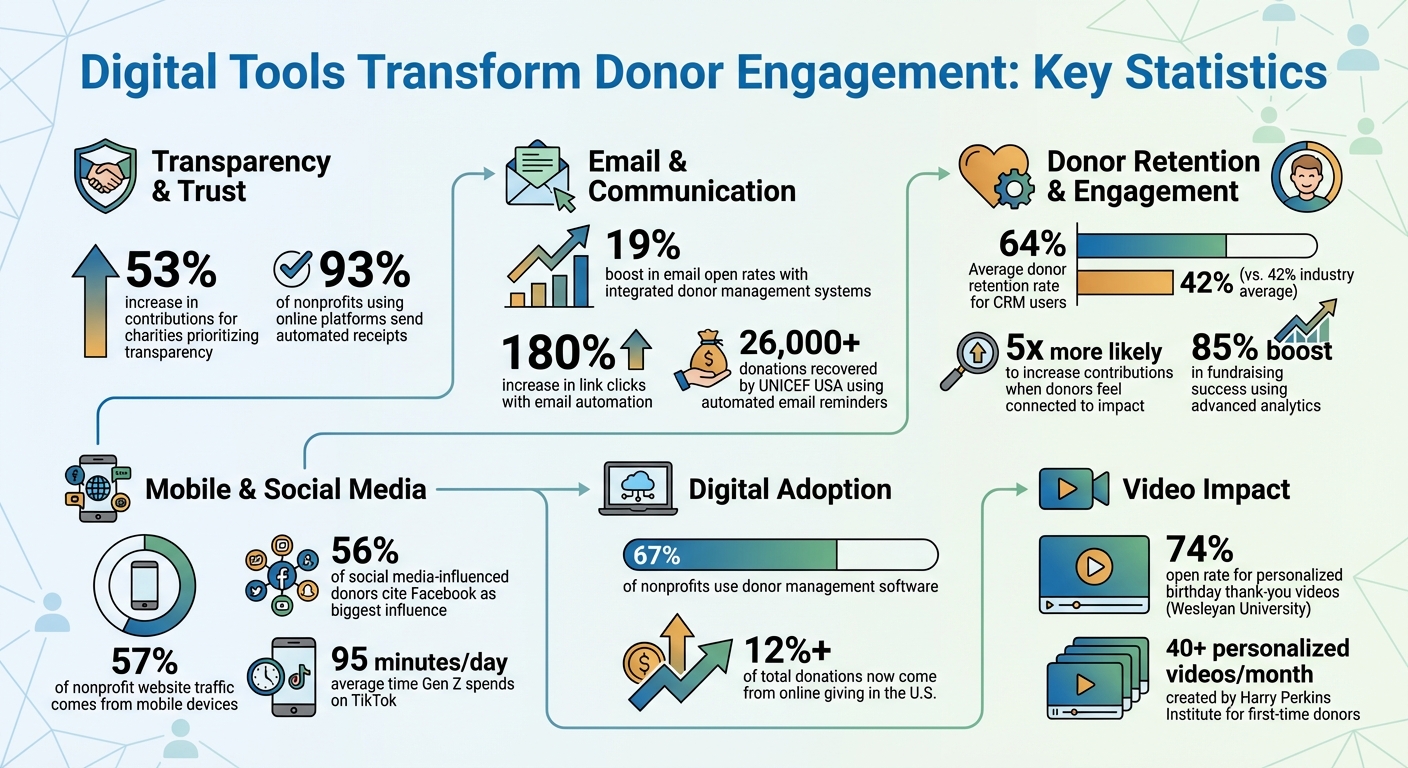
Digital Tools Impact on Nonprofit Donor Engagement: Key Statistics
Finally, a Digital Fundraising Strategy That Works
Key Digital Tools for Donor Engagement
Digital tools are essential for streamlining donor engagement and making it easier for teams to connect with supporters. Tools like CRM systems, email automation platforms, and donor portals play a vital role in modern sponsorship programs, each contributing to stronger and more lasting relationships with donors.
CRM Systems for Sponsorship Management
CRM systems are a game-changer for nonprofits, helping them manage donor data, spot trends, and encourage recurring contributions. These platforms keep track of every interaction with supporters - from the first donation to ongoing commitments - creating a full picture of each relationship.
For sponsorship programs, CRMs simplify tasks like automating receipts, integrating with payment systems, and tracking donations for specific children or projects. This level of organization helps nonprofits identify new fundraising opportunities and maintain long-term donor relationships.
Email Automation and Donor Journeys
Email automation has transformed how nonprofits communicate with sponsors. These tools can send personalized messages at key moments, such as welcome emails for new donors, reminders about upcoming payment dates, or updates on the progress of specific projects.
For example, UNICEF USA used automated email reminders to recover over 26,000 donations that might have been lost otherwise. Another study revealed that integrating donor management systems with email automation tools led to a 19% boost in email open rates and a 180% increase in link clicks.
Meg Hanson, Donor Relations Manager at Big Brothers Big Sisters of Dane County, shared her perspective: "Momentum is instrumental in helping me stay connected with my large portfolio of donors, allowing me to keep them updated on the incredible work we're doing while maintaining a personal touch".
By leveraging donor data, nonprofits can ensure each email feels personal and relevant, avoiding the impersonal tone of mass messaging. These tailored communications build trust and set the stage for the added transparency offered by donor portals.
Donor Portals for Transparency and Self-Service
Donor portals give supporters the tools to manage their contributions independently. These online platforms let donors access their giving history, update recurring donations, and download tax receipts without needing staff assistance.
When donors can log in anytime to check their sponsorship details, update payment information, or retrieve receipts, they feel more connected to the programs they’re supporting. These portals become a central hub where donors can see the impact of their contributions, reducing administrative inquiries and freeing up nonprofit teams to focus on their mission-critical work.
Personalization and Engagement Through Digital Channels
Nonprofits have a unique opportunity to build stronger bonds with donors by creating personalized digital experiences. When outreach feels tailored to a donor’s interests and past contributions, they’re more likely to stay engaged over time. This approach works hand-in-hand with the digital tools already discussed, adding another layer to donor relationships.
Personalized Storytelling for Impact
Digital platforms make it easier than ever for nonprofits to share stories that connect with donors on a personal level. By analyzing donor data, organizations can craft messages that highlight the specific projects or causes each supporter values most. Research shows that personalized communication leads to higher open rates, better click-through rates, and improved donor retention.
AI tools like ChatGPT and Microsoft Copilot can streamline content creation, but human oversight remains essential to ensure the messaging stays consistent and meaningful. Josh Kligman, Co-founder and CEO of Storyraise, underscores the importance of thoughtful storytelling:
"Start by thinking about what it is you want to accomplish [through your campaign], which is usually saying 'thank you' and showcasing how those funds or that time that donors and other stakeholders [have invested to] help your organization move forward."
Video has become a standout tool for personal recognition. For example, Wesleyan University sends personalized birthday thank-you videos to donors, achieving an impressive 74% open rate. Similarly, the Harry Perkins Institute creates over 40 personalized thank-you videos each month for first-time donors, introducing their impact and making supporters feel valued. These examples show how video can turn a simple acknowledgment into a memorable and impactful moment.
Mobile-Optimized Sponsor Engagement
With mobile devices accounting for 57% of nonprofit website traffic, it’s crucial to ensure that digital platforms perform smoothly on smartphones. Donors should have easy access to sponsorship details, payment updates, and impact stories - all optimized for mobile use.
Text-to-give campaigns are a great example of mobile-friendly engagement. By texting a specific keyword, supporters can donate quickly and easily. Before launching such campaigns, it’s essential to test donation pages on mobile devices to confirm they’re user-friendly.
Mobile apps can also send push notifications to keep donors informed. Whether it’s a welcome message, milestone celebration, or project update, these notifications deliver timely information directly to supporters' phones. The key is to use them thoughtfully - strategically timed messages can strengthen connections without overwhelming recipients.
Social Media for Sponsorship Community Building
Social media platforms offer nonprofits a space to build community among donors while spotlighting the collective impact of their support. Interactive tools like polls, comment threads, and celebratory posts can foster meaningful engagement.
When sharing stories on social media, nonprofits can combine personalized storytelling with privacy-conscious updates. For example, anonymized impact stories can highlight successes without compromising confidentiality. Tagging donor organizations in thank-you posts, sharing event photos, and creating recap videos are all effective ways to showcase involvement. Among donors influenced by social media, 56% say Facebook plays the biggest role in their decision to give.
For younger audiences, platforms like TikTok and Instagram offer unique ways to connect. TikTok, in particular, is popular with Gen Z, who spend an average of 95 minutes per day on the app - nearly double the time spent on Facebook and Instagram. Nonprofits can even use TikTok’s Donation Stickers during live streams or videos, enabling donors to contribute without leaving the platform.
Social media engagement also provides valuable data. Insights from likes, comments, and shares can be integrated into a nonprofit’s CRM system to better understand what resonates with different donor groups. This feedback loop allows organizations to refine their approach, ensuring that future interactions feel even more relevant and meaningful.
Building Transparency and Trust With Digital Tools
Donors today expect more than just promises - they want clear proof that their contributions are making a real difference. Digital tools step in to provide this clarity, offering full visibility into how funds are spent and the results they achieve. In fact, charities that prioritize transparency have seen a 53% increase in contributions. By turning promises into measurable outcomes, these tools help bridge the gap between donor expectations and nonprofit accountability.
Real-Time Tracking of Donations and Impact
Real-time tracking transforms pledges into visible, verifiable outcomes, giving donors the ability to see results as they happen instead of waiting for annual updates. Many sponsorship management platforms now feature dashboards that track payments, donor retention rates, and project funding progress. Using advanced analytics, organizations have reported an 85% boost in fundraising success.
These tools also empower donors by allowing them to set up alerts - for example, notifications when their donations are allocated to program delivery or administrative costs. Emerging technologies like blockchain further enhance this process by creating secure, unchangeable records of transactions, ensuring the integrity of donations. These innovations not only protect donor data but also strengthen confidence in how contributions are used.
This level of transparency lays a strong foundation for personalized communication, which is key to fostering long-term donor relationships.
Data-Driven Personalization for Long-Term Relationships
Using data analytics and segmentation, nonprofits can tailor their communication to connect with donors on a personal level. When donors feel a genuine connection to an organization’s impact, they are five times more likely to increase their contributions over time. Personalized digital experiences - such as dashboards that show real-time updates on the impact of contributions or secure donor portals with financial and project updates - can enhance this connection. Ensuring strict data security further reinforces trust in these personalized interactions.
In addition to personalized outreach, providing clear financial documentation helps build even greater trust.
Financial Transparency Through Digital Receipts
Automated receipts and annual summaries offer donors clear, documented proof of their contributions. Approximately 93% of nonprofits using online platforms send these receipts, which comply with U.S. standards by including accurate dates (MM/DD/YYYY), exact dollar amounts (e.g., $50.00), and all necessary nonprofit identification details.
Sponsorship management software also simplifies financial tracking and reporting, offering nonprofits detailed, real-time oversight of donations. These platforms often include visual tools like charts and graphs to showcase the impact of contributions, helping donors see how their money is being used. This level of transparency reassures donors that their contributions are managed responsibly and effectively.
How to Implement Digital Tools in Your Program
Evaluating Your Current Digital Capabilities
Start by auditing your digital tools - everything from email platforms to payment processors. Map out each tool and look for overlaps or gaps in your system. For instance, while 67% of nonprofits rely on donor management software to handle communications, donation tracking, and reporting, many still face challenges with fragmented systems that don’t work well together.
"We recommend conducting a data audit of your online fundraising ecosystem to understand what software you will need to connect with your donor management platform." – Kindful
Take a closer look at past campaigns to identify what worked and where engagement dropped off. Dive into your donor data to see which communication channels deliver the best results. From there, create two lists: one for must-have features that address your biggest pain points and another for "nice-to-have" features that can be considered later. This way, you can focus on tools that will make an immediate impact instead of getting distracted by less critical options.
Having a clear understanding of your digital setup not only reduces inefficiencies but also builds donor confidence through better engagement. This process sets the stage for selecting a platform that aligns with your program’s goals.
Selecting a Sponsorship Management Platform
When choosing a sponsorship management platform, look for one that integrates smoothly with your existing accounting, payment, and marketing systems. This prevents the creation of new data silos. A good example is HelpYouSponsor, which offers strong integration capabilities and features tailored for sponsorship programs. These include tools for tracking commitments, donor portals for transparency, and compliance with U.S. standards (like MM/DD/YYYY date formats and pricing such as $50.00).
Pricing is another important factor. HelpYouSponsor uses a tiered model:
- A free plan for up to 10 commitments per month, ideal for small organizations.
- A Pro plan at $50/month for up to 63 commitments.
- A Max plan at $0.80 per commitment for larger programs.
This flexible approach ensures that nonprofits of all sizes can manage donor interactions effectively without overspending. Once you’ve selected a platform, the next step is to integrate it seamlessly and measure its impact on your program.
Integrating Systems and Measuring Success
Begin by connecting your CRM, payment processor, and email marketing platform. For example, in 2025, Bloomerang’s CRM integrates with tools like Fundraise Up for donation syncing, Mailchimp for email campaigns, and QuickBooks for financial management. These integrations eliminate manual data entry and ensure information flows smoothly across systems.
To gauge success, track key metrics like donor retention, email engagement, and website performance. Nonprofits using Bloomerang CRM, for instance, report an average donor retention rate of 64% - 22 points higher than the industry average of 42%. Use your CRM’s dashboard to segment donors based on their behavior and giving history. You can also add interactive elements, like fundraising thermometers, to visually track campaign progress and inspire participation. With online giving now making up over 12% of total donations in the U.S., it’s clear that digital channels need close attention.
"Donor preferences will naturally evolve over time, and fundraising teams must track supporters' responses to determine which strategies are most effective. Analytics tools offer the insights needed to identify shortcomings and pivot when needed." – Insightful Philanthropy's donor cultivation guide
Conclusion
Digital tools have revolutionized how nonprofits connect with donors, making interactions more personalized and transparent. These tools go beyond simple transactions, fostering deeper engagement, open communication, and stronger donor relationships. Shifting from one-way messaging to meaningful two-way conversations has become essential for building trust that lasts.
HelpYouSponsor offers nonprofits a suite of powerful tools, including CRM systems, automated communications, donor portals, and real-time impact tracking. By consolidating these features, nonprofits can streamline operations while delivering a smooth experience for both their teams and supporters. With these tools in place, organizations can refine their strategies and improve execution.
To make the most of these advancements, nonprofits should align their digital strategies across all development efforts and invest in reliable digital infrastructures. Regularly assess your current setup, select tools that can grow with your organization, and monitor key metrics like donor retention. Whether managing a handful of donors or a large base, the right digital tools can amplify fundraising efforts and strengthen donor connections.
FAQs
How can CRM systems improve donor engagement in sponsorship programs?
CRM systems are a game-changer for nonprofits looking to build stronger connections with their donors. By analyzing data and tracking donor behavior, these tools provide insightful information that helps organizations understand their supporters better. They also take care of repetitive tasks - like sending thank-you notes or program updates - freeing up time while ensuring consistent communication.
What really sets CRMs apart is their ability to create personalized outreach. By segmenting donors based on preferences or giving history, nonprofits can craft messages that resonate on a deeper level. This approach not only strengthens relationships but also fosters trust and encourages ongoing support. With streamlined communication and improved transparency, CRMs help nonprofits engage donors more effectively and sustain their sponsorship efforts over the long haul.
How does personalized storytelling help build stronger connections with donors?
Personalized storytelling has the power to forge genuine connections with donors by highlighting the tangible difference their contributions make. When donors encounter real-life stories about the people or communities they've helped, it creates an emotional bond and reinforces their trust in your organization.
This strategy also keeps donors engaged in the long run by making their participation feel uniquely meaningful and fulfilling. Crafting stories that align with a donor's specific interests or reflect their past contributions can deepen their sense of involvement and strengthen their dedication to your cause.
Why is transparency essential for engaging donors, and how can digital tools help?
Transparency plays a key role in building trust and strengthening relationships with donors. It shows accountability and reassures donors that their contributions are being used effectively to create meaningful change. People want to feel confident that their support is making a real difference.
Digital tools have made it simpler than ever to maintain this transparency. With features like real-time updates, clear financial reporting, and detailed transaction records, donors can easily track how their contributions are being used. This level of openness not only keeps them informed but also deepens their connection to your mission, increasing the likelihood of their continued support.