
How Cross-Border Fees Impact Sponsorship Donations
Currency conversion, wire and processing fees can cut 5–15% from international sponsorship donations — and nonprofits can limit losses.


Cross-border fees quietly reduce the impact of international donations. A $50 monthly donation to support a child in another country might shrink by 5–10% due to fees like currency conversion, wire transfers, and payment processing. For nonprofits, this means fewer resources for education, healthcare, and housing.
Here’s what you need to know:
- Fees add up: Credit card processors take around 2.8%, while currency conversion and wire transfers can claim 1–5% or more.
- Nonprofits lose funding: A $30 monthly donation may drop to $25.50 after fees, cutting into resources for critical programs.
- Annual impact is large: For 500 donors giving $30/month, nonprofits could lose $14,400–$18,000 annually to fees.
To reduce costs, nonprofits can use low-fee payment gateways, batch transactions, or negotiate better rates. Platforms like HelpYouSponsor also help by offering tools to manage fees and track donations effectively. Every dollar saved means more support for those in need.
What are Cross Border Fees? (And how to avoid them!)
sbb-itb-a630d3d
What Are Cross-Border Fees?
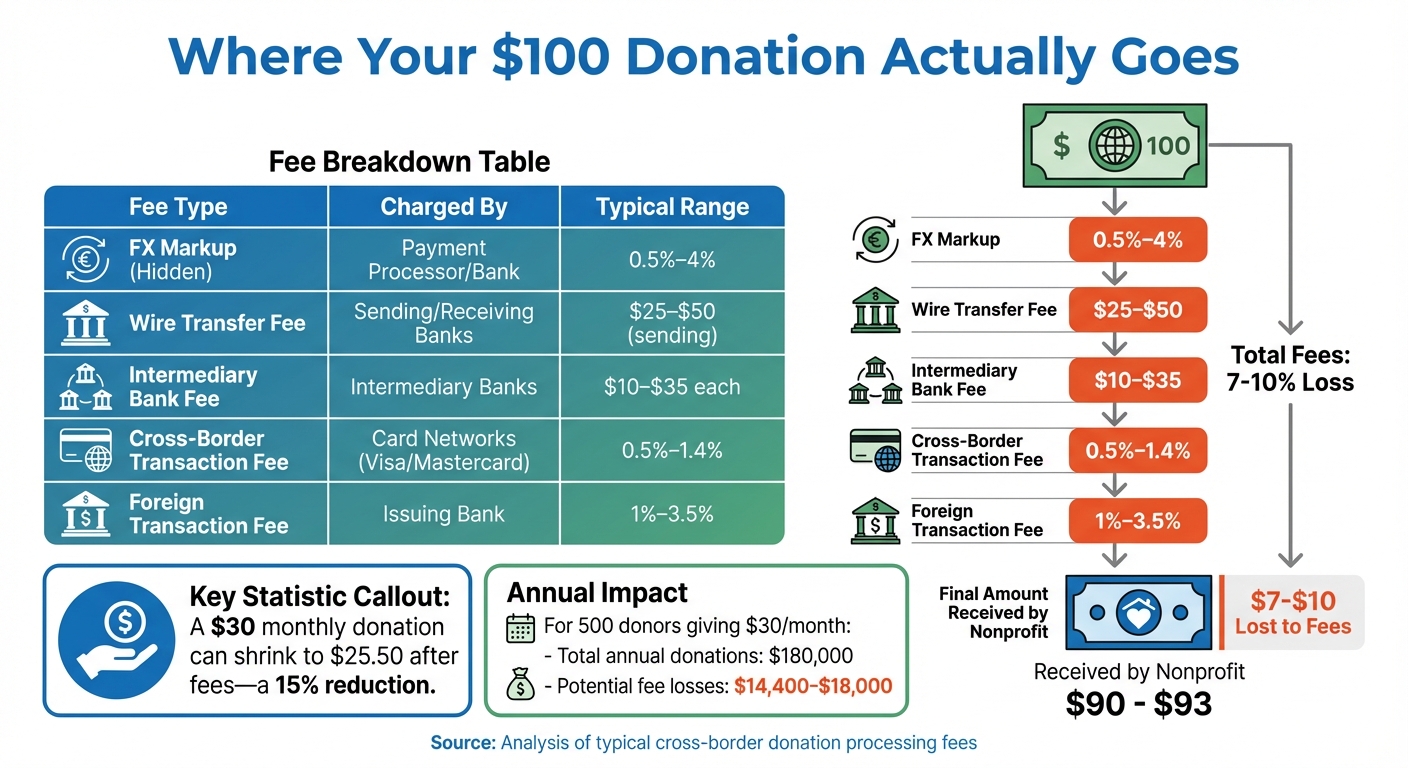
Cross-Border Donation Fees Breakdown: Where Your Money Goes
Cross-border fees are charges that come into play when a transaction crosses national boundaries or involves a foreign currency. These fees help cover the added complexity, risks, and infrastructure costs of processing payments across different regulations, currencies, and jurisdictions.
Interestingly, the trigger for these fees isn't always the currency itself. Even when the transaction involves U.S. dollars - like a donation sent to a Kenyan nonprofit - cross-border fees apply if the sender's and recipient's banks are in different countries.
Common Types of Cross-Border Fees
When a donation moves from a U.S. donor to an international nonprofit, multiple fees can chip away at the original amount. Let’s break down the main types of fees to understand where the money goes.
-
Currency conversion fees (FX markups): These are often the most hidden yet significant costs. Banks typically add a markup of 1% to 3% over the mid-market exchange rate, though some payment processors may charge as much as 4%. Brahim Oubrik, Senior Data Engineer at IdealRemit, explains:
"Free means the fee is invisible, not that it does not exist. Always look at the total cost, not just the fee line."
- Wire transfer fees: These fees are more visible. Sending banks charge $25 to $50 to initiate a transfer, while receiving banks may deduct another $10 to $20 when crediting the funds.
- Intermediary bank fees: When a payment travels through intermediary (or correspondent) banks, each one takes a cut - usually between $10 and $35 per bank. If the sending and receiving banks don’t have a direct relationship, these fees are unavoidable.
- Card network fees: When donors use credit or debit cards for international donations, card networks like Visa and Mastercard impose fees. Visa charges 1% for U.S. dollar settlements and 1.4% for non-U.S. dollar transactions, while Mastercard charges 0.6% and 1%, respectively. On top of this, card issuers add foreign transaction fees ranging from 1% to 3.5%.
- Payment processor fees: Platforms like PayPal charge around 3.9% plus fixed fees for international business transactions, with an additional markup of 3% to 4% for currency conversion. Altogether, these fees can exceed 7% of the donation amount.
Here’s a quick breakdown of these fees:
| Fee Type | Charged By | Typical Range |
|---|---|---|
| FX Markup (Hidden) | Payment Processor/Bank | 0.5%–4% |
| Wire Transfer Fee | Sending/Receiving Banks | $25–$50 (sending) |
| Intermediary Bank Fee | Intermediary Banks | $10–$35 each |
| Cross-Border Transaction Fee | Card Networks (Visa/Mastercard) | 0.5%–1.4% |
| Foreign Transaction Fee | Issuing Bank | 1%–3.5% |
Who Pays Cross-Border Fees?
When you look at how these fees are structured, it becomes clear that nonprofits often bear the brunt of the costs. Unlike domestic transactions, where fees are typically upfront, cross-border fees are deducted as the donation moves through the banking system, reducing the final amount that nonprofits receive.
For instance, a $100 donation from a U.S. donor might shrink to $92 or $93 after fees, with $7 to $8 lost along the way.
Some payment systems offer a "sender pays all fees" option (known as the "OUR" charge-bearer code in SWIFT transfers). However, even this doesn’t guarantee that the nonprofit will receive the full donation. Banks can’t predict the exact deductions made by intermediary banks downstream.
This system essentially acts as a hidden tax on international giving, cutting into funds that nonprofits rely on for critical services like education and healthcare. For organizations operating with tight budgets, implementing cost-effective donor stewardship becomes even more critical as these losses can significantly impact their ability to deliver essential sponsorship programs.
How Cross-Border Fees Affect Sponsorship Donations
For nonprofits managing international sponsorship programs, cross-border fees can take a sizable chunk out of every donation. This issue becomes even more noticeable with recurring monthly sponsorships, where the same deductions are applied repeatedly. Let’s break down how these fees impact individual contributions and the overall annual funding for nonprofits.
Calculating Fee Impact on Individual Donations
Take a $30 monthly sponsorship from a U.S. donor to an overseas child sponsorship program. By the time this donation is processed, it faces several layers of fees - card network charges, processing fees, foreign transaction costs, and currency conversion rates. Together, these can total between 7% and 10.5%, meaning that $2.10 to $3.15 of each $30 donation is lost to fees.
If the nonprofit uses an intermediary to ensure U.S. tax compliance, an additional 1%–5% fee may apply. This could reduce the donor's $30 contribution to as little as $25.50 - a total reduction of up to 15%.
Here’s another example: A single $1,000 donation might face deductions like a $16.65 platform fee, a $2.50 fixed certificate fee, GST, and a hidden currency conversion markup. For instance, the provider’s exchange rate might be ₹81.83 per USD, compared to the mid-market rate of ₹83.50, further reducing the donation’s value.
Annual Fee Losses for Nonprofits
What seems like small monthly deductions can snowball into significant yearly losses. Imagine a sponsorship program with 500 donors contributing $30 each month. That totals $180,000 annually. Even with a conservative fee rate of 5%, the nonprofit loses $9,000 a year. But with real-world fees often ranging from 8% to 10% - due to intermediaries and various payment methods - annual losses could climb to $14,400–$18,000.
For the 92% of U.S. nonprofits operating on budgets under $1 million, these losses are a major blow. That money could have been used to sponsor more children, pay teacher salaries, or fund medical supplies. Nonprofits strive to allocate at least 75% of every dollar directly to their programs, ensuring donors’ contributions have maximum impact. Cross-border fees, however, make it harder to maintain this standard, putting added strain on organizations trying to meet donor expectations and fulfill their missions.
How to Reduce Cross-Border Fees
Nonprofits can cut cross-border fees by implementing a few smart strategies.
Use Low-Fee Payment Gateways
Payment processors vary widely in their fees. For example, traditional banks often charge $40–$50 per international transfer and tack on 3%–5% in conversion markups. In contrast, providers like Wise charge between 0.4% and 1% using mid-market rates. To put that into perspective, a $1,000 donation might cost $40–$70 in fees through a traditional bank, but only $4–$10 with Wise.
For nonprofits, PayPal offers a discounted rate of 1.99% + $0.49 per transaction, compared to its standard business rate of 2.89% + $0.49. Stripe also provides nonprofit pricing at 2.2% + $0.30, lower than the standard 2.9% + $0.30. European nonprofits can benefit from Mollie's rates, which are 1.8% + €0.25 for EU card transactions and just 0.25% + €0.25 for SEPA Direct Debit payments.
Batch Transactions to Lower Costs
Consolidating smaller donations into fewer, larger transfers can significantly cut down on fixed fees. For instance, instead of processing individual monthly sponsorships, batch them together. This approach reduces per-transaction charges and intermediary bank fees.
Use Local Currency Accounts
Multi-currency accounts allow nonprofits to accept donations in the donor's currency, delaying conversion until rates are more favorable. This strategy can save money on exchange fees. For example, routing European donations through a local acquirer in euros turns what would have been a cross-border transaction into a domestic one. SEPA transfers within Europe are often free or cost very little, while ACH transfers for U.S. donors help avoid high credit card interchange fees. Platforms like Stripe support over 100 currencies, making it easier to manage international donations. By avoiding unnecessary conversions, nonprofits can ensure more of each donation goes directly to their programs.
Negotiate Nonprofit Rates
Many payment processors offer discounted rates for verified 501(c)(3) organizations or their international equivalents, though these discounts aren't always advertised. Presenting an IRS determination letter or charity registration documents can help secure lower rates from providers like Stripe, PayPal, or Braintree. Larger organizations might also negotiate interchange-plus pricing, which offers transparency and minimal markups. Additionally, research shows that 53.4% of donors are willing to cover processing fees if given the option on the donation form, significantly reducing fee burdens.
How HelpYouSponsor Helps Reduce Transaction Costs
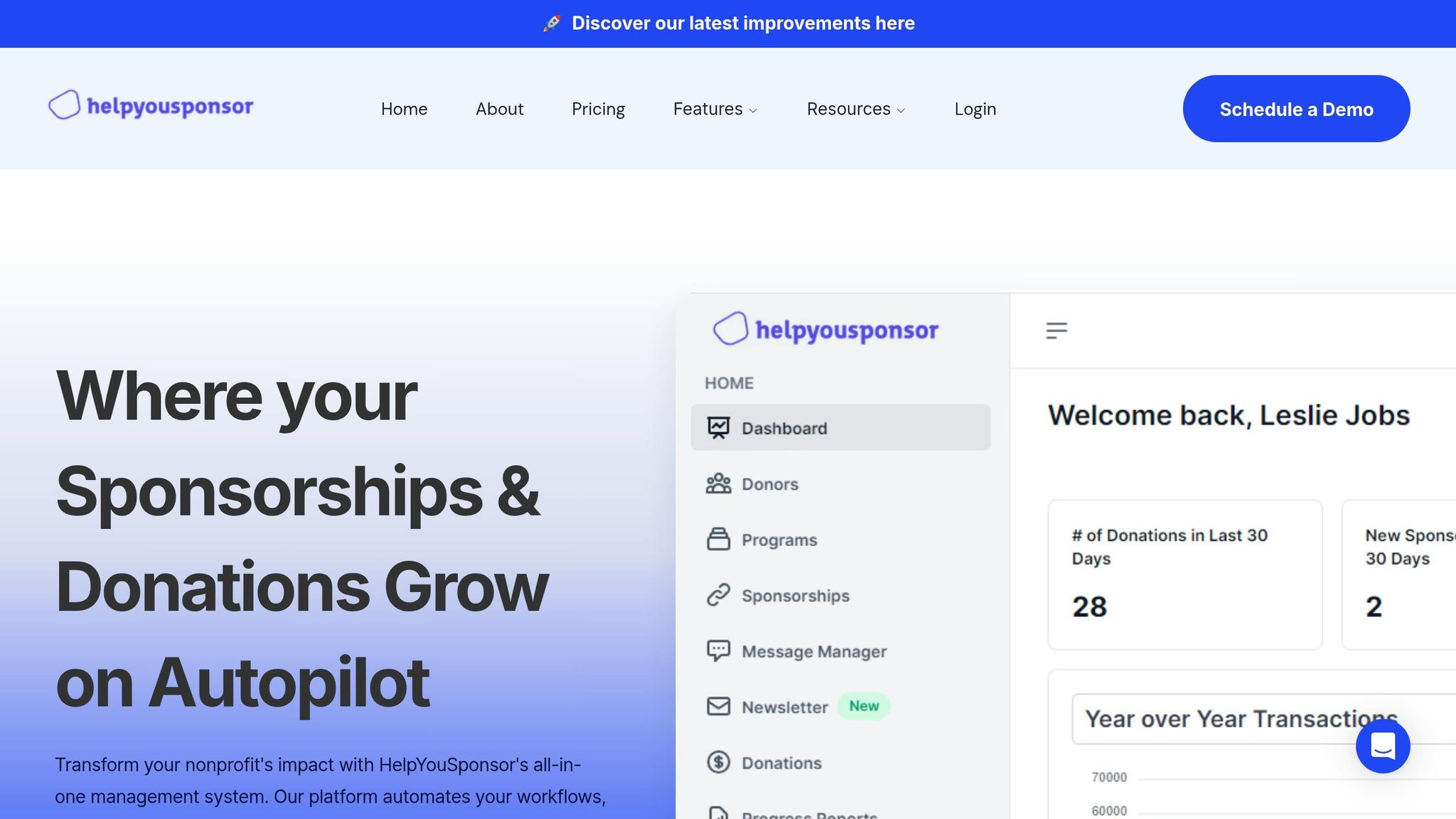
HelpYouSponsor empowers nonprofits to minimize transaction costs by offering the freedom to choose payment processors that align with their specific needs. The platform supports a range of payment gateways, including Stripe, PayPal, Flutterwave, QPayPro, and Authorize.net, allowing organizations to select the option with the lowest fees for their region. Nonprofits can even run dual gateways, such as combining PayPal with a credit card processor, to provide donors with multiple cost-effective payment options. This flexibility ensures more efficient fee management and better oversight of donations.
Payment Gateway Integration
HelpYouSponsor takes a proactive approach to reducing costs through smart payment gateway integration. By working with low-fee processors, the platform helps nonprofits avoid excessive fees on international donations, ensuring that a larger share of contributions goes directly to their programs. For instance, PayPal offers nonprofits a discounted domestic rate of 1.99% + $0.49 per transaction, but international donations come with an extra 1.50% fee. If your organization handles a significant volume of international contributions, switching to gateways like Flutterwave or QPayPro via HelpYouSponsor might help cut those additional costs.
The platform also supports external payment systems, enabling nonprofits to track donations processed through custom-negotiated rates with local banks or processors. Additionally, organizations can manage expenses by toggling credit card processing settings for individual programs in the "Program Settings" section. This feature is especially helpful for international projects, such as funding medical surgeries or construction campaigns, where cross-border fees can add up quickly.
Donation Tracking and Reporting
HelpYouSponsor simplifies donation tracking with its Donations Table, which provides detailed transaction records, and an Activity Log that tracks both successful and failed payments. Nonprofits can filter, export, and audit their data seamlessly, with features like QuickBooks integration and multi-currency support ensuring accurate accounting for international contributions. The platform also includes graphical analytics, offering a clear view of transaction trends over three years. These insights make it easier for organizations to identify which payment gateways deliver the best value for cross-border donations.
Conclusion
Cross-border fees take a toll on donations, cutting into the funds intended for essential programs. These fees, typically ranging from 1% to 5% per transaction, can significantly diminish the resources available for initiatives like child sponsorship and medical care. For context, efficient charities usually allocate at least 75 cents of every donated dollar directly to programs, so even minor losses to transaction fees can ripple into major impacts.
Nonprofits have options to mitigate these losses. Using low-fee payment gateways, batching transactions, opening multi-currency accounts, negotiating nonprofit rates, and managing currency risks are all effective strategies to safeguard donations.
Platforms like HelpYouSponsor play a key role in helping nonprofits stretch every dollar further. By supporting multiple payment gateways such as Stripe, PayPal, Flutterwave, QPayPro, and Authorize.net, HelpYouSponsor enables organizations to select the most cost-efficient donation processing methods. Its robust tracking and reporting tools also make it easier to identify which options provide the best value.
This is especially critical for child sponsorship programs, where every penny matters. Take St. Jude Children's Research Hospital, for example - they allocate 82 cents of every dollar to care and research. Reducing transaction fees, even slightly, can unlock significant resources for life-changing services.
FAQs
Why do international donations lose money even in U.S. dollars?
International donations often lose value, even when sent in U.S. dollars, due to hidden cross-border fees. These fees can include exchange rate markups, intermediary bank charges, and transfer fees. The lack of transparency around these costs means nonprofits may receive significantly less than the donor intended.
What’s the easiest way to estimate fee losses on monthly sponsorships?
To get a clear picture of fee losses, take into account the combined effect of platform and payment processing fees, which generally fall between 5-15% of each donation. A processing fee calculator can be a helpful tool - just input your donation amounts and platform specifics to calculate the total losses. This insight can help you plan more effectively and consider ways to minimize these expenses.
How can HelpYouSponsor help reduce cross-border donation fees?
HelpYouSponsor cuts down on cross-border donation fees by simplifying payment processing, automating recurring donations, and connecting with various payment gateways. This approach lowers transaction costs and makes it easier for nonprofits to receive donations efficiently.