
Building Connected Nonprofit Communities Through Technology
How tech helps nonprofits automate tasks, boost donor engagement, manage sponsorships, and measure impact to build stronger, more connected communities.

Nonprofits are increasingly turning to digital tools to overcome limited resources and expand their impact. From automating sponsorship programs and building effective sponsorship programs to improving donor engagement, technology is helping organizations save time, communicate effectively, and focus on their mission. Here are the key takeaways:
- Efficiency Boost: Automation can reduce manual tasks by up to 90%, freeing staff to focus on community impact.
- Donor Engagement: Personalization and data-driven strategies improve donor retention by 25% and increase recurring donations.
- Collaboration Tools: Platforms like Asana, Monday.com, and Slack streamline project management and communication.
- Sponsorship Management: Solutions like HelpYouSponsor simplify donor tracking and automate repetitive tasks, saving over 20 hours weekly.
- Data Insights: Analytics tools help nonprofits measure outcomes and optimize efforts, leading to smarter decision-making.
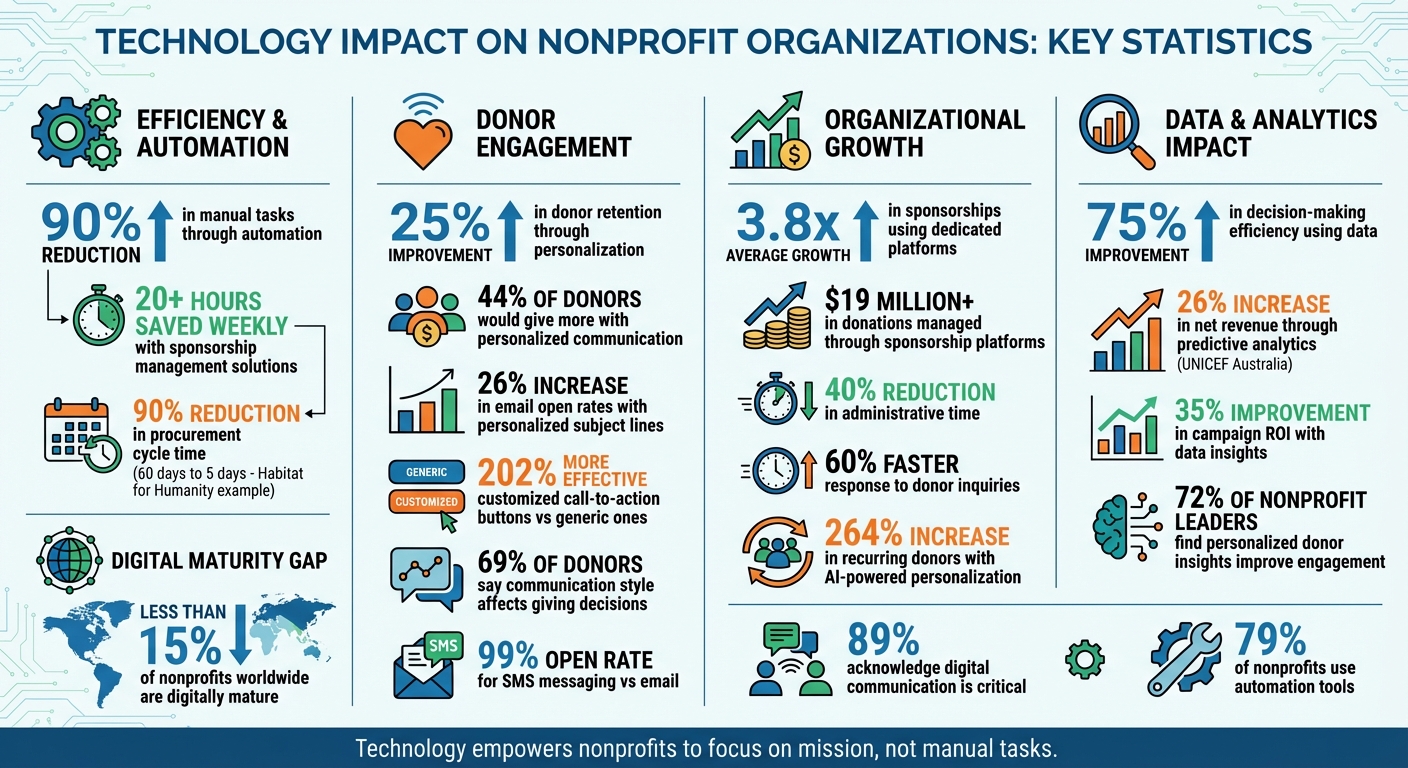
Key Technology Impact Statistics for Nonprofits
How Nonprofits Can Scale Donations with CRM: Ditch Spreadsheets for Smarter Donor Management
Digital Tools for Collaboration and Communication
Nonprofits rely on effective tools to keep teams aligned, engage volunteers, and communicate with donors, even across different time zones. The right digital solutions replace scattered emails and outdated spreadsheets with centralized systems that help everyone stay on track.
Project Management Platforms
Project management platforms serve as a central hub for your organization's work. Instead of digging through email threads for the latest document or wondering who owns a task, tools like Asana, Monday.com, and Notion provide real-time updates on project progress.
- Asana: Offers a free plan for up to 15 users, with eligible nonprofits receiving a 50% discount on Premium or Business plans.
- Monday.com: Provides nonprofits with 10 free seats on its Pro tier.
A great example of these tools in action comes from Habitat for Humanity International. Between 2022 and 2023, they overhauled their procurement process by switching from paper forms and emails to a no-code workflow platform. This move cut their procure-to-pay cycle from 60 days to just 5 - an impressive 90% reduction - allowing staff to focus on building homes instead of chasing paperwork.
To maximize the benefits of these tools, start by standardizing processes and assigning clear roles. Tackle high-impact areas first, such as volunteer onboarding or grant tracking, to demonstrate value before rolling out changes across the organization.
Community Engagement Tools
Building strong connections with your community requires consistent, centralized communication. Engagement platforms like Kannect simplify this by combining messaging, event RSVPs, and member management into one system.
For smaller nonprofits, unified platforms eliminate the hassle of managing multiple tools. Kannect, for instance, offers a free plan with no user caps or hidden costs, making it ideal for organizations with tight budgets. When choosing engagement tools, focus on audience segmentation. Tailor your messages to specific groups - volunteers, donors, or board members - rather than sending out generic updates.
In addition to traditional platforms, real-time communication systems ensure quick, efficient interactions, especially for urgent updates or time-sensitive tasks.
Real-Time Communication Systems
Instant messaging and video conferencing tools are now essential for nonprofits. Platforms like Slack and Microsoft Teams help reduce email overload by organizing conversations into department-specific channels:
- Slack: Includes 90 days of message history on its free plan.
- Microsoft Teams: Available for free to eligible nonprofits through Microsoft 365 Business Basic, with Standard plans costing about $3 per user per month.
For video meetings and virtual events, Zoom remains a popular choice due to its simplicity and one-click access to webinars. Nonprofits can save up to 50% on Zoom plans through TechSoup.
When it comes to urgent outreach, SMS messaging platforms boast a 99% open rate, far outperforming email. For grassroots coordination, WhatsApp Business offers a cost-free option for small teams, making it especially useful in remote areas.
Research highlights that 69% of donors say a nonprofit's communication style affects their decision to give again. This underscores the importance of selecting tools that not only streamline communication but also build lasting relationships with supporters.
Nonprofits can access discounted pricing for many of these tools through TechSoup. By embracing these digital solutions, organizations can enhance their efficiency and focus more energy on impactful programs like child sponsorship, paving the way for even more advanced strategies down the line.
HelpYouSponsor: A Platform for Sponsorship Management
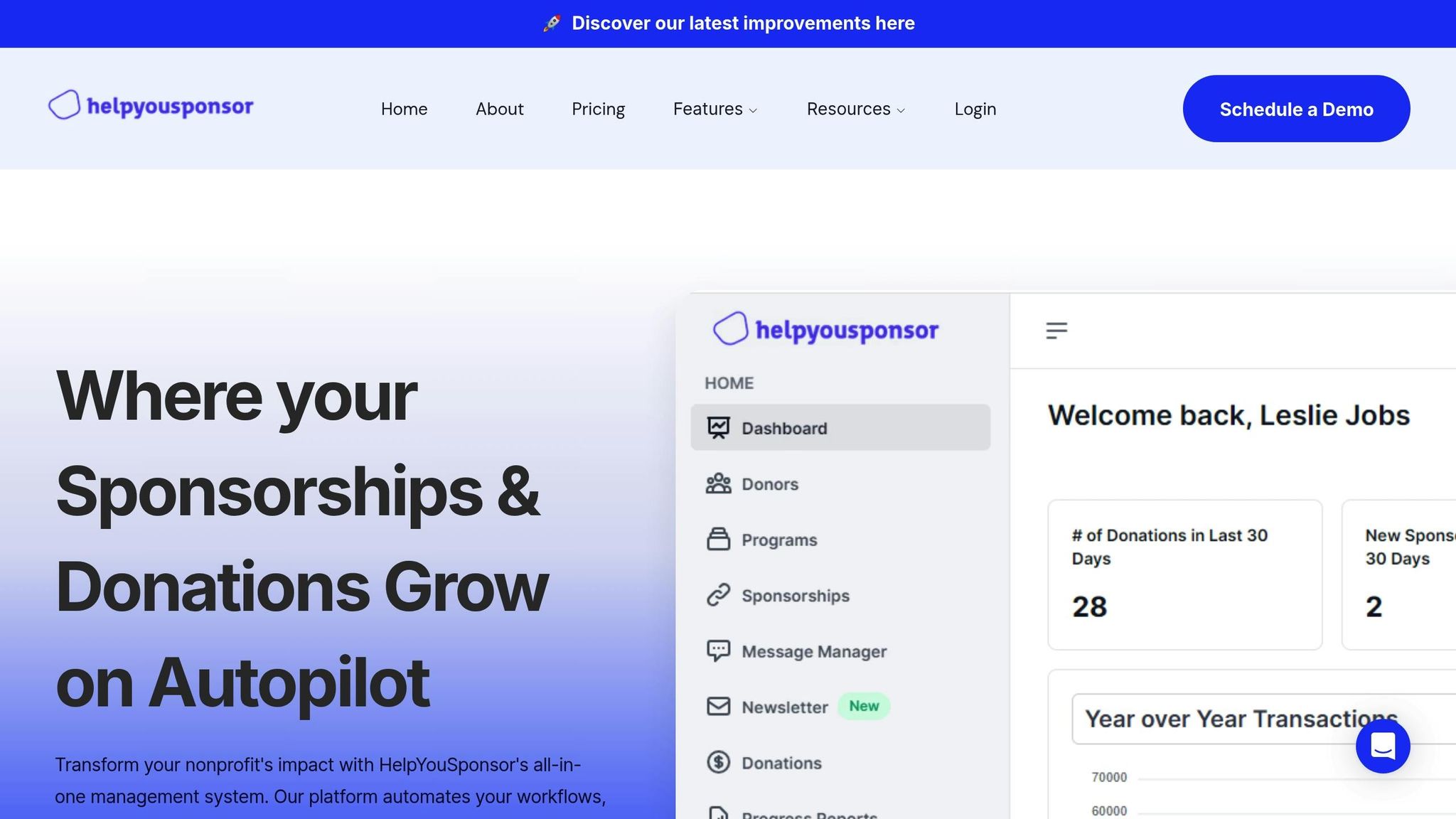
Sponsorship programs bring unique challenges, from managing long-term commitments to ensuring consistent communication between donors and beneficiaries. While general collaboration tools can help with organization, they often fall short when it comes to addressing these specific needs. That's where HelpYouSponsor steps in, offering tools that strengthen donor and beneficiary relationships while aligning sponsorship programs with your mission.
HelpYouSponsor supports a range of sponsorship models, from child sponsorships to infrastructure campaigns, all while fostering lasting connections. Currently, organizations using the platform manage over $19 million in donations and have grown their sponsorships by an average of 3.8x.
Arnold Mukisa, the founder of HelpYouSponsor, explains its mission:
"HelpYouSponsor is an autopilot for your sponsorships and donations. We provide nonprofit organisations with a centralised platform where they can consolidate donor data, track donations, and automate the sending of receipts and thank-you messages."
The platform automates 90% of repetitive tasks, including payment tracking, receipts, and thank-you messages, saving nonprofit staff over 20 hours per week. These automation tools are a cornerstone of the platform’s features, which are detailed below.
Features and Benefits
HelpYouSponsor combines essential tools into one streamlined system. Its constant communication features help build stronger relationships between sponsors and recipients. Automated email workflows and website integration allow organizations to display sponsorship profiles and donation buttons directly on their sites, ensuring timely updates and a smooth sponsor experience - all without manual effort. Research shows that 72% of nonprofit leaders find personalized donor insights improve supporter engagement.
On the technical side, HelpYouSponsor integrates with payment gateways like Stripe, PayPal, and Authorize.net to handle recurring donations seamlessly. For organizations managing multiple sponsorship types, the platform’s multi-program support eliminates the need for separate systems. Real-time analytics and customizable dashboards provide instant insights into program performance, enabling teams to make informed decisions that enhance donor engagement.
Pre-built integrations with tools like Mailchimp, Zapier, Salesforce, and QuickBooks ensure smooth data transfers, cutting down on the errors often associated with spreadsheet-based systems - errors that affect up to 75% of organizations monthly.
Organizations using HelpYouSponsor report a 40% reduction in administrative time and respond to donor inquiries 60% faster. The platform’s automation features also improve donor retention by 25%.
Pricing and Plans
HelpYouSponsor offers flexible pricing based on the number of "commitments" your organization tracks each month. A "commitment" refers to a sponsorship or donation managed within the system, ensuring you only pay for what you use.
| Plan | Monthly Price | Commitments Included | Best For |
|---|---|---|---|
| Free | $0/month | Up to 10 sponsorships | Small nonprofits just getting started |
| Pro | $50/month | Up to 63 commitments | Growing organizations |
| Growth | $0.80 per commitment | Unlimited commitments | Larger programs |
| Enterprise | Custom pricing | 500+ commitments | Large organizations needing custom solutions |
All plans include unlimited users and come with a 30-day money-back guarantee. The Free plan allows smaller nonprofits to explore the platform without financial risk, while the Pro and Growth tiers scale alongside your needs. Enterprise customers benefit from dedicated account management and tailored development.
Security is a priority across all plans, with features like bank-level encryption, role-based access controls, and GDPR compliance ensuring donor data remains secure - whether you’re managing 10 sponsorships or 5,000.
Improving Donor Engagement and Fundraising
Technology has reshaped how nonprofits connect with donors, turning one-time contributors into long-term supporters. The secret lies in personalized communication, smart automation, and data-driven strategies that make donors feel genuinely appreciated.
Personalized Communication
Gone are the days when "Dear Friend" emails were enough. Donors want to feel like their contributions matter. In fact, 44% of donors say they’d give more if the communication felt personal. The stats prove it: personalized email subject lines can boost open rates by 26%, and customized call-to-action buttons are 202% more effective than generic ones.
Take the American Cancer Society as an example. By using machine learning to fine-tune their digital ad campaigns, they saw a 17% increase in donation revenue, engagement rates nearing 70%, and a click-through rate 87.5% higher than before. They achieved this by analyzing donor behavior and adjusting their messaging in real time, going beyond basic personalization.
Personalization involves more than just using someone’s name - it’s about tailoring messages based on donation history, location, and interests. Using dynamic content and behavioral triggers can help craft messages that resonate.
Creating a seamless experience across channels is equally important. Whether through email, SMS, social media, or direct mail, an omnichannel approach ensures that donors receive a consistent story wherever they engage. Offering donor portals where supporters can update their preferences, access tax receipts, or track their impact can also build trust and transparency.
Timing matters too. For new donors, follow the Two-Week Rule: send a thank-you immediately, a welcome email within two days, and follow up with gratitude within 7–10 days. This simple sequence can boost repeat donations by over 80%.
Once you’ve nailed personalization, automation can help sustain these efforts without losing the human touch.
Automation for Efficiency
Automation tools are now used by 79% of nonprofits to handle repetitive tasks and maintain donor engagement. However, automation isn’t about replacing human connection - it’s about creating more time for it. As Matt Bitzegaio aptly says:
"Without human relationships at the core, automation does not help to scale fundraising".
Boys Town offers a great example. By nurturing their subscriber list year-round with automated gratitude messages, e-cards, and storytelling, they doubled their GivingTuesday text revenue.
Automation works best for routine tasks like sending receipts, thank-you notes, and donation reminders. But when it comes to major gifts and milestones, personal outreach is still essential. The goal is to find a balance. As Jeff Schreifels of Veritus Group puts it:
"You cannot automate your way to trust and you can't scale connection through software alone. You build it one donor at a time - through listening, thanking, inviting, and showing up".
By combining automation with authenticity, nonprofits can pave the way for smarter, data-driven fundraising strategies.
Data-Driven Insights
Data analytics can uncover patterns that intuition might miss. For example, UNICEF Australia used predictive analytics to increase net revenue by 26%, improve campaign ROI by 35%, and save $30,000 by reducing unnecessary mailers. By identifying which donors were most likely to respond to specific appeals, they avoided wasted effort.
Mercy Ships UK found a similar success story. By consolidating donor data, they discovered 300 high-potential donors already in their system, including one giving just $5/month but with an estimated net worth of $85 million. Without data analysis, opportunities like this could be overlooked.
Strategic segmentation is key. Tools like RFM analysis (Recency, Frequency, Monetary value) help group donors by behavior patterns. Testing is equally important - use A/B testing to refine subject lines, call-to-action buttons, and imagery for better results. For instance, Animal Haven in New York adopted AI-powered personalization in 2019 and saw a 264% increase in recurring donors.
Setting SMART goals (Specific, Measurable, Achievable, Relevant, Time-bound) for campaigns ensures progress is measurable. Nonprofits using data report a 75% improvement in decision-making efficiency. Behavioral triggers can also automate targeted messages, like sending a welcome series to first-time donors or a “we miss you” email after 60 days of inactivity.
Here’s a quick look at how different donor segments prefer to engage:
| Donor Segment | Communication Focus | Preferred Channel |
|---|---|---|
| First-time Donors | Welcome series & impact stories | Email & SMS |
| Monthly Givers | Program updates & exclusive content | Mobile app & email |
| Major Donors | Personal impact reports & direct contact | Phone & in-person |
| Legacy Supporters | Long-term vision & estate planning | Direct mail & email |
As Matt Bitzegaio reminds us:
"You're building a donor base, not a database".
Technology provides the tools, but it’s the meaningful relationships that create lasting support.
Measuring Impact and Growing Nonprofit Communities
Nonprofits are increasingly relying on data and analytics to understand their impact and drive meaningful change. This shift from basic metrics to more sophisticated insights is reshaping how organizations measure success and grow their communities.
Analytics and Reporting
Tracking the right metrics can transform how nonprofits operate. The focus is moving beyond simple outputs like "dollars raised" to outcomes that highlight real social impact. As Mario Morino from Venture Philanthropy Partners explains:
"Without understanding outcomes, you can't get at the issue of what works and what doesn't".
One emerging tool is Social Return on Investment (SROI), which quantifies the broader value generated by nonprofit programs. For instance, JVS Greater Boston analyzed its "Bridges to College" and "CNA Training" programs and discovered that every $1 invested produced $20 in social value by the second year. Similarly, The Freshwater Trust applied big data to river conservation, using factors like sunlight and land slope to optimize efforts. This approach not only saved millions but also created jobs.
Nonprofits should focus on a few key metrics that align closely with their mission. Even small organizations can start with free tools like Google Forms, Tableau Public, and Google Data Studio to build a foundation of actionable insights.
Transparency is now a priority for donors. They expect updates that show exactly how their contributions are making a difference, whether through personalized impact reports, live project updates, or interactive dashboards. Blockchain technology is also gaining traction, offering tamper-proof records and real-time donation tracking to enhance trust.
These data-driven insights are essential for shaping effective growth strategies.
Growth Strategies
Armed with analytics, nonprofits can plan strategies to expand their impact. Scaling up often involves smart technology and collaborative measurement systems. For example, Strive Partnership in Cincinnati brought together 15 Student Success Networks to meet bi-weekly and share performance data. This collaboration led to a 10% increase in kindergarten readiness within a year. Jeff Edmondson, Managing Director, has shown how shared metrics can help tackle broader systemic challenges.
Virtual engagement also offers new opportunities for growth. During COVID‑19, UNICEF Croatia launched "The Milky Way Race", a digital campaign that attracted 5,500 participants and raised over HRK 700,000 for maternity wards while tracking participant activity online.
Modernizing technology is another key step. Conducting a technology audit can help nonprofits replace outdated systems and reduce manual tasks, freeing up staff for more impactful work. Save the Children, for instance, revamped its donor management system over 18 months, leading to a 40% improvement in program efficiency, a 30% rise in donor engagement, and a 25% cut in administrative costs.
Building online communities is yet another way to strengthen connections. Features like real-time updates, direct messaging, and impact dashboards keep supporters engaged and informed. With 89% of nonprofits identifying digital communication as critical to their mission, these tools are becoming essential for sustained growth.
Conclusion
Technology isn't replacing human connection in the nonprofit world - it’s strengthening it. By using automated systems and centralized data, staff can focus more on fostering genuine relationships and achieving their mission. This digital shift doesn’t just make operations smoother; it creates opportunities for deeper connections and broader impact. As Cara Dickerson, H. Art Taylor, and Renée Croteau explain:
Technology can track engagement. Leadership turns engagement into belonging.
Real-world examples back this up. Right To Play saw their monthly donor base skyrocket from 100 to over 3,000 between 2018 and 2020 after adopting digital fundraising tools. Similarly, HIAS slashed caseworker intake time by 80% with a new case-management system in May 2020, enabling them to assist far more refugees every day. These aren’t just efficiency gains - they’re shifts that allow nonprofits to expand their reach and deepen their impact.
Still, there’s work to be done. With fewer than 15% of nonprofits worldwide considered "digitally mature" and 89% acknowledging the importance of digital communication, the gap between understanding and action is glaring. Closing this gap is both a challenge and an opportunity. Nonprofits that act decisively now - whether by starting small with pilot projects or equipping their staff with the necessary tools - will be better positioned to thrive in this increasingly digital age.
The path forward starts with mapping out key processes, standardizing workflows, and using data to identify areas of disengagement. Whether it’s managing and growing sponsorships through platforms like HelpYouSponsor or improving donor communication strategies, the goal remains the same: to create stronger human connections that drive meaningful change.
As Justin Spelhaug, Global Head of Tech for Social Impact at Microsoft, puts it:
Technology can be a multiplier, so we've invested in a digital foundation that makes innovation more effective in this sector.
FAQs
What’s the best first process to automate?
When it comes to automation in nonprofits, donor data management is the perfect place to start. Automating tasks like data entry, processing donations, and sending communications doesn’t just save time - it also minimizes mistakes.
More importantly, it allows nonprofits to focus on what truly matters: building stronger relationships with donors. With automation, personalized outreach becomes easier, which can lead to better engagement and higher donor retention rates. And let’s be honest, repeat donations can make a huge difference in sustaining nonprofit efforts.
By starting with donor data automation, nonprofits lay the groundwork for adopting more advanced technology down the road. It’s a practical first step that delivers immediate benefits while setting the stage for future growth.
How do we personalize donor messages at scale?
To craft personalized donor messages on a large scale, you can rely on segmentation, automation, and AI tools. Start by segmenting your donors into groups based on factors like demographics, donation history, or their motivations for giving. This allows you to create messages that feel more relevant and meaningful to each group.
Automation tools are another key resource. These tools can send personalized emails automatically, incorporating dynamic details like the donor's name or specific donation amounts. These messages can even be triggered by donor actions, ensuring timely and relevant communication.
AI takes things a step further by analyzing donor data to uncover patterns and predict future behavior. This insight helps fine-tune your messaging, making it more effective while saving you time. The result? Better engagement and improved donor retention.
How do we measure real impact, not just outputs?
Measuring real impact goes beyond counting outputs like the number of people reached or resources handed out. It’s about looking at the deeper, long-term changes - things like improved skills, enhanced well-being, or stronger communities. To track these meaningful outcomes, tools like Social Return on Investment (SROI), participatory assessments, and data analytics can be incredibly helpful.
The key is to choose the right metrics, gather data in a consistent way, and pair that data with compelling storytelling. Stories bring the numbers to life, helping to build trust and demonstrate progress. This combination not only shows what’s working but also guides smarter decisions for creating lasting change.